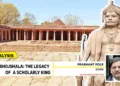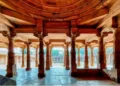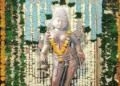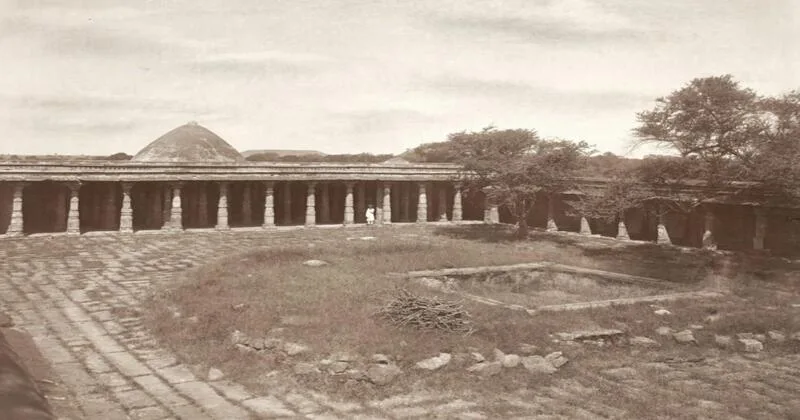
On May 15, 2026, the Madhya Pradesh High Court did what nine centuries of invasion, colonial indifference and post-Independence political appeasement had conspired to prevent. It declared Bhojshala in Dhar a temple dedicated to Maa Saraswati and ordered that namaz inside the complex cease. A division bench of Justice Vijay Kumar Shukla and Justice Alok Awasthi delivered the verdict after years of legal proceedings, a 98-day ASI scientific survey and over a thousand years of buried civilisational memory finally demanding to be heard.
When Dhar Was the Oxford of the World – 1034 CE
To understand Dhar and Bhojshala, one must travel back to the 11th century to the reign of Raja Bhoj of the Paramara dynasty (1000–1055 CE), one of the known scholar-kings in all of Indian history.
At Dhar, then capital of the Paramara kingdom, Raja Bhoj established the Bhojshala, an elaborate temple-academy dedicated to Vagdevi, the Devi of speech and learning, a form of Saraswati. The Jain scripture Prabandha Chintamani records this institution in 1034 CE. At its peak, Bhojshala hosted nearly 1,400 scholars, poets and theologians. The Saraswati Kanthabharana, Rajamartanda and Avani Koormashatam, seminal Sanskrit texts, were composed within its boundary. Raja Bhoj himself authored 84 works spanning astronomy, grammar, philosophy, Ayurveda, architecture and military science. Dhar, under the Paramaras, was among the great intellectual capitals of the medieval world. The Bhojshala was its crown jewel. Then came the invasions.
In 1305 CE, Alauddin Khilji’s forces swept into Malwa. The original Saraswati temple was attacked. Historical accounts record that 1,200 students and teachers were killed for refusing conversion. In the 14th and 15th centuries, the structure was progressively absorbed into an Islamic complex, the Kamal Maula Mosque built using the very pillars, stone slabs and architectural elements of the Hindu temple it displaced. The original idol of Vagdevi was eventually removed by Lord Curzon in 1902 and taken to the British Museum in London, where it remains to this day. For over 700 years, Raja Bhoj’s temple sat buried inside the walls of a mosque.
ASI Speaks: The History Cannot Be Unsaid
It took an order from the Madhya Pradesh High Court in March 2024 to set the archaeological reckoning in motion. The court directed the ASI to conduct a “scientific survey” of the disputed Bhojshala complex. What followed was 98 days of meticulous excavation, documentation and analysis supervised under Dr Alok Tripathi, Additional Director General of the ASI, using Ground Penetrating Radar (GPR) and GPS mapping technology. The results were submitted to the court in a 2,000-page report in July 2024.
Over 1,700 relics were recovered from the site, including a damaged idol of Vagdevi, validating the site’s original religious identity at its most fundamental level. Ninety-four architectural artefacts were catalogued. Thirty-seven intact or fragmented idols of Hindu deities, including Ganesha, Brahma, Narasimha, Bhairav, Krishna, Hanuman, Shiva, and Parvati, are embedded within the very walls of the mosque that claimed to have replaced them. An inscription explicitly naming King Naravarman of the Paramara dynasty, who ruled around 1094–1133 CE, was discovered on site. Thirty-one coins spanning the Indo-Sassanian period to the British era completed a numismatic timeline of the site’s layered history. The ASI made a conclusion that the existing structure was made from parts of earlier temples.
The MP High Court division bench, in its May 2026 judgment, accepted this evidence. Historical literature, architectural analysis, ASI findings and inscriptions all established Bhojshala as a centre of Sanskrit learning and a Saraswati temple associated with Raja Bhoj. The court set aside the 2003 ASI arrangement that had permitted Friday namaz at the site. It was observed that the Muslim community may seek alternative land for a mosque from the state government. After 721 years, the Devi returned to her rightful home.
ASI has passed order in compliance of order passed by the Hon’ble High court. Now the Hindu community has unrestricted access to Bhojshala complex. pic.twitter.com/mbddiKVxmA
— Vishnu Shankar Jain (@Vishnu_Jain1) May 16, 2026
Kashi Does Not Forget: Gyanvapi and the Vyas Ji Ka Tahkhana
While Dhar was witnessing its own archaeological reckoning, the sacred city of Varanasi is asking for the restoration of Vyas ji ka Tahkhana. The Gyanvapi mosque stands adjacent to the Kashi Vishwanath temple within metres of one of Hinduism’s most ancient and venerated jyotirlingas. It is widely documented that Mughal emperor Aurangzeb ordered the demolition of the original Kashi Vishwanath temple in 1669 CE, and the Gyanvapi mosque was built using its ruins. The ASI 839-page survey report, submitted to the Varanasi District Court in January 2024, confirmed precisely this. The report stated that the pre-existing structure was destroyed in the 17th century during Aurangzeb’s reign and that, based on scientific studies/survey carried out, study of architectural remains, exposed features and artefacts, inscriptions, art and sculptures, it can be said that there existed a Hindu temple prior to the construction of the existing structure.
The Gyanvapi complex has four tahkhanas, basement cellars, one of which had remained in the possession of the Vyas family, hereditary priests who had conducted daily puja in that subterranean space for generations. In 1993, during the tenure of Chief Minister Mulayam Singh Yadav, that worship was abruptly prohibited, and the basement was sealed. For thirty-one years, idols sat in darkness. Aarti went unsung. The Akhand Jyoti was extinguished by political vendetta. Somnath Vyas petitioned the court simply for the right to do what his forefathers had done.
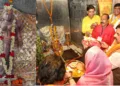
On January 31, 2024, a week after the ASI report was made public, the Varanasi District Court granted that right. The ‘Vyas Ji Ka Tahkhana’ was reopened. Within days, a priest in saffron performed the Mangla Aarti, the Bhog Aarti and the Shayan Aarti. The Akhand Jyoti was lit once more. Advocate Vishn Shankar Jain, the tireless legal warrior of the Hindu side, confirmed on social media, “Shayan aarti done by a pujari of KVM Trust after putting up idols. An Akhand Jyoti started in front of them.” Thirty-one years of enforced silence ended with the lighting of a lamp.
The Places of Worship Act
The Places of Worship (Special Provisions) Act, 1991, introduced by the Congress government under P.V. Narasimha Rao, stipulates that the religious character of any place of worship shall remain as it was on August 15, 1947, and no court may entertain any plea to alter it. Any violation carries up to three years imprisonment. The Ayodhya dispute was expressly exempted when the Act was passed, allowing it to proceed to its historic conclusion. The Act was plainly designed to freeze in place the consequences of medieval iconoclasm to make permanent what conquerors had imposed by force.
Because Gyanvapi, Bhojshala and a growing number of similar sites are protected monuments under the Ancient Monuments and Archaeological Sites and Remains Act, 1958 and that Act’s jurisdiction supersedes the 1991 law. ASI-protected sites are subject to archaeological survey and scientific scrutiny regardless of the Places of Worship Act. It was this exception that allowed courts to order ASI surveys of Gyanvapi and Bhojshala.
In December 2024, the Supreme Court itself acknowledged the constitutional questions raised by the Places of Worship Act, calling for the Central Government to file an affidavit on petitions challenging the law and ordering that no new suits challenging religious sites be registered pending its examination. The Act, once thought impregnable, is now under judicial scrutiny at the highest level. What political legislation sought to bury, archaeological science is unearthing one stratum at a time.
The Civilisational Continuum From Ayodhya to Dhar
Ayodhya was not the end of a dispute. It was the beginning of a reckoning. The Ram Mandir consecration in January 2024, over five centuries after Babur’s general Mir Baqi demolished the original temple and constructed the Babri Masjid, represented something larger than a legal verdict.
What followed in 2024 and 2025 across Gyanvapi, Bhojshala, Sambhal and other sites is the continuation of that assertion. Each ASI survey, court order and reopened temple basement is a civilisational act of memory, a refusal to accept that the violence of medieval conquest should be treated as neutral, settled history.
Bharat’s temples were never religious structures. They were universities (such as Bhojshala, which hosted 1,400 scholars), astronomical observatories, centres of medicine, hubs of language preservation and anchors of community identity. When they were demolished, entire civilisational ecosystems were dismantled. The mosques built on their ruins were not neutral replacements; they were deliberate erasures. The Bhojshala verdict of May 2026 is coming just days before the original Vagdevi inscription’s 992nd anniversary.
What Comes Next: The Arc Bends Toward Justice
The Muslim side in Bhojshala has announced it will challenge the verdict in the Supreme Court. The Gyanvapi mosque committee continues to contest the ASI findings at multiple court levels. The Places of Worship Act challenge is pending before the Supreme Court. The legal battles will continue for years. But the civilisational momentum has shifted irreversibly.
Raja Bhoj built his Bhojshala so that knowledge could be passed from one generation to the next, undimmed by politics or power. The scholars who studied there, the priests who tended its sanctum, the kings who patronised its learning, could not have imagined that their civilisational inheritance would one day need to be proven in a courtroom using Ground Penetrating Radar.
From Raja Bhoj’s vision in 1034 CE to the MP High Court’s verdict in 2026 CE, the arc of civilisational memory is long. But in the present Bharat, where science, law and cultural confidence are finally aligned. Mata Saraswati has come home to Dhar. The lamp burns again beneath Kashi. And Bharat is remembering not with rage, but with resolve.