
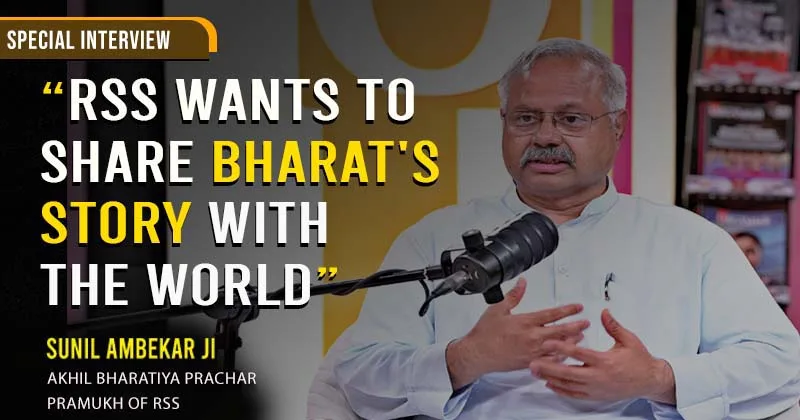
RSS Sarkaryavah Dattatreya Hosabale, during his visit to the United States, engaged with think tanks, academia, and the Indian diaspora across Stanford, Washington, DC, and Chicago, presenting a civilisational perspective on Bharat, countering long-held misconceptions and emphasising Dharma, unity, and global responsibility. The Akhil Bharatiya Prachar Pramukh of RSS, Sunil Ambekar Ji speaks to Organiser Weekly’s Editor, Prafulla Ketkar on Hosabale Ji’s historic visit. Excerpts:
Recently RSS Sarkaryavah Dattatreya Hosabale visited Europe and the United States. He participated in various conferences and events there, spoke about AI and human life, and also addressed the RSS centenary year at the Hudson Institute. What was the purpose of this visit and why is RSS reaching out globally?
RSS has entered its centenary year. RSS works at the grassroots level with common people, and its journey is closely linked with Bharat’s story, developmental journey, and social transformation over the last 100 years. We want to share this story with the world.
Secondly, there are solutions within our civilisational understanding for many modern-day challenges. For example, yoga is helping people even in developed nations. Similarly, our family awakening initiatives can help societies across the world.
Thirdly, there are many misunderstandings about Hindutva, RSS, and Bharat’s historical journey. Through direct people-to-people dialogue with important opinion makers and public figures, we can explain these aspects better. This particular visit focused on the UK, Europe, especially Germany, and the USA.
The interaction at Stanford was especially interesting, where Shri Dattatreya Hosabale spoke about the dharmic understanding of technology and AI. Is RSS also thinking seriously about technological developments and their impact on society?
For many years, there has been a misconception in the worlds of science and philosophy that spirituality and science are separate. But in Hindu philosophy, spirituality encompasses everything, and science is one way of understanding reality.
Science and spirituality are not opposites. They can go hand in hand. Science can help us understand spirituality, and spirituality can help us understand science. As Swami Vivekananda and others have said, the ultimate evolution of science connects with the knowledge traditions of Bharat. RSS is trying to explore these knowledge systems.
You were also part of the Europe visit. How was the response? How are people receiving Bharat’s and RSS’s point of view?
People are curious about Bharat and Hindutva. Some understand Bharat through yoga, some through the Kumbh, and others are interested in understanding how Bharat is emerging economically and in various sectors.
I do not say RSS alone is responsible for all this, but in the last 100 years RSS has devoted its energy to Bharat’s growth story and the unity of Hindu society. The emphasis has been on creating a harmonious and developed society that can live peacefully with diversity.
“In the last 100 years RSS has devoted its energy to Bharat’s growth story and the unity of Hindu society. The emphasis has been on creating a harmonious and developed society that can live peacefully with diversity”
The response was very positive. People interacted with Dattatreya Hosabale in depth. In London, academicians from Cambridge, Oxford, and other institutions discussed philosophical ideas, Bharat’s story, and how RSS motivates people to participate in nation-building.
Even senior professors from management schools were interested in understanding how people are inspired to contribute to collective growth. These discussions were very meaningful.
Dattatreya Hosabale also spoke about Hindu unity. What role do you see for Hindus and people of Indian origin living abroad?
Earlier also, our Sarsanghchalaks have always said that Hindus living abroad should become responsible and contributing citizens of their respective countries while also preserving Hindu heritage, culture, traditions, and values for the next generation.
At the same time, they should share these values with society at large in those countries. Many organisations are already engaged in such work. During the visit, Dattatreya Hosabale met such organisations, community leaders, and members of the diaspora in various gatherings.
Are there plans for further outreach and interaction in other parts of the world?
Yes, certainly. We are trying to reach out to important people in different countries. Outreach is happening in places like Japan, South Korea, Indonesia, South Africa, Kazakhstan, and the SAARC countries.
Whenever people from other countries visit Bharat, we also interact with them. The aim is not merely to introduce RSS, but to discuss Hindu philosophy, the meaning of Hindutva, Bharat’s historical journey, and its future direction.
We also want to discuss how this philosophy can help humanity live peacefully in a world facing increasing conflicts. Our lifestyle, which is closely connected with nature and the environment, may offer solutions to environmental challenges as well.
There are many such possible solutions. We want to discuss not just the problems, but also solutions to
global issues.