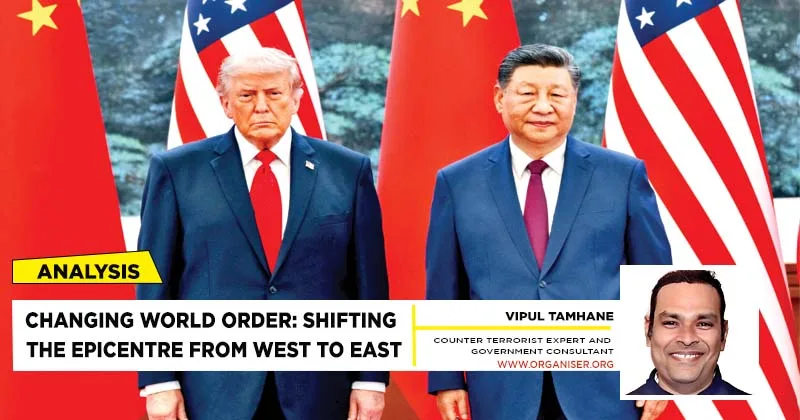
There is a moment in the lifecycle of every great power transition when the choreography of diplomacy stops being merely symbolic and starts being structurally revelatory. We are living in that moment, now. When the President of the United States and the President of Russia, plus the U.S. Secretary of State carries out high-stakes diplomatic missions to Asia acutly within days of each other; visiting Beijing then New Delhi in quick succession, the message that is encoded in those travel plans is hard to misread. In other words, Asia is not the place where great powers project influence anymore. Not really. Asia is where great powers go to survive.
The sheer density of Western and great-power diplomatic traffic into Asia over the past twelve months constitutes one of the most significant geopolitical signals of our era. It demands serious analytical attention.
Diplomatic Rush
The sequence of visits reads like a strategic primer. President Trump’s delegation to Beijing showed up carrying, along with a pile of officials, the CEOs of Apple, Tesla and Boeing, a line-up that signalled, pretty clearly, that this was geo-economic diplomacy more than anything else, reading it as a show of power will be foolish. The talks focused on keeping the bilateral relationship stable, handling Taiwan frictions, syncing up on regional emergencies, and making sure American firms still can reach Chinese markets and the whole manufacturing machine. But under the polished communiqués there was a more stubborn reality, the one everyone dances around: the United States can’t really bankroll full confrontation with China anymore, because the money and industrial fallout from decoupling has turned into something structural, not just a temporary price. Washington, D.C., whether it wants to say it or not, is moving away from being a Pacific hegemon towards acting like an offshore balancer, and it feels like they’re trying to steer influence instead of just ordering it. It’s not only posture, it’s more like a re-do on the way issues get handled, and honestly the wording around it is… oddly careful.
Relevance of Beijing Visit
At the same time, Putin’s near simultaneous visit to Beijing looked just as revealing. Russia, now increasingly hemmed in by the Atlantic system after the Ukraine invasion is basically finishing that long Eastward strategic turn. Moscow and Beijing also kept pushing the two-party commerce past two hundred billion dollars and, somehow, the energy linkages, like the Power of Siberia corridor, make that hold feel even tighter. On top of that the military political coordination keeps climbing, step by step. The imbalance, if you look straight at it, is pretty blunt: Russia needs China much more than China needs Russia.
Beijing, meanwhile, takes the dependence in a pragmatic way, meaning discounted energy, continental strategic depth, and a reasonably handy partner against Western pressure. At the same time it stays careful about not getting fully tangled in Moscow’s wars, even if both sides benefit. In the end, the Eurasian landmass that people once described as the world’s geopolitical heartland is consolidating, and it’s consolidating around Asian economic pull, not Atlantic routines.
Significance of Visit to India
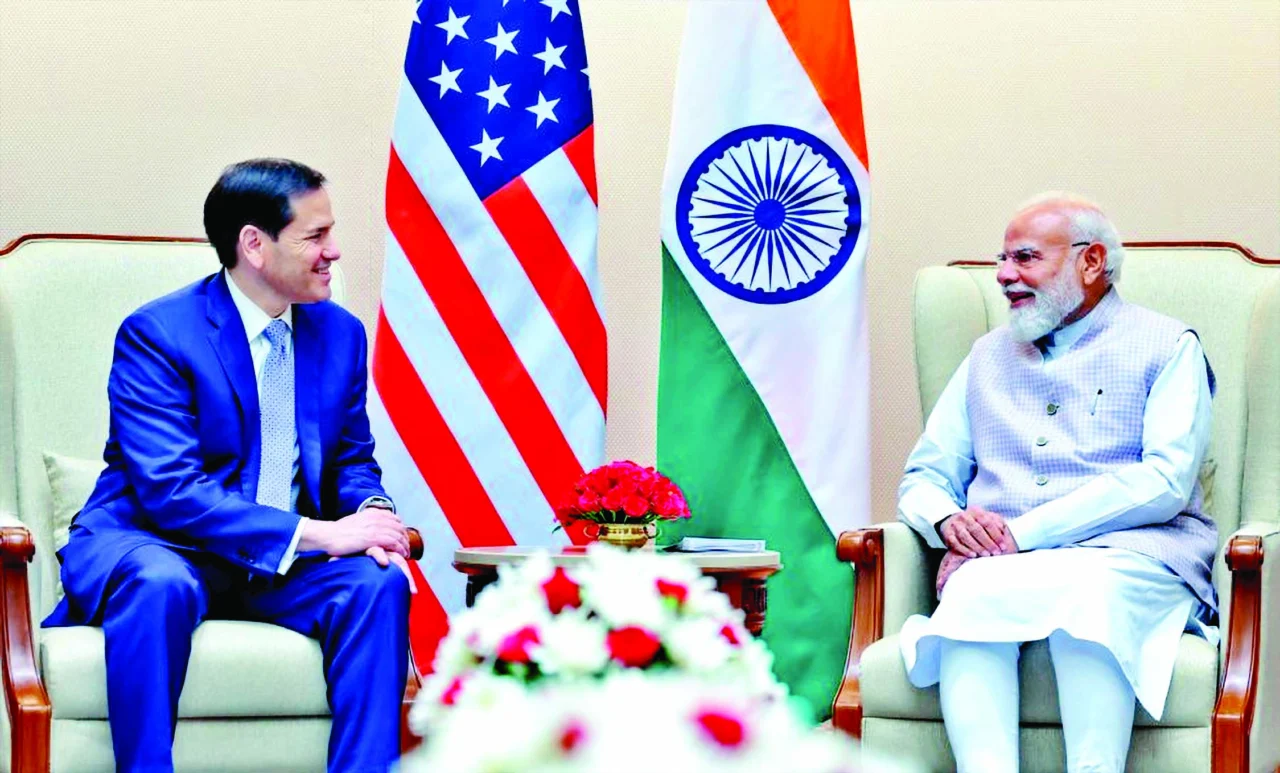
Secretary Rubio’s immediate flight to New Delhi, following Putin’s visit to China, no sooner than Trump’s Beijing visit, completed the strategic picture. Washington, D.C., sees this like any image of a sleepy G-2 lodging with China where America and China hash out the Asian order mostly between themselves, would be terrible, honestly catastrophic, for the Indo-Pacific blueprint the United States has been building for years. India is the needed counterweight, the real linchpin. If New Delhi isn’t in the mix, not really, the Quad just caves, Indo-Pacific deterrence starts to crack, and the whole balancing machinery against Chinese regional dominance loses its main continental hold; talk Taiwan.
Rubio’s stop, in the deepest sense, was reassurance diplomacy, the point was to show that U.S. involvement with China doesn’t translate into walking away from India. And that these two visits had to be staged in something close to a near-simultaneous rhythm, tells you a lot about how tangled, and mutually reliant Asian geopolitics has become.
Beyond these headline summits, the wider pattern of Western diplomatic activity across Asia shows the same underlying structural reality, doing the rounds at every level. French President Macron’s trip through Vietnam, Indonesia, and Singapore, ending with a speech at the Shangri-La Dialogue, looked like a clear signal that Europe’s biggest military power is, basically, reshaping its strategic self around the Indo-Pacific. Even within the multilateral stuff, the Shangri La Dialogue in Singapore seems to have become the main global security forum , overtaking Munich in strategic urgency and pulling in Western defence establishments as consistently as a NATO summit.
Meanwhile Britain, recalibrating its post Brexit relevance, has been doing two things at once, economic normalisation with China on one side and security deepening with Japan on the other.
These have led the East to wake up to consolidate all of a sudden, it seems, Japanese Prime Minister Ishiba’s stopovers in Vietnam and the Philippines pointed to Tokyo’s deeper commitment to Southeast Asian maritime safety, a stance that would have felt almost impossible under Japan’s post-war constitutional limits. South Korea too has slipped forward, quietly becoming one of Asia’s more energetic strategic middle powers, building fresh arrangements across Southeast Asia and South Asia in semiconductors, shipbuilding, and other essential mineral supply lines.
So the cumulative message doesn’t get any clearer, the Indo Pacific has replaced the North Atlantic as the primary stage for great power competition, economic stakes, and strategic worry.
New Centre of Gravity
The analytical framework for getting a handle on these developments was basically set out with a significant prescience by the experts regurgitating the same into the body of knowledge analysing Asia’s geopolitics since the late 1980s, that the 21st century would not be just about China rising, but about Asia showing up as a coherent system, like an interconnected ecosystem of about five billion people, stitched together by supply chains energy corridors, infrastructure networks, and yes commercial interdependence. Until now the pundits kept suggesting that the economic geography, not military power, just on its own, would be the real lever for global influence. And then there were these several theories on “multi-alignment”, where Asian states would refuse to pick just one side, keeping overlap in their relationships, partnering in more than one direction at the same time, so they can keep strategic autonomy. If you look at it since 2025, the big-structure call has held up surprisingly well, even if the cheerier expectation of Asian harmony got, let’s say, outpaced by what actually happened.
Consider the evidence in favour. China has, in fact, become diplomatically hard to ignore, even its most loud and stubborn rivals have to keep dealing with Beijing again and again. The institutional stuff the typical Asia experts seemed to have mapped out, i.e. the Asian Infrastructure Investment Bank, the Regional Comprehensive Economic Partnership, and all the ASEAN frameworks that are expanding, coalesced into this parallel economic order that doesn’t really ask for Western permission, or for Western leadership either.
Germany’s economic dependence on China, which was made extra visible by Olaf Scholz’s 2024 visit to Beijing, and yes the delegation came with the CEOs of BMW, Mercedes-Benz, Siemens and BASF, showed what the academia basically already bet on: that even Western powers who are security anxious can’t simply decouple economically, because the price of that move threatens their own industrial core back home. Europe is, more and more, tuning its trade policy, its green transition agenda and its supply chain blueprints around Asian demand systems.
The emerging Asian order is also not cohesive in the way the “Asian system” framing implies. Deep rivalries persist between China and India, China and Japan, Iran and the Gulf states. ASEAN’s strategic ambiguity, while tactically rational for its members, makes collective action on security almost impossible. The Asian century is multipolar, but multipolarity, historically, has been as generative of instability as of balance.
What the current diplomatic moment actually reveals: a world moving away from American unipolarity toward a more fluid great-power competition, and Asia is the main place where it all shows up. The United States is no longer this automatic default hegemon, not fully. Instead it’s just one of several big players trying to maneuver for advantage inside a setup that now basically runs on Asian terms. China is sitting right in the middle of that whole system, not like some unchallenged empire exactly, but more like an unavoidable node, as the gurus peeking behind the bamboo curtain would observe, as a central junction people can’t really ignore. India, Japan, and ASEAN states have genuine agency and are using it. Russia has integrated Eastward by strategic necessity. Europe seeks relevance through engagement rather than direction.
This is, in its essentials, the world the west has been describing from under the cloak, except it is not peaceful, not cooperative, and not yet stable. The future is indeed Asian. But what Asian future it will be remains as it has always been, genuinely and dangerously open and vulnerable as it shapes.