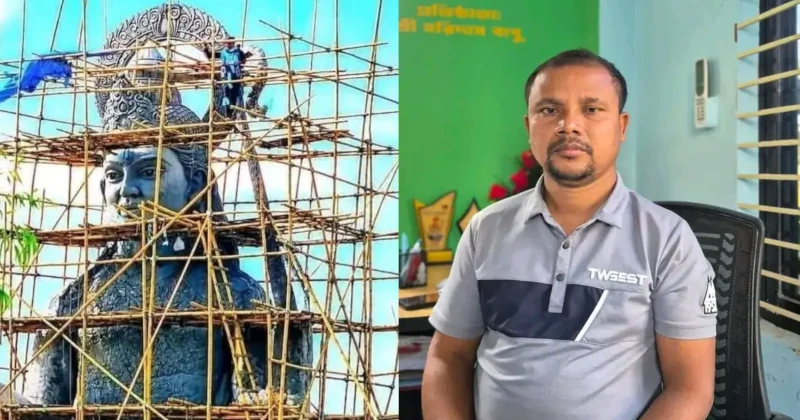
DHAKA: Haridas Chandra Tarani Das, the man who recently came into the national spotlight for spearheading the construction of what was projected to be Asia’s largest 81-foot-tall statue of Bhagwan Ram in Bangladesh, has been arrested in a money laundering case involving alleged suspicious financial transactions worth Tk 9.35 crore (approximately Rs 6.8 crore). His arrest has triggered sharp reactions from the Bangladesh Hindu Buddhist Christian Unity Council, which has alleged authorities of selectively targeting a Hindu Mandir organiser while failing to act against those who allegedly incited communal hostility over the Ram murti project.
#BREAKING: Bangladesh Hindu Buddhist Christian Unity Council has strongly condemned and expressed deep concern over the arrest of Haridas Chandra Tarani Das, who recently drew public attention after proposing the construction of an 81-foot-tall statue of Lord Rama within the… pic.twitter.com/8sh8eO5mE6
— Aditya Raj Kaul (@AdityaRajKaul) July 13, 2026
Haridas Chandra, also known as Tarani Das, was taken into custody shortly after midnight on July 12, near the Sri Sri Radha Gobinda Kali mandir in Madhya Ramchandrapur village under Gaibandha’s Palashbari upazila. The arrest followed a case filed by Bangladesh’s Criminal Investigation Department (CID) under the Prevention of Money Laundering Act, after investigators claimed to have uncovered suspicious financial transactions amounting to Tk 9.35 crore through multiple bank and mobile financial service accounts linked to him.
According to the CID’s Financial Crime Unit, its preliminary investigation found that Haridas had no identifiable legitimate source of income capable of explaining the large volume of deposits made into his accounts.
Investigators alleged that money had been transferred from individuals across Bangladesh before being almost entirely withdrawn. Authorities claimed the transactions did not correspond with his known profession and described them as “suspicious,” prompting the registration of a money laundering case at Dhaka’s Uttara West Police Station.
The CID stated that its probe was initiated following allegations connecting Haridas to fraud involving government job recruitment, transfer rackets, hundi operations and organised crime. Officials further alleged that he may have laundered both local and foreign currency through multiple banking channels and mobile financial service accounts.
The agency said its investigation into the financial trail remains ongoing. A Dhaka Metropolitan Court on July 13, placed Haridas on a four-day remand, partially allowing a seven-day remand sought by investigators.
Detective Branch Inspector KM Rakibul Huda told the court that custodial interrogation was necessary to determine the origin of the funds, identify those who deposited the money and uncover others allegedly involved in the transactions.
During the hearing, Haridas strongly denied wrongdoing. Addressing the court with permission, he stated, “I was once a farmer and now manage a mandir. If managing a mandir makes me a criminal, then there is nothing I can do.”
Rejecting allegations of illegal financial dealings, he maintained that the money under scrutiny consisted entirely of donations received from devotees for mandir-related activities.
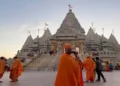
He urged authorities to verify whether any of the funds had actually been used for unlawful purposes. Haridas had attracted nationwide attention after announcing plans to construct an 81-foot-tall statue of Bhagwan Ram within the premises of the Sri Sri Radha Gobinda Kali mandir in Palashbari.
Mandir authorities described the proposed structure as the largest Ram murti in Asia, making it one of the most ambitious Hindu religious projects ever announced in Bangladesh.
The mandir itself underwent extensive renovation after Haridas reportedly returned to the area in 2024 following a prolonged stay in India.
According to local residents, a mandir committee was subsequently formed with Haridas serving as president and Bipin Chandra Das as general secretary. Renovation work began in May 2025, after which the shrine was renamed the Radha Gobinda and Kali Mandir.
Construction of the Ram statue, however, became the subject of intense controversy. Work on the massive Ram murti was suspended on 9 June following protests led by the Imam Ulama Parishad, which questioned the source of funding for the project.
Among its eight-point demand, the organisation called upon intelligence agencies and government authorities to investigate whether any foreign country, organisation or individual had directly or indirectly financed or influenced the construction.
The protests soon spread across Palashbari and other regions of Bangladesh, with demonstrators demanding the removal of the proposed murti, a financial investigation into the project and Haridas’s arrest.
Within weeks, the CID launched its financial probe, culminating in Haridas’s arrest. Apart from the money laundering allegations, the CID has made several additional claims regarding Haridas’s background.
According to investigators, Haridas allegedly travelled illegally to India after completing his Higher Secondary Certificate examination in 2008 and later returned to Bangladesh after receiving what officials described as education and training.
The CID further alleged that he converted to Islam in 2019 and adopted the name Touhid Islam.
Authorities also claimed that Haridas falsely projected himself as a protocol officer attached to former Prime Minister Sheikh Hasina by allegedly using edited photographs showing himself with the former premier and staging fake telephone conversations using contacts saved under the names of influential individuals.
Investigators further stated that they had located information relating to another criminal case registered against him at Banani Police Station under provisions of the Penal Code and the Digital Security Act.
These allegations remain part of the ongoing investigation.
Soon after Haridas’s arrest, the Bangladesh Hindu Buddhist Christian Unity Council issued a strongly worded statement condemning the action. Describing the arrest as “unfortunate and unacceptable,” the organisation argued that Haridas had been targeted after gaining prominence through the Ram murti project.
The Council alleged that while authorities had moved swiftly against the mandir organiser, those responsible for spreading communal hatred and mobilising protests against the proposed Ram statue had not faced comparable legal action.
Calling the arrest contrary to democratic principles and the rule of law, the minority rights organisation demanded Haridas’s immediate release.