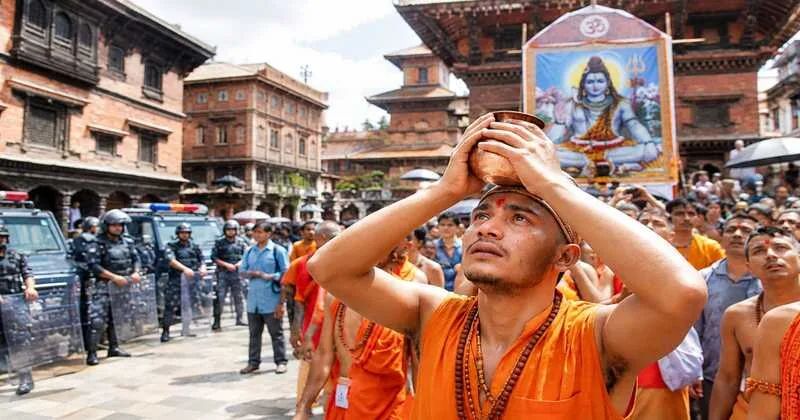
New Delhi: Tensions continue to grip several districts in Nepal following a violent attack by members of the Muslim community on a Hindu Kanwar Yatra procession in the Sunsari district, which borders Bihar. The clash, which erupted on July 26, 2026, was triggered by a dispute over the use of a DJ sound system by the Hindu devotees as they passed through a Muslim-majority area.
The ensuing violence resulted in the deaths of three Hindus, numerous injuries, and the widespread imposition of curfews and security crackdowns across multiple districts. The victims who lost their lives have been identified as Ganesh Yadav, Om Prakash Mehta, and Jay Prakash Mehta. Approximately two dozen people sustained injuries during the unrest.
The situation deteriorated to such an extent that the Armed Police Force and Nepal Army personnel were deployed to maintain order, and authorities reportedly resorted to air surveillance to monitor the sensitive areas.
Massive protests erupt
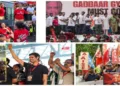
In the aftermath of the killings, a massive protest was organized by several Nepali Hindu organizations in Janakpurdham on July 30, 2026. The protestors, expressing their outrage over the attacks, jammed key areas of the city, raised slogans, and burned effigies of the Nepali Prime Minister and Home Minister. Local police intervened, using tear gas to disperse the crowd and subsequently imposed a curfew in the area to prevent further escalation.
After four days of relative silence, Nepali Prime Minister Balen Shah finally addressed the violence on July 30, 2026. He appealed for unity and social harmony, urging citizens to show restraint. Shah stated that his government is treating the situation with “full seriousness and sensitivity.” He acknowledged the “tragic incident” in Dewanganj, Siraha, and Sunsari, and the “turbulent atmosphere” that has gripped several districts since then.
Prime Minister Shah announced the formation of an investigation committee by the Ministry of Home Affairs to probe the incidents of violence and ensure the prosecution of the culprits. He also promised compensation to the victims. According to Assistant Chief District Officer of Sunsari, Poshan Lamichhane, the kin of the deceased will receive Nepali Rupees (NRs) 2,00,000, while the injured will be provided with NRs 50,000 for treatment expenses.
The government has reportedly reached an agreement on a seven-point resolution with the families of the deceased, assuring them of swift action against the attackers.
The Inciting Incident: A calculated attack on a peaceable procession
The unrest was ignited on July 26, 2026, in Sunsari’s Dewanganj Rural Municipality-3, Kaptainganj. A peaceful Hindu religious procession, carrying a DJ sound system and heading to offer water to the Koshi River, entered a predominantly Muslim locality around 10:15 pm.
Reports indicate that members of the Muslim community took offense to the DJ music and religious flags carried by the Hindus. This disagreement quickly escalated into a violent altercation, with the Muslim group launching a concerted attack on the procession.
On 26 July (Sunday) in Nepal, a kanwar procession of saffron-clad men chanting Bol Bam was passing through a Muslim-dominated area in Sundari district (close to Indian border) when stone-pelting happened from a mosque
Hindus retaliated and, soon, it blew into a communal riot.… pic.twitter.com/xDHgFlB59D
— Swati Goel Sharma (@swati_gs) August 2, 2026
The situation rapidly spiraled out of control, involving stone-pelting and clashes. Nepal Police and Armed Forces intervened to disperse the crowds. The police reportedly fired multiple rounds, which tragically led to the loss of three lives, including 30-year-old Om Prakash Mehta. Senior Superintendent of Police Yogendra Singh Thapa, spokesperson for the Koshi Province Police Office, confirmed that 24 people, including security personnel, were injured.
The injured included 10 Nepal Police personnel, five Armed Police Force personnel, and nine civilians, all of whom are receiving treatment in hospitals in Biratnagar and Sunsari. Even Inspector Rakesh Rai of the Area Police Office, Dewanganj, suffered head injuries requiring five stitches during the efforts to control the violence.
The Islamic violence did not remain contained within Kaptainganj; it rapidly spread to neighboring areas as protestors engaged in widespread arson, vandalism, stone-pelting, and clashes with security forces. Several vehicles, shops, and private properties were damaged or destroyed during the chaos. The unrest extended to parts of Madhesh Province, affecting Dhanusha and Siraha districts.
Escalating unrest and the fight for justice
To bring the situation under control, authorities initially imposed a curfew from 7 am on July 27, 2026, in Harinagara, Bhutaha, Kaptainganj, Ghuski, and Dewanganj. As the violence spread, the restrictions were extended to 10 areas, prohibiting movement, public gatherings, rallies, and demonstrations. Curfews have now been implemented in Inaruwa, Janakpur, Siraha, Golbazaar, Lahan, and other sensitive locations. In Dhanusha, curfews are in effect in Laxminia Hatbazaar, Belauni Road, Nagarain Municipality, Dudhmati Bridge, and parts of Janakpur. In Siraha, restrictions have been enforced in the Golbazaar area along the East-West Highway.
The Devanganj Rural Municipality, recognizing the gravity of the situation and the injustice faced by the Hindu community, has declared Om Prakash Mehta and Jay Prakash Mehta as “Balidan” (martyrs) at the local level. The municipality has vowed to urge the Nepal government to confer official martyr status on the deceased.
Army deployed in Sunsari, Nepal
Radical Islamists attacked Hindus living in this area. pic.twitter.com/lXiWdKQDc8
— Vikas Pokhariyal (@vikasindiafirst) August 1, 2026
Furthermore, the municipality approved financial aid of 1 million Nepalese rupees for each bereaved family. Those left permanently disabled or severely injured due to gunshot wounds will receive 200,000 Nepalese rupees each, while those with minor disabilities will receive 50,000 Nepalese rupees in compensation.
The municipality also resolved to seek government compensation for individuals whose homes, businesses, and properties were destroyed during the violence.
The ongoing tensions have raised significant concerns regarding commercial activities between India and Nepal, as Sunsari serves as a crucial transit and commercial corridor between the two nations. Lawmakers Basna Thapa and Oren Rai have also raised concerns in Parliament regarding the rising tensions in the southern districts.
Authorities have deployed 211 security personnel in the affected areas to maintain peace and prevent any further outbreaks of violence. Former Nepalese monarch Gyanendra Shah has also expressed his concern over the escalating communal tension, recalling the decades of harmony among Nepal’s diverse ethnic and religious groups and urging the preservation of the country’s multi-ethnic, multilingual, and multi-religious identity, along with its tradition of respecting all faiths.