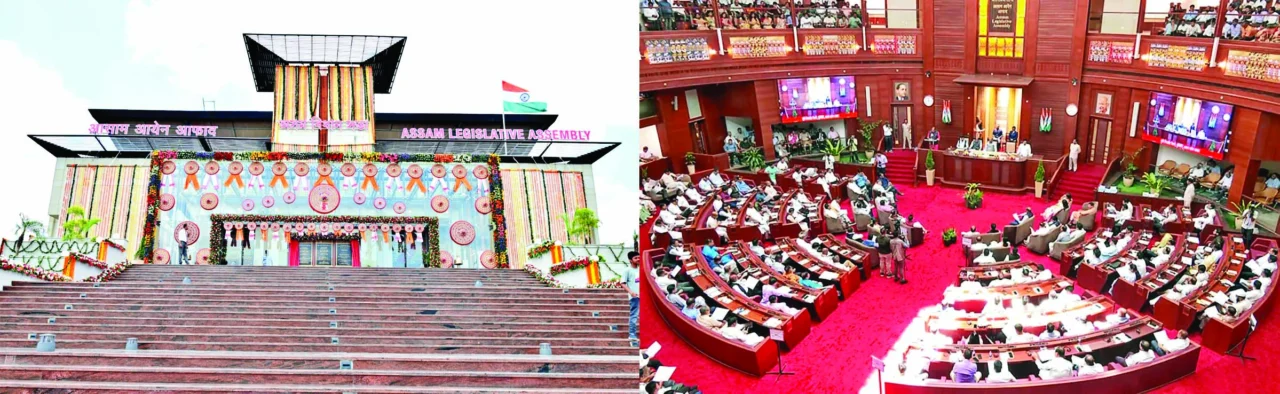
Uniform Civil Code (UCC) Bill was finally passed in the Assam Assembly on May 27, with absolute majority despite opposition from the Congress party and its alliance partner. Assam became the third State after Uttarakhand and Gujarat to implement UCC. Congress brought many amendments and demanded the Bill to send to the Select Committee of the Assembly, but it was rejected. Surprisingly, Congress wanted to allow a person to marry a second time if the first wife is physically not fit to do all the work, but it too was rejected. CM Sarma said, in Bharatiya culture a wife is a partner for life. “If she is unhealthy and unable to do all the work then it doesn’t allow the husband to marry a second woman. The demand of the Congress party is inhumane,” he added.
The BJP-led NDA Government on May 25, tabled the Uniform Civil Code (UCC) Bill in the State Assembly as part of their election promise.
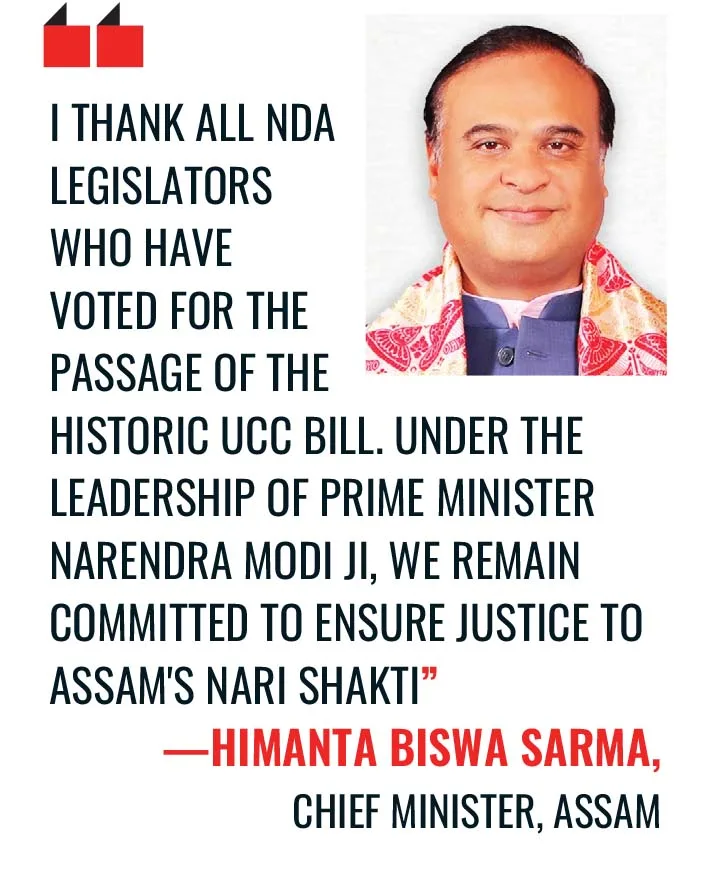
Participating in the debate in Assembly, CM Himanta Biswa Sarma said, “Congress party is opposing the UCC only to appease the Muslim community. Their entire debate is based on the Quran, Sharia law and Quranic verses, they never talk about Bhagwadgita. Congress has now turned to a one religion party which is a matter of concern. But they shouldn’t forget that it was the Indian National Congress which demanded the implementation of UCC in India. It seems the Congress MLAs’ debate in the Assembly against UCC resembles the Muslim League’s representation”, CM said.
Assam has become the only third State in the country to implement UCC to bring gender justice to the society. It is indeed a great day for Assam, CM Sarma added.
What is Assam UCC?
The Statement of Objects and Reasons attached to the Bill states that its core purpose is to “consolidate and simplify laws governing marriage, divorce, succession and live-in relationships” across communities in the state.
Major Highlights of the Bill
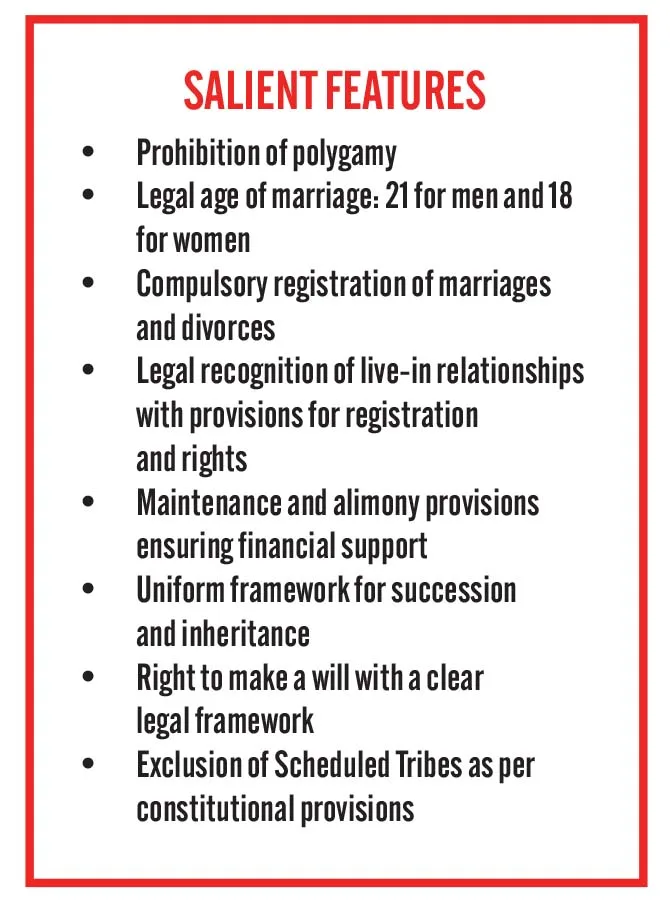
One Law, One State: The Code applies to the entire State of Assam. It also covers Assam residents living outside the State. However, it explicitly exempts Scheduled Tribes — communities protected under Article 366 (25) read with Article 342 of the Constitution. Everyone else falls under it.
Ban on Polygamy: The practice of having more than one spouse at a time will be strictly prohibited under the proposed law. The offender will attack a criminal offence case and imprisonment upto 7 years. Any polygamous marriage contracted before or after the Code comes into force must be declared and registered within a government-notified period.
Minimum Age of Marriage: The Bill lays down clear conditions for a valid marriage. The man must be at least 21. The woman must be 18. Neither party can have a living spouse. Consent obtained through force, fraud or deception will make the marriage void. Marriages within prohibited degrees of relationship are not allowed.
All marriages — whether Hindu, Muslim, Christian or any other faith — must be registered. Couples have 60 days from the date of marriage to file with the Sub-Registrar. Marriages performed between October 25, 2024 and the date the Code comes into force must be registered within six months. Failure to register attracts a penalty of up to Rs 25,000.
In the Assembly, CM Sarma said, “Congress Legislative Party leader Wajed Ali Chaudhary’s daughter is studying MBBS. It is fine he wants his daughter to be a Doctor, but in Assembly he is opposing UCC and supporting child marriage of thousands of Muslim girl children which is condemable.”
Curb on Love Jihad: Any act of force conversion, relation with forged identity, harassment and relation with deception will be considered as criminal offence with a provision upto 7 years of imprisonment.
Live-In Relationships: For the first time in Assam, live-in relationships get a legal framework. Partners must submit a jointly signed statement to the Sub-Registrar. Ending the relationship also requires a formal written statement of termination. Children born from live-in relationships — biological, adopted or born through surrogacy — are recognised under the law.
The Bill lists specific grounds for divorce — including adultery, cruelty, desertion for over two years, conversion of religion, and incurable mental illness. Mutual consent divorce is also permitted, provided the couple has lived separately for at least one year.
No divorce petition can be filed within one year of marriage, except in cases of exceptional hardship.
Courts must attempt reconciliation before granting divorce. Petitions must be disposed of within six months.
Rights of Children from Live-In Unions: The Bill formally recognises and protects the rights of children born to couples in live-in relationships, giving them legal standing.
Right of Property: UCC brings equal rights of property to both boy and girl children. In case of death of a person his property will be equally divided equally between wife, children and living parents.
Exemption for Scheduled Tribes: In a crucial carve-out, the Bill clearly states that its provisions will not apply to Scheduled Tribes residing in Assam, thereby excluding tribal communities from its ambit and protecting their customary practices.
Congress MLA questioned why tribals are exempted from UCC. CM said, the medicines would be given where the disease is? If there is no foul play in the customary tradition of a society, then what is the need of UCC there, he replied.
Unified Framework for Personal Laws: The legislation seeks to bring all communities — barring Scheduled Tribes — under a single, unified legal framework covering marriage, divorce, and inheritance.
BJP MLA Diplu Ranjan Sharma said, it was our promise to bring UCC. Now Muslim appeasement will end and gender equality will be established in the state.
The Bill does not interfere with religious ceremonies. Marriages can still be solemnised through Nikah, Saptapadi, Anand Karaj, Ahom Chaklong Bibah or any other faith-based ritual. The Code only requires that these marriages be registered.
The introduction of the Bill, however, did not go down well with the Opposition benches. Parties including the Indian National Congress, Raijor Dal, and the All India Trinamool Congress strongly objected to the manner in which the Bill was being pushed through. Left MLA Akhil Gogoi said that the mandatory registration of live-in relation is outdated and not a progressive thinking. It will affect the freedom of the youth.
Assam became one of the early movers among Indian States to introduce a UCC framework at the State level, following Uttarakhand and Gujarat which had enacted its own UCC legislation. The people of Assam have already given their mandate for whom the Congress party should think or whom they should represent.