





Bengal Verdict 2026: A new eastern doctrine emerges
June 23, 2026
  • Read Ecopy
  • Circulation
  • Advertise
  • Careers
  • About Us
  • Contact Us
Android AppiPhone AppArattai
Organiser
  • ‌
  • Bharat
    • Assam
    • Bihar
    • Chhattisgarh
    • Jharkhand
    • Maharashtra
    • View All States
  • World
    • Asia
    • Europe
    • North America
    • South America
    • Africa
    • Australia
  • Editorial
  • International
  • Opinion
  • RSS @ 100
  • More
    • Op Sindoor
    • Analysis
    • Sports
    • Defence
    • Politics
    • Business
    • Economy
    • Culture
    • Special Report
    • Sci & Tech
    • Entertainment
    • G20
    • Azadi Ka Amrit Mahotsav
    • Vocal4Local
    • Web Stories
    • Education
    • Employment
    • Books
    • Interviews
    • Travel
    • Law
    • Health
    • Obituary
  • Subscribe
    • Subscribe Print Edition
    • Subscribe Ecopy
    • Read Ecopy
  • ‌
  • Bharat
    • Assam
    • Bihar
    • Chhattisgarh
    • Jharkhand
    • Maharashtra
    • View All States
  • World
    • Asia
    • Europe
    • North America
    • South America
    • Africa
    • Australia
  • Editorial
  • International
  • Opinion
  • RSS @ 100
  • More
    • Op Sindoor
    • Analysis
    • Sports
    • Defence
    • Politics
    • Business
    • Economy
    • Culture
    • Special Report
    • Sci & Tech
    • Entertainment
    • G20
    • Azadi Ka Amrit Mahotsav
    • Vocal4Local
    • Web Stories
    • Education
    • Employment
    • Books
    • Interviews
    • Travel
    • Law
    • Health
    • Obituary
  • Subscribe
    • Subscribe Print Edition
    • Subscribe Ecopy
    • Read Ecopy
Organiser
  • Home
  • Bharat
  • World
  • Operation Sindoor
  • Editorial
  • Analysis
  • Opinion
  • Culture
  • Defence
  • International Edition
  • RSS @ 100
  • Magazine
  • Read Ecopy
Home Politics

Closing the Eastern Ledger: Bengal, borders, and rewriting of Bharat’s strategic Geography

As Bengal enters a new political era, the significance of the 2026 mandate extends beyond government formation. It raises larger questions about how history, demography, national identity, and strategic interests are converging to reshape India's eastern frontier

Siddhartha DaveSiddhartha Dave
Jun 2, 2026, 07:00 pm IST
in Politics, Bharat, West Bengal
Follow on Google News
FacebookTwitterWhatsAppTelegramEmail

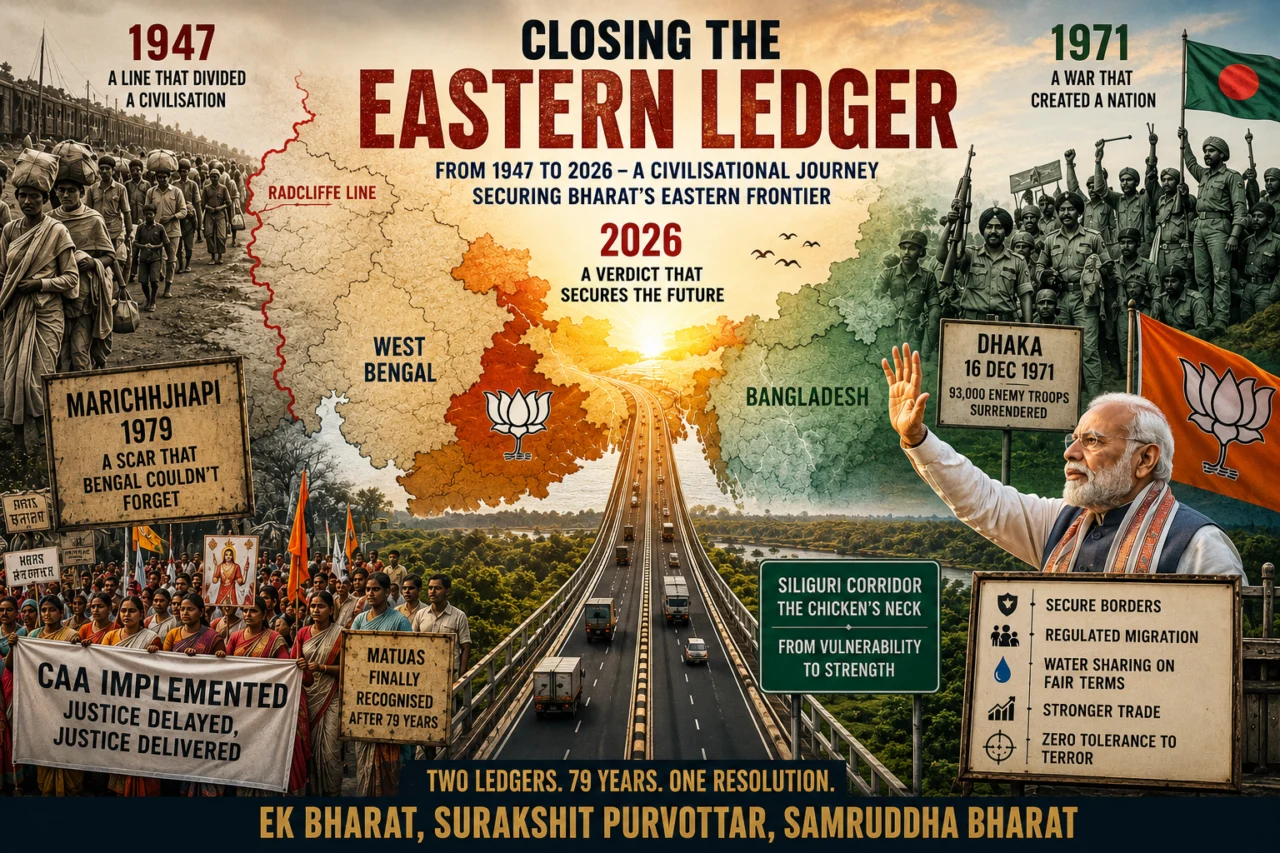
May 4, 2026 will likely be remembered not merely as an electoral victory for the BJP, but as a decisive moment in the long arc of Bharat’s civilisational and strategic consolidation. What unfolded in West Bengal was not simply the defeat of a long-entrenched political tyranny; it was the culmination of historical currents set in motion during the trauma of the Partition of India and the upheaval of the Bangladesh Liberation War. The political verdict represents the closing of what may be termed two unresolved “ledgers” in Bharat’s eastern frontier.

To understand the magnitude of this shift, one must revisit the arbitrariness of the Radcliffe Line, drawn hurriedly, under the supervision of Cyril Radcliffe. That line was not merely a cartographic exercise; it fractured a civilisation, dislocated millions, and created enduring demographic and political fault lines. Bengal, perhaps more than any other region, internalised this rupture. The refugee flows, especially among communities like the Matuas, were not transient episodes but generational experiences of displacement, marginalisation, and deferred political recognition.

For decades, these communities existed on the margins of electoral arithmetic but rarely at its centre. The Left Front’s long rule, followed by the tenure of Mamata Banerjee, did little to structurally integrate these displaced populations into a coherent national narrative. Left-sponsored massacre of Marichjhapi (1979) were not merely policy failures but civilisational ruptures that Bengal collectively chose to forget, even as their consequences lingered beneath the surface.

Read More: Trade Barriers, AI Battles and Military Containment: The European-US strategic front against China takes shape

Parallelly, the events of 1971 transformed Bengal into the crucible of a new nation-state. The genocide unleashed during Operation Searchlight and the subsequent refugee influx into Bharat created both humanitarian and strategic imperatives. Under Indira Gandhi, Bharat decisively intervened, leading to the birth of Bangladesh. Bengal, in that moment, was not merely a state—it was the staging ground of geopolitical transformation.

Yet, history has a way of leaving unfinished business. The decades that followed saw porous borders, demographic anxieties, and political calculations that often prioritised immediate electoral gains over long-term national coherence. The eastern frontier remained a zone of ambiguity—strategically sensitive yet politically fragmented.

The developments since 2024, including the fall of Sheikh Hasina in Bangladesh and the rise of polarising leadership under Muhammad Yunus, introduced new uncertainties into the region. Bharat’s response, particularly after the Pahalgam attack and Operation Sindoor, signalled a shift towards assertive national security posturing. The eastern theatre, long overshadowed by western concerns, began to acquire renewed strategic salience.

It is within this broader framework that the 2026 Bengal verdict must be situated. The implementation of the Citizenship Amendment Act (CAA) in border districts was not merely a legal exercise; it was a civilisational acknowledgement of historical displacement. For communities like the Matuas, it represented the fulfilment of a promise deferred since 1947. Citizenship, in this context, became a tool of geopolitical stabilisation rather than mere administrative classification.

The Strategic Consequence of Alignment

The electoral outcome—where the Bharatiya Janata Party secured a commanding majority—has done something far more consequential than a routine change of government. It has structurally aligned the political will of West Bengal with the strategic intent of the centre.

For decades, West Bengal functioned as a semi-autonomous geopolitical buffer in Bharat’s eastern calculus. National security concerns—whether related to border fencing, illegal migration, river water negotiations, or cross-border intelligence coordination—were often filtered through state-level political considerations. With the departure of Mamata Banerjee, that buffer has dissolved.

This alignment now enables a unified eastern doctrine.

Border management is no longer reactive or negotiative—it is becoming systemic. The fencing of vulnerable stretches, technological surveillance, and coordinated action between central agencies and the state administration can now proceed without institutional friction. This alone marks a transformation in how Bharat secures one of its most sensitive frontiers.

Reimagining the Siliguri Corridor

Perhaps the most critical shift lies in the strategic revaluation of the Siliguri Corridor—the so-called Chicken’s Neck. This narrow strip, connecting Bharat with her northeastern states, has historically been its most fragile geographic vulnerability.

For decades, the corridor existed as a paradox—vital yet exposed.

Now, with political synchronisation between Delhi and Kolkata, the corridor can be transformed from a liability into a hardened strategic artery. Infrastructure expansion—roads, railways, airstrips, and logistics hubs—can be accelerated. Military mobility can be streamlined. Intelligence grids be deepened.

For the eight northeastern states—Ishan Pradesh—this shift is existential. It reduces isolation, enhances connectivity, and strengthens integration with the national core.

What was once a narrow passage of vulnerability can now become a corridor of strategic depth.

The Bangladesh Reset

The implications extend decisively across the border.

Bangladesh’s strategic calculus has historically relied on leveraging internal asymmetries within Bharat. A politically divergent West Bengal provided diplomatic cushioning, allowing Dhaka to balance between Delhi, Beijing, and Islamabad.

That space has now constricted.

With a unified Indian position, every major lever—trade, transit, water sharing (including Teesta and other river systems), and migration control—comes under tighter strategic calibration. Bangladesh is no longer dealing with multiple political signals from within Bharat; it faces a consolidated state response.

This does not necessarily imply confrontation, but it does eliminate ambiguity.

Dhaka must now make clearer strategic choices. A tilt toward China invites heightened Indian countermeasures in the eastern theatre. Engagement with Pakistan carries its own risks in the current security environment. Even neutrality will now require negotiation with a far more assertive Bharat. The era of hedging is narrowing.

From History to Statecraft

What makes May 4, 2026 significant is not just the electoral outcome, but the historical continuity it represents.

In 1947, a line was drawn that fractured Bengal.
In 1971, Bengal became the launchpad for the creation of Bangladesh.
In 2026, Bengal has reshaped Bharat’s eastern strategic doctrine.

The ledger metaphor is not rhetorical—it is civilisational.

It signifies that history, long deferred, has finally been accounted for.

In 1971, Bengal helped create a nation.
In 2026, it has fortified one.

This was not merely an election.
It was a verdict on what it ultimately means to be a nation-state—geographically secure, politically aligned, and historically conscious.

Jai Hind.

Topics:
Siddhartha Dave
Siddhartha Dave
Siddhartha Dave is an alumnus of the United Nations University in Tokyo and a former Lok Sabha Research Fellow. He writes on foreign affairs and national security. [Read more]
ShareTweetSendShareSend
✮ Subscribe Organiser YouTube Channel. ✮
✮ Join Organiser's WhatsApp channel for Nationalist views beyond the news. ✮
Previous News

No place for Jihadi extremism in the modern world; ideological supporters must also be held accountable: Alok Kumar Ji

Next News

Uniform Civil Code in Assam: Restoring dignity with equality

Related News

(Left) Petrol bomb hurled at BJP leader’s clinic opposite newly inaugurated RSS office in Bhatinda (Right) BJP leader Dr Tarsem Garg

Punjab: Petrol bomb hurled at BJP leader’s clinic opposite newly inaugurated RSS office in Bhatinda

Functionaries of Akhil Bharatiya Rashtriya Seva Bharati on the stage release Rashtriya Seva Sadhana–2026

Tamil Nadu: Seva Bharati reviews service initiatives, charts roadmap for future expansion

PM Modi Pays Homage to Jan Sangh Founder Syama Prasad Mookerjee

Balidan Diwas: PM Modi pays tribute to Jan Sangh founder Syama Prasad Mookerjee, hails his nationalist legacy

Odisha Legislative Assembly Speaker Surama Padhy conducting proceedings of the State Assembly in Bhubaneswar. (File Photo)

Odisha Speaker rejects BJD and Congress petitions seeking disqualification of 11 MLAs over Rajya Sabha cross-voting

Bastar Yatra 2026: Inside Chhattisgarh’s unique Goncha festival celebrating Bhagwan Jagannath and tribal traditions

(Left) Dr. Shyama Prasad Mookerjee (Right) of Dr Keshav Baliram Hedgewar

Bengal and the Sangh: The historical bond forged by Dr Keshav Baliram Hedgewar and Shyama Prasad Mookerjee

Load More

Latest News

(Left) Petrol bomb hurled at BJP leader’s clinic opposite newly inaugurated RSS office in Bhatinda (Right) BJP leader Dr Tarsem Garg

Punjab: Petrol bomb hurled at BJP leader’s clinic opposite newly inaugurated RSS office in Bhatinda

Functionaries of Akhil Bharatiya Rashtriya Seva Bharati on the stage release Rashtriya Seva Sadhana–2026

Tamil Nadu: Seva Bharati reviews service initiatives, charts roadmap for future expansion

PM Modi Pays Homage to Jan Sangh Founder Syama Prasad Mookerjee

Balidan Diwas: PM Modi pays tribute to Jan Sangh founder Syama Prasad Mookerjee, hails his nationalist legacy

Odisha Legislative Assembly Speaker Surama Padhy conducting proceedings of the State Assembly in Bhubaneswar. (File Photo)

Odisha Speaker rejects BJD and Congress petitions seeking disqualification of 11 MLAs over Rajya Sabha cross-voting

Bastar Yatra 2026: Inside Chhattisgarh’s unique Goncha festival celebrating Bhagwan Jagannath and tribal traditions

(Left) Dr. Shyama Prasad Mookerjee (Right) of Dr Keshav Baliram Hedgewar

Bengal and the Sangh: The historical bond forged by Dr Keshav Baliram Hedgewar and Shyama Prasad Mookerjee

French President Emmanuel Macron welcomes India's Prime Minister Narendra Modi during the G7 summit, in Evian-les-Bains, France, June 16, 2026.

From Global South to Global Power: Why G7 continues to seek India’s presence and partnership

Remembering Dr Shyama Prasad Mookerjee on his death anniversary – A great Nationalist and architect of political vision

Quetta court awards life imprisonment to Dr Mahrang

Balochistan: Quetta court awards life imprisonment to Dr Mahrang; BYC calls it Pakistan’s hatred towards Baloch masses

(Left) Site of fire at the coaching centre in Lucknow (Right) Trishank Krishna and Virdendra Shukla arrested

Lucknow Coaching Centre Fire: 4 officials suspended, building owners arrested; Regulatory lapses exposed

Load More
  • Privacy
  • Terms
  • Cookie Policy
  • Refund and Cancellation
  • Delivery and Shipping

© Bharat Prakashan (Delhi) Limited.
Tech-enabled by Ananthapuri Technologies

  • Home
  • Search Organiser
  • Bharat
    • Assam
    • Bihar
    • Chhattisgarh
    • Jharkhand
    • Maharashtra
    • View All States
  • World
    • Asia
    • Africa
    • North America
    • South America
    • Europe
    • Australia
  • Editorial
  • Operation Sindoor
  • Opinion
  • Analysis
  • Defence
  • Culture
  • Sports
  • Business
  • RSS @ 100
  • Entertainment
  • More ..
    • Sci & Tech
    • Vocal4Local
    • Special Report
    • Education
    • Employment
    • Books
    • Interviews
    • Travel
    • Health
    • Politics
    • Law
    • Economy
    • Obituary
  • Subscribe Magazine
  • Read Ecopy
  • Advertise
  • Circulation
  • Careers
  • About Us
  • Contact Us
  • Policies & Terms
    • Privacy Policy
    • Cookie Policy
    • Refund and Cancellation
    • Terms of Use

© Bharat Prakashan (Delhi) Limited.
Tech-enabled by Ananthapuri Technologies









