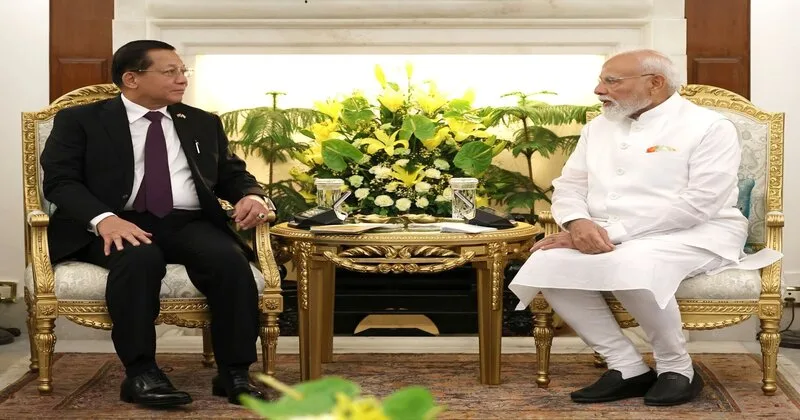
New Delhi: Prime Minister Narendra Modi urged Myanmar’s President U Min Aung Hlaing to find a path towards democratic transition in the country and emphasised the need for the inclusion of all stakeholders in the country’s peace process.
Responding to a media query on if PM Modi raised concerns about Aung San Suu Kyi, the State Counsellor of Myanmar, who was ousted following a coup in 2021 and the state of democracy in Myanmar during his bilateral meeting, Foreign Secretary Vikram Misri said, “The Prime Minister did raise this matter with the President and this was a discussion that was largely in the context of the peace process that is or has been underway in Myanmar for quite some time”.
Misri pointed out that a final agreement among all stakeholders has not yet been reached, but emphasised that PM Modi highlighted the importance of Myanmar returning to democracy, achieving lasting peace, ensuring inclusivity and involving all stakeholders in the process.
Clarifying India’s stance, Misri said that engagement with Myanmar is not meant to comment on its internal politics, but is guided by the principle that sustained dialogue is essential for India as a neighbour. “And the answer is clearly not disengagement. History has shown that disengagement doesn’t give us any results that are better than engagement and it certainly doesn’t produce democratic change, if that is what we are interested in”, Vikram Misri further added.
Misri also stated that disengagement creates a vacuum that others, who have no interest in democracy, are quick to fill, to India’s disadvantage and stressed that India has consistently engaged with Myanmar, using these interactions to convey its views on democracy, the peace process, inclusivity and the crucial need to involve all stakeholders in the dialogue.
Concerns over armed group atrocities along India’s border regions
Prime Minister Narendra Modi also raised concerns over the impact of Myanmar’s armed group activities along India’s border areas and discussed the issue of refugees with the President of Myanmar U Min Aung Hlaing, during the high-level bilateral talks between the two leaders, the Ministry of External Affairs stated.
Addressing a special briefing on the visit of Myanmar’s President, Foreign Secretary Vikram Misri said that the Prime Minister specifically addressed concerns about cross-border spillover from Myanmar’s internal conflict, while noting that such actions, along with corresponding military operations by the Myanmar Army close to the border, have significant implications for people living on the Indian side.
Misri added that PM Modi urged Myanmar authorities to ensure that operations near the border do not harm civilians living on the Indian side. On the refugee situation, Misri acknowledged the influx into Mizoram due to the active hostilities in the Southeast Asian country. “As far as the issue of refugees is concerned, it is a bit of a more complicated matter. There is a system to send the refugees back; there is a mechanism for it. And the authorities of both countries are in contact with each other as to how they will be sent back”, Misri reiterated.
Addressing concerns over Mizoram’s demography, Misri said, “The Myanmar government also believes that these people have not come as permanent refugees. And as soon as normalcy returns on the other side of the border, these people will go back to their side”. The critical matter came to discussuion during the high-level bilateral talks between Prime Minister Narendra Modi and visiting Myanmar President U Min Aung Hlaing.
Myanmar assures action against insurgency; Acknowledges India’s national security concerns
Myanmar assured India that it will take “everything necessary” to clamp down on Indian insurgent groups operating from within its borders, ensuring they no longer pose a threat to India’s security. The assurance came during high-level bilateral talks between Prime Minister Narendra Modi and visiting Myanmar President U Min Aung Hlaing.
Foreign Secretary Vikram Misri revealed that Prime Minister Modi directly confronted the issue of cross-border insurgent activity during his discussions with the Myanmar President. “There is the very important question of the activities of Indian insurgent groups in Myanmar close to our borders. And this is something again that the Prime Minister raised with the President”, Misri said.
“President once again reiterated his assurance that Myanmar was sensitive to these concerns and again would do everything necessary to ensure that there was action against these and these did not become a cause of threat against the security of India”, he added.
India’s 8 decade of constitutional experience acts as an example for Myanmar in its democratic transition
Responding to a question on Myanmar’s internal security situation, Misri highlighted that internal security discussions covered two key aspects: ongoing fighting in peripheral regions between the Myanmar military and ethnic armed groups and the country’s efforts to bring all ethnic organisations onto a single platform to advance the peace process. He said the peace process seeks to examine “what kinds of changes might be needed” in Myanmar’s governance structure to build “broad national consensus”.
The Foreign Secretary added that stability in Myanmar is a major interest for India, given the safety of people living along the 1,643-km border, the importance of connectivity to Southeast Asia and the broader coherence of ASEAN, where Myanmar is a significant member.
Misri also underscored India’s long-standing position that Myanmar’s challenges must ultimately be resolved internally through a Myanmar-led and Myanmar-owned process, noting that India authorities have shared their nearly eight-decade-long experience in constitutional governance and federalism, organising workshops and seminars to support Myanmar’s learning and dialogue.
(With Inputs from ANI)