The Dark Chapter of Congress: A controversial political narrative
June 30, 2026
  • Read Ecopy
  • Circulation
  • Advertise
  • Careers
  • About Us
  • Contact Us
Android AppiPhone AppArattai
Organiser
  • ‌
  • Bharat
    • Assam
    • Bihar
    • Chhattisgarh
    • Jharkhand
    • Maharashtra
    • View All States
  • World
    • Asia
    • Europe
    • North America
    • South America
    • Africa
    • Australia
  • Editorial
  • International
  • Opinion
  • RSS @ 100
  • More
    • Op Sindoor
    • Analysis
    • Sports
    • Defence
    • Politics
    • Business
    • Economy
    • Culture
    • Special Report
    • Sci & Tech
    • Entertainment
    • G20
    • Azadi Ka Amrit Mahotsav
    • Vocal4Local
    • Web Stories
    • Education
    • Employment
    • Books
    • Interviews
    • Travel
    • Law
    • Health
    • Obituary
  • Subscribe
    • Subscribe Print Edition
    • Subscribe Ecopy
    • Read Ecopy
  • ‌
  • Bharat
    • Assam
    • Bihar
    • Chhattisgarh
    • Jharkhand
    • Maharashtra
    • View All States
  • World
    • Asia
    • Europe
    • North America
    • South America
    • Africa
    • Australia
  • Editorial
  • International
  • Opinion
  • RSS @ 100
  • More
    • Op Sindoor
    • Analysis
    • Sports
    • Defence
    • Politics
    • Business
    • Economy
    • Culture
    • Special Report
    • Sci & Tech
    • Entertainment
    • G20
    • Azadi Ka Amrit Mahotsav
    • Vocal4Local
    • Web Stories
    • Education
    • Employment
    • Books
    • Interviews
    • Travel
    • Law
    • Health
    • Obituary
  • Subscribe
    • Subscribe Print Edition
    • Subscribe Ecopy
    • Read Ecopy
Organiser
  • Home
  • Bharat
  • World
  • Operation Sindoor
  • Editorial
  • Analysis
  • Opinion
  • Culture
  • Defence
  • International Edition
  • RSS @ 100
  • Magazine
  • Read Ecopy
Home Politics

Dark Chapter of Congress: How partition, territorial concessions and political decisions shaped India’s troubled legacy

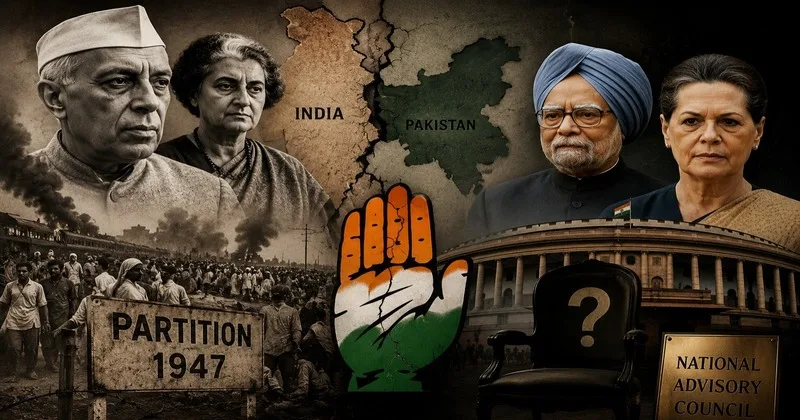
From the Partition of India to the creation of the National Advisory Council in 2004, several Congress-led decisions had far-reaching consequences for India's territorial integrity, governance, and national security. This article examines these controversies and the political debates surrounding the Nehru-Gandhi family's legacy

WEBDESKWEBDESK
Jun 2, 2026, 02:30 pm IST
in Politics, Bharat
Follow on Google News
From Partition to the National Advisory Council in 2004, Congress-led decisions are seen as having lasting impacts on India’s territorial integrity

From Partition to the National Advisory Council in 2004, Congress-led decisions are seen as having lasting impacts on India’s territorial integrity

FacebookTwitterWhatsAppTelegramEmail

The history of modern India is deeply shaped by the Partition of 1947 and the political developments that followed in the decades of nation-building. Over time, different political interpretations have emerged regarding the role of early Congress leadership and later governments in shaping territorial, constitutional, and governance outcomes.

कांग्रेस का काला अध्याय
78. 2 जून 1939 को ही अंग्रेजों ने भारत विभाजन की नींव कॉंग्रेस के साथ यानि नेहरु जी के साथ मिलकर बनाई थी ।1947 में भारत पाकिस्तान दो देश धर्म के आधार पर बने,पाकिस्तान ने कश्मीर का हिस्सा अपने क़ब्ज़े में ले लिया,लड़ाई आज भी हम लड़ रहे है फिर भी नेहरु जी… pic.twitter.com/ACcrgaC4z9

— Dr Nishikant Dubey (@nishikant_dubey) June 2, 2026

Partition and the End of Colonial Rule

The Partition of British India in 1947 was the result of complex negotiations involving the British government, the Indian National Congress, the Muslim League, and other stakeholders. The final boundary, drawn by the Radcliffe Commission, led to the creation of India and Pakistan.

This event triggered one of the largest migrations in human history and widespread communal violence. It also left unresolved territorial disputes, most notably over Jammu and Kashmir, which became a long-standing point of conflict between the two nations.

Over the years, various political narratives have attempted to assign responsibility for the Partition outcomes, but historical scholarship generally views it as a consequence of multiple interacting political and colonial factors rather than the actions of any single leader or party.

Territorial Realities After Independence

After 1947, the territorial map of India was shaped primarily by the Radcliffe Award and subsequent administrative integration of princely states. Regions such as Punjab, Bengal, Assam, and others were divided during Partition based on demographic, administrative, and strategic considerations at the time.

Some political arguments have questioned specific boundary outcomes, including the placement of certain districts and culturally significant regions. However, these decisions were largely part of the broader and immediate Partition settlement rather than later legislative actions in the 1960s.

Political Authority and Governance in 2004

A significant shift in Indian governance occurred in 2004 when the United Progressive Alliance came to power. Manmohan Singh assumed office as Prime Minister, while the Congress party leadership played a major role in coalition coordination.

During this period, the National Advisory Council was created as a consultative platform bringing together experts and civil society representatives to advise on policy formulation. It functioned in an advisory capacity rather than as a constitutional executive authority.

The presence of such a body generated debate in political circles regarding the balance between elected institutions and advisory mechanisms. Supporters viewed it as an innovation in participatory governance, while others questioned its influence on policy direction.

The narrative connecting Partition-era decisions with later governance structures reflects a broader political interpretation of Indian history. It frames early national decisions and later institutional developments as part of a continuous pattern shaping state power, territorial integrity, and governance models.

At the same time, mainstream historical accounts emphasise the complexity of these events, highlighting multiple actors, constrained decision-making environments, and evolving constitutional frameworks.

India’s political history remains deeply contested, particularly regarding Partition and post-independence governance. Different interpretations continue to shape public debate, reflecting the enduring significance of these events in understanding the nation’s past and present.

 

Topics: Sonia GandhiJawaharlal Nehrumanmohan singhPartition of Indiaindian politicsindia pakistan relationsNational Advisory CouncilCongress
ShareTweetSendShareSend
✮ Subscribe Organiser YouTube Channel. ✮
✮ Join Organiser's WhatsApp channel for Nationalist views beyond the news. ✮
Previous News

PM Modi pushes for democracy in Myanmar; Naypyidaw vows action against insurgents threatening India’s national security

Next News

Mumbai Terror Plot Exposed: ISI-underworld nexus aimed to target Siddhivinayak Temple & Bhabha Atomic Research Centre

Related News

PM Narendra Modi disguised as a Sardar during 1975 Emergency (This is an AI generated image)

Emergency 1975: How young Narendra Modi worked underground to support families of jailed satyagrahis

Uttar Pradesh CM Yogi Adityanath

Uttar Pradesh: CM Yogi slams Congress on ‘Samvidhan Hatya Diwas,’ says “democracy was strangled to save power”

The Emergency: India’s darkest chapter, the struggle for democracy and the ban on the RSS

Tamil Nadu Higher Education Minister P. Viswanathan (Black T Shirt)

Tamil Nadu: TVK minister faces POCSO complaint over alleged inappropriate conduct with girl athletes in viral videos

Keralam Chief Minister VD Satheeshan (Left Side)

Keralam: CM Satheeshan’s new liquor policy proposal triggers internal conflict within Congress

Prime Minister Narendra Modi

Viksit Bharat: PM Modi slams Congress — ‘Blocks development, claims credit’

Load More

Latest News

President Droupadi Murmu paid tribute to the heroes of the Santhal rebellion on the occasion of Hul Diwas

Hul Diwas: President Murmu pays tribute to heroes of Santhal rebellion, says their sacrifice will inspire forever

A representative image

Escalating unrest and civilian casualties in Pakistan Occupied Jammu and Kashmir: A 15 year overview

A representative image

Twelve years of pension reforms: Over 3.28 lakh PPOs issued through Bhavishya platform

Representative image made using AI

Religious festival or display of violence? 12 incidents of killings and attempts to kill Hindus during Muharram

A representative image

Nirbhay Chetna: Govt launches world’s largest gender sensitisation drive for women, targets 17.5 lakh representatives

A representative image made from AI

From Digital Consumer to Technology Powerhouse: How India is building technologies that are shaping Viksit Bharat 2047

Representative image

FCRA Amendment Bill 2026: Why evangelical groups are rattled over India’s oversight on foreign funding

Sir Dinshaw Maneckji Petit Birth Anniversary: Remembering Bombay's Textile Pioneer

Birth Anniversary of Sir Dinshaw Petit: The visionary who built Bombay’s textile empire

Guru Hargobind ji

Remembering Guru Hargobind Ji on Prakash Parv: Visionary who united spirituality with the sword of justice

Security personnel along with the miscreants and arma and ammunitions that have been seized in assam

Manipur: Huge cache of arms and ammunitions recovered: Security forces intensify operations

Load More
  • Privacy
  • Terms
  • Cookie Policy
  • Refund and Cancellation
  • Delivery and Shipping

© Bharat Prakashan (Delhi) Limited.
Tech-enabled by Ananthapuri Technologies

  • Home
  • Search Organiser
  • Bharat
    • Assam
    • Bihar
    • Chhattisgarh
    • Jharkhand
    • Maharashtra
    • View All States
  • World
    • Asia
    • Africa
    • North America
    • South America
    • Europe
    • Australia
  • Editorial
  • Operation Sindoor
  • Opinion
  • Analysis
  • Defence
  • Culture
  • Sports
  • Business
  • RSS @ 100
  • Entertainment
  • More ..
    • Sci & Tech
    • Vocal4Local
    • Special Report
    • Education
    • Employment
    • Books
    • Interviews
    • Travel
    • Health
    • Politics
    • Law
    • Economy
    • Obituary
  • Subscribe Magazine
  • Read Ecopy
  • Advertise
  • Circulation
  • Careers
  • About Us
  • Contact Us
  • Policies & Terms
    • Privacy Policy
    • Cookie Policy
    • Refund and Cancellation
    • Terms of Use

© Bharat Prakashan (Delhi) Limited.
Tech-enabled by Ananthapuri Technologies