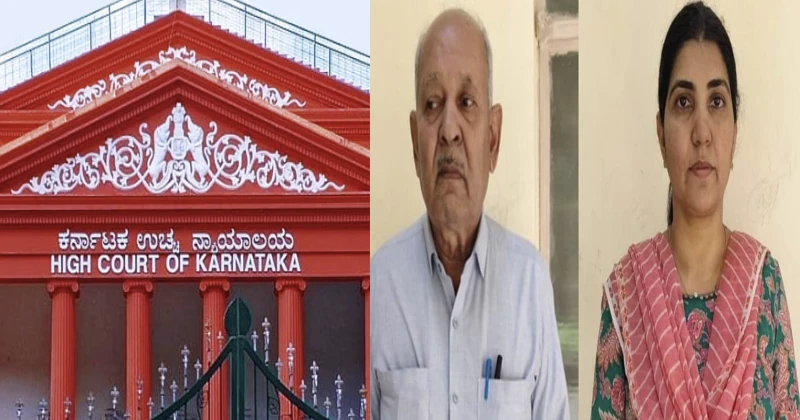
BENGALURU: The Karnataka High Court has refused to quash criminal proceedings against a father-daughter duo accused of masterminding a sophisticated fake government recruitment racket that allegedly cheated more than 40 job aspirants of over Rs 5.3 crore by issuing forged appointment letters, creating fake government email IDs, running bogus training centres and falsely promising jobs in several Union and State government departments.
Justice M. Nagaprasanna passed the order while dismissing a petition filed by Shamshad Begum, an MBA graduate, and her father M.A. Mansur Ahmed, who had sought to set aside the criminal case registered against them. Holding that the allegations disclosed a prima facie case of organised fraud, the court ruled that the investigation must continue.
In a strongly worded observation, the High Court said it would not extend its “protective hands” to persons accused of exploiting innocent job seekers through forged appointment orders, fake government departments, fabricated email IDs and fictitious training programmes. The court observed that if such fraudulent activities were ignored in one case, they could spread unchecked elsewhere.
The bench noted that the complaint clearly explained the elaborate modus operandi allegedly adopted by the accused. It observed that the allegations were not limited to false promises of employment but revealed a carefully orchestrated conspiracy involving multiple stages intended to convince victims that the recruitment process was genuine.
According to investigators, the accused projected themselves as politically influential persons with close links to senior government officials and leaders. They allegedly claimed they could secure jobs in prestigious departments, including the Railways, Income Tax Department, Health Department, Irrigation Department and Social Welfare Department through their political influence.
The investigation revealed that educated unemployed youth, particularly from North Karnataka, were approached through personal contacts and recommendations. The accused allegedly demanded between Rs 5 lakh and Rs 10 lakh from each candidate, assuring them that the money would be used to secure permanent government employment.
Police said the fraud did not stop with collecting money. To make the operation appear authentic, the accused allegedly created fake government email IDs resembling official addresses and regularly communicated with candidates through those accounts. Forged appointment letters carrying official-looking seals, logos and signatures were then issued to candidates, convincing them that they had successfully secured government jobs.
The victims were subsequently instructed to report for training at specially arranged centres in Bengaluru, Mumbai and Kolkata. These centres, investigators alleged, were entirely bogus and had been created solely to lend credibility to the recruitment process. Candidates attended what they believed were official induction programmes before eventually realising that no government department was involved.
Investigators further alleged that, in an effort to silence doubts and attract more victims, the accused even credited four months’ salary into the bank accounts of a few selected candidates. These payments allegedly created confidence among the victims, many of whom then introduced relatives and friends into the scheme, significantly expanding the fraud.
The case came to light after Sangamesh Rachayya Vastrad of Vijayapura lodged a complaint with the Central Crime Branch (CCB) on November 17, 2025. He alleged that he alone had paid over Rs 2.5 crore after collecting money from relatives and acquaintances who were seeking government jobs.
Following the complaint, the Organised Crime Wing (East) of the CCB launched a detailed investigation. Officers scrutinised financial transactions, examined digital evidence and verified forged documents allegedly generated between 2023 and 2025. Most of the money, police said, had been transferred through online banking channels.
The investigation eventually uncovered what police described as an extensive fake recruitment network involving forged government correspondence, fabricated training centres and counterfeit appointment documents. The accused were arrested on June 4 and taken into police custody for questioning.
Police are also probing the possible involvement of other family members and associates who may have assisted in operating the alleged racket. Investigators are tracing the money trail and attempting to recover the funds collected from victims.
During the High Court hearing, counsel for the petitioners argued that none of the alleged victims had directly lodged the complaint and contended that the criminal proceedings were retaliatory in nature. The defence maintained that the complainant had no direct connection with the alleged recruitment fraud and sought quashing of the FIR.