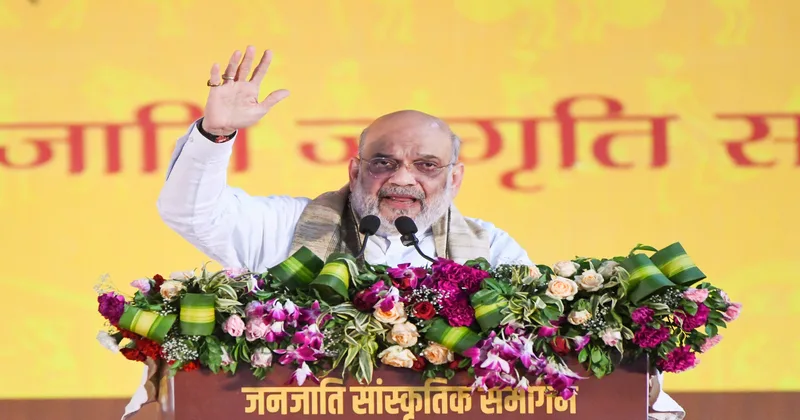
New Delhi: The Janjati Sanskritik Samagam at the Red Fort grounds, held to mark the 150th birth anniversary of Birsa Munda, turned into a crucial platform for the Centre to address growing anxieties around the Uniform Civil Code (UCC), with Union Home Minister Amit Shah directly countering what he termed a “conspiracy” to mislead tribal communities.
Addressing a gathering of nearly 1.5 lakh tribal representatives from across the country, Shah said attempts were being made to spread fear that the UCC would erode tribal customs, traditions, and identity. He categorically rejected the claim.
#WATCH | Delhi: At the "Janjati Sanskritik Samagam”, Union Home Minister Amit Shah says, "A conspiracy has just begun that UCC (Uniform Civil Code) will deprive the tribal people of their culture, their traditions, their customs, and their right to live. Today, as the Home… pic.twitter.com/JzQzi73MCD
— ANI (@ANI) May 24, 2026
Quoting him from visuals shared by ANI, Shah said that no provision of the UCC would be imposed on tribal communities or individuals. He emphasised that the Narendra Modi government had already ensured that tribal groups are kept outside the ambit of such laws through specific provisions.
He pointed to examples of states like Gujarat and Uttarakhand, where UCC frameworks have been implemented under BJP governments, reiterating that tribal rights remain untouched. His message was direct and political: tribal communities should not be misled and must carry this clarification back to their villages, forests, and hill regions
Cultural assertion meets political messaging
The event itself was framed as a historic coming together of tribal India, described by Shah as a “Mahakumbh” of Janjati identity. Invoking Birsa Munda’s legacy, he underlined the philosophy of jal, jungle, zameen as central to tribal life and sustainable development.
Shah also linked tribal traditions to the broader framework of Sanatan culture, stating that nature worship forms its core. He added that the current government had prioritised tribal welfare, recalling the establishment of the Tribal Affairs Ministry under former Prime Minister Atal Bihari Vajpayee.
The Samagam saw large-scale participation from across states, including delegations from the Andaman and Nicobar Islands, alongside processions through key Delhi locations culminating at the Red Fort grounds.
Voices from the Dias: Conversion, identity, and assertion
Speakers from organisations such as the Janjati Suraksha Manch raised concerns about religious conversions, calling them a threat to tribal identity and culture. Several speakers argued that conversion leads to cultural erosion and demanded policy measures to address the issue, including revisiting reservation benefits.
These remarks reflected an undercurrent within the gathering that tied cultural preservation with resistance to conversion, positioning tribal identity firmly within a civilisational and religious framework.
UCC debate gains parallel momentum
Shah’s remarks come at a time when the UCC debate is gaining traction in states beyond BJP strongholds. Notably, Assam has recently introduced a Bill seeking to ban polygamy and mandate registration of live-in relationships, signalling a broader push toward legal uniformity.
Against this backdrop, Shah’s intervention appears aimed at politically insulating tribal communities from the UCC discourse, ensuring that the issue does not trigger unrest or resistance in these regions
A calibrated message
By combining cultural symbolism with policy clarity, the government used the Janjati Sanskritik Samagam to send a dual message: reaffirmation of tribal identity and reassurance on legal autonomy.
Shah’s closing line captured the intent succinctly. There is no need for tribal communities to fear the UCC, he said, urging them to reject misinformation and stay aligned with what he described as the government’s commitment to protecting their rights and traditions.