


The multiple award-winning Khadima: The Caregiver, directed by Govind K Saji, opens with a fleeting definition of the draconian Kafala system practised in the West Asia. While this entry at New Delhi’s 18th Habitat Film Festival is a telling reminder about the rampant violation of human rights taking place on a regular basis in the GCC countries in the name of employment given to migrant workers, anyone delving into the nuances of this ‘sponsorship’ programme would acknowledge it as nothing but modern day slavery. The shorts, presented succinctly by Saji, has a housemaid escaping from Saudi Arabia to India, her home country, after a three-year torture by her sponsor. The social activist helping her, arranges a final video call with her son, before she leaves. The audience learns — through her own admission — how she endured all the torment thinking of the stability she was providing her son back home. The situation seems quite tragic, and in a way, hopeless.
A System Backed by Sharia
Keeping this scene in mind, one should do a thorough round-up of the Kafala system, which forms not just the reason for the migrant labour situation in the GCC countries but also enables the functioning of human trafficking rackets in Southeast Asian countries, including India. On paper, the Kafala, or Kefala, system in the Middle East involves binding a migrant worker’s residency and employment status to a specific employer throughout their period of residence in a country. Under this arrangement, the employer holds substantial authority over the worker, including the ability to approve or deny job changes and permission to leave the country. Obviously, this dependency creates a significant power imbalance that heightens the risk of abusive practices, including sexual ones. This practice has been criticised by human rights organisations for creating easy opportunities for the exploitation of workers, as many employers confiscate their passports and abuse them with little chance of legal repercussions and even repatriation. In 2014, the International Trade Union Confederation estimated that there were 2.4 million enslaved domestic workers in the Arab Gulf countries under the Kafala, which, as a legal framework, has its roots in Sharia law. So, understandably, the labourer can be punished unfairly and harshly if his or her ‘master’ deems so.
The Fake Narrative of Universal Muslim Brotherhood
In January 2024, domestic workers constituted approximately 32.4 per cent of female employment in the Arab states, many of whom faced various forms of abuse. According to the International Labour Organisation, “The informal, unregulated and isolated nature of their work renders migrant domestic workers vulnerable to exploitation, abuse and forced labour. Often, they are denied many basic labour rights related to freedom of association, remuneration, working hours, periods of rest, retention of their identity documents, leave and freedom of movement outside the households they work in.”
This lopsided nature of the system is effectively exposed in Saji’s short film when the protagonist’s worst fears come true. As she and her helper are caught, beaten up brutally and taken away, the employers come across as nothing less than brute Arabs repulsed by the ‘slaves’ they monetarily ‘own’. And yet, when Indian Muslims — plenty Keralite Muslims and Hindus from lower middle-class families are victims of the Kafala) have to choose between nationalism and Ummah, they opt for the latter without batting an eyelid. Despite never considered ‘brethren’ by their Arab fraternity, who unleash the same degree of abuse on Indian Hindus, Christians and Muslim migrant workers.
LIVES LOST TO OBLIVION
As incisive as Saji’s work is, this is not the first time that the Malayalam movie industry has made movies on the grey Kafala system rampant in the Middle East. Salim Ahmed’s Pathemari (2015), starring the iconic Mammootty as Narayanan, reveals the socio-economic struggles of Keralite expatriates albeit through a poignant lens. The same sentiment is reflected in Khaddama, director Kamal’s 2011 survival drama film starring Kavya Madhavan as Aswathi, a housemaid (khaddama being a colloquial term for khadima, meaning servant in Arabic) escaping from Saudi after being brutalised in an Arab household. While Pathemari (due to a softer approach) was embraced in Gulf countries, Khaddama was banned for release there. Maybe because the narrative reveals not only the several regressive Middle Eastern practices but also how these migrants lose their self-identity after years of trauma. In the end, just like how social worker Razzak (played by Sreenivasan) faces the dilemma of transporting unclaimed bodies of unknown Indians to their homeland, every labourer sacrificing their all to earn a few riyals eventually becomes a faceless, nameless entity pining for the simple lives they lead with their families at home.
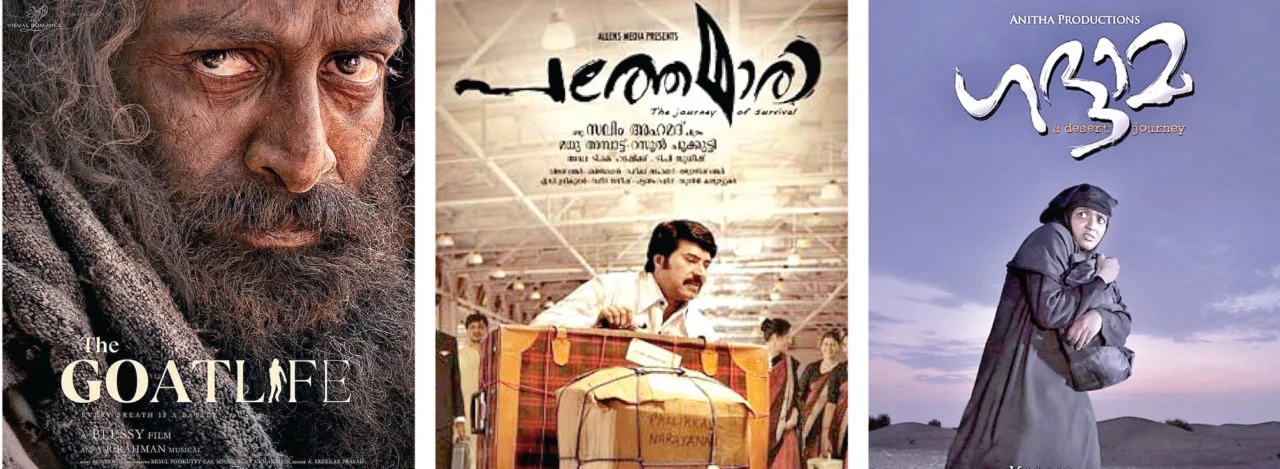
That brings us to the heart-wrenching saga of Najeeb in Blessy’s The Goat Life, featuring Prithviraj Sukumaran’s earnest portrayal of a wronged migrant worker forced to live an emaciated shepherd’s life in Saudi Arabia. While this 2024 survival drama, based on Beyamin’s award-winning novel Aadujeevitham, was the most talked-about film on this painful subject, it stays banned in Saudi Arabia and Kuwait due to its blatant exposé of the Kafala system. Najeeb and Aswathi got second chances though, to pick up pieces of their lost lives. Narayanan wasn’t that fortunate. After years of labouring to provide for his family, who in the end disregarded his role as a husband, father or human deserving compassion, he had to die far away from his beloved Kerala.
This element of dehumanisation leaves Saji’s audience with a question. What ultimately becomes of his subject who is preyed upon by a system abolished only on paper? Does she find reprieve from the stark reality that continues to ruin many, many innocent lives?