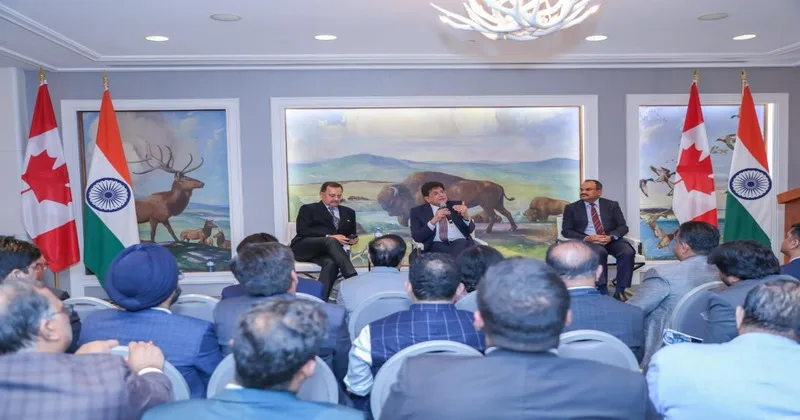
At a time when the global economy is being reshaped by supply-chain disruptions, geopolitical fragmentation and the race for strategic technologies, Union Minister of Commerce and Industry Piyush Goyal’s recent visit to Canada was far more than a routine trade engagement. The three-day visit from May 25–28, spanning Ottawa and Toronto, marked a serious attempt by India to revive and recalibrate economic ties with Canada through trade negotiations, investment partnerships, technology collaboration and strategic resource cooperation.
The visit carried symbolic and strategic weight because it came with the largest-ever Indian business delegation to Canada, comprising representatives from more than 100 Indian companies. More importantly, the delegation reflected the sectors India now considers central to its long-term economic and geopolitical ambitions, critical minerals, clean energy, aerospace, digital infrastructure, artificial intelligence, agritech, logistics and advanced manufacturing.
With bilateral trade currently estimated at around Rs. 78,846 crore (US$ 8.5 billion), both countries have now publicly committed themselves to an ambitious target of expanding trade to Rs. 4.84 lakh crore (US$ 50 billion) by 2030. The scale of the target itself signals that the visit was not merely diplomatic optics. It was about laying the groundwork for a strategic economic partnership in a rapidly changing global order.
CEPA returns to the centre of India-Canada relations
The most significant outcome of the visit was the renewed political momentum behind the proposed India-Canada Comprehensive Economic Partnership Agreement (CEPA). For years, CEPA negotiations remained slow-moving and uncertain. However, the latest engagements suggest that both sides now see the agreement as economically necessary and strategically beneficial.
During discussions in Ottawa, Piyush Goyal met Canadian Prime Minister Mark Carney and conveyed greetings from Prime Minister Narendra Modi while reaffirming India’s commitment to a forward-looking economic partnership. The political messaging was important because it indicated that both governments are attempting to stabilise and deepen economic engagement despite previous diplomatic strains.
What stood out during the visit was Prime Minister Mark Carney describing the proposed CEPA as a “game changer.” Such language reflects growing recognition in Canada that India is no longer merely an emerging market but a critical long-term economic partner with massive demand potential, manufacturing capabilities and technological ambitions.
Glimpses of my highly productive visit to Canada. 🇮🇳🤝🇨🇦
The engagements reaffirmed the renewed momentum in India-Canada relations & our shared commitment to advancing mutual growth and prosperity. pic.twitter.com/suP1vqdz10
— Piyush Goyal (@PiyushGoyal) May 30, 2026
The meetings with Canada’s Minister of International Trade Maninder Sidhu, Agriculture Minister Heath MacDonald and Foreign Minister Anita Anand further expanded the scope of discussions beyond conventional trade issues. The agenda included agri-technology, food processing, clean energy, logistics, infrastructure and digital transformation, sectors that align directly with India’s long-term economic priorities.
For India, CEPA is not simply about tariff reductions. It is about securing technology partnerships, improving access to investment capital, integrating with advanced supply chains and strengthening its position within global manufacturing networks. The agreement also offers India an opportunity to diversify trade partnerships at a time when many economies are seeking alternatives to overdependence on single-country supply chains.
The composition of the Indian business delegation itself reflected this strategic thinking. By bringing leaders from more than 100 companies, India demonstrated that it is approaching Canada not only as a trading partner but also as a source of technology, capital and strategic resources.
Critical minerals and the new strategic economy
One of the most important dimensions of the visit was the growing focus on critical minerals and strategic industries. In the emerging global economic order, access to lithium, cobalt, nickel and rare earth minerals has become central to industrial competitiveness, electric mobility, renewable energy systems and advanced electronics manufacturing.
Canada possesses substantial reserves of critical minerals and has increasingly positioned itself as a reliable democratic supplier in global markets. India, meanwhile, is aggressively expanding its electric vehicle ecosystem, renewable energy ambitions and semiconductor-related capabilities. The convergence of these interests explains why critical minerals featured prominently in the discussions.
During his meeting with Ontario Premier Doug Ford, Piyush Goyal discussed collaboration in manufacturing, technology, infrastructure, clean energy, food processing and critical minerals. This was strategically significant because Ontario is one of Canada’s major industrial and resource hubs.
India’s growing emphasis on critical minerals is directly linked to its ambition of becoming a global manufacturing and clean-energy powerhouse. As countries compete for control over future supply chains, India is attempting to ensure that its industrial growth is not constrained by resource vulnerabilities. Partnerships with countries such as Canada therefore become strategically important not only economically but geopolitically.
New York | Union Minister of Commerce & Industry, Piyush Goyal meets Chairman of Warburg Pincus, Chip Kaye; Morgan Stanley Chairman & CEO Ted Pick; Amneal Pharmaceuticals Co-Founder & Co-CEO Chintu Patel; and Mastercard CEO Michael Miebach, on the sidelines of a Roundtable hosted… pic.twitter.com/5jNGy4wuc3
— ANI (@ANI) May 29, 2026
The discussions on clean energy, renewables and infrastructure also fit into India’s broader transition strategy. India’s economic rise increasingly depends on its ability to combine industrial expansion with energy transition goals. Access to strategic minerals and advanced technologies will be central to that effort. Equally important was the emphasis on aerospace and advanced manufacturing during interactions with the Indian business delegation. These are sectors where India seeks to move up the global value chain rather than remain confined to low-cost production. The visit therefore reflected a larger shift in India’s external economic policy, from merely increasing exports to building long-term strategic industrial partnerships.
Investment, technology and India’s expanding economic magnetism
Another major pillar of the visit was attracting long-term institutional investment into India’s growth sectors. The meetings with major Canadian investment institutions underscored growing international confidence in India’s economic trajectory.
Piyush Goyal met Jo Taylor to discuss investment opportunities across infrastructure, renewables, healthcare, financial services, manufacturing, technology and the digital economy. These discussions are important because global pension funds are among the world’s largest sources of patient long-term capital. Similarly, discussions with John Graham focused on expanding institutional investments into infrastructure, logistics, transportation, renewable energy, financial services and digital infrastructure in India. CPP Investments already has substantial exposure to India, including investments in infrastructure, real estate and financial services.
Engaged with over 50 prominent business and industry leaders at the Roundtable hosted by the Consulate General @IndiaInNewYork in collaboration with @USISPForum.
Highlighted India's strong growth story, reform-driven business environment, and expanding opportunities for global… pic.twitter.com/nTOadNjM5u
— Piyush Goyal (@PiyushGoyal) May 29, 2026
The Toronto leg of the visit further reinforced India’s ambition to become a global technology and innovation hub. At the University of Toronto’s Munk School of Global Affairs and Public Policy, the minister spoke about India’s economic transformation and future opportunities for bilateral cooperation. The visit to the Ontario Centre of Innovation and discussions with Canada-India Tech Connect focused on artificial intelligence, quantum computing, agritech, cleantech and deep tech.
These sectors are not incidental additions to the bilateral agenda. They represent the technologies that will shape future economic power. India’s outreach in AI, quantum computing and deep tech demonstrates that its external economic engagements are increasingly linked to technological competitiveness rather than only trade expansion.
Diaspora, diplomacy and India’s larger strategic confidence
The visit also demonstrated the growing importance of the Indian diaspora in shaping India’s external economic relationships. During his interaction with members of the Canada-India Foundation and the broader Indo-Canadian community, Piyush Goyal highlighted their role in strengthening business engagement and people-to-people ties between the two nations.
This outreach matters because the Indo-Canadian community occupies an increasingly influential position in business, academia, technology and public life. India’s diplomatic and economic strategy now consistently integrates diaspora networks as facilitators of investment, innovation and strategic engagement.
The visit also reflected India’s growing confidence in presenting itself as a global economic power rather than merely a developing economy seeking external assistance. Throughout the engagements, the messaging from the Indian side remained focused on opportunity, partnership and strategic collaboration. India is no longer approaching advanced economies from a position of dependency.
Instead, it is presenting itself as an indispensable growth partner, manufacturing hub and technology market capable of shaping future global supply chains. The scale and breadth of the discussions, covering trade, critical minerals, AI, quantum computing, infrastructure, clean energy, logistics, pension investments and manufacturing, reveal how India’s economic diplomacy has evolved. Economic engagement is now closely tied to strategic autonomy, supply-chain resilience and technological advancement. In many ways, Piyush Goyal’s Canada visit represented a broader shift in India’s global approach. India is building partnerships that are not limited to exports and imports alone. It is constructing long-term strategic economic relationships designed to support its rise as a major industrial, technological and geopolitical power.