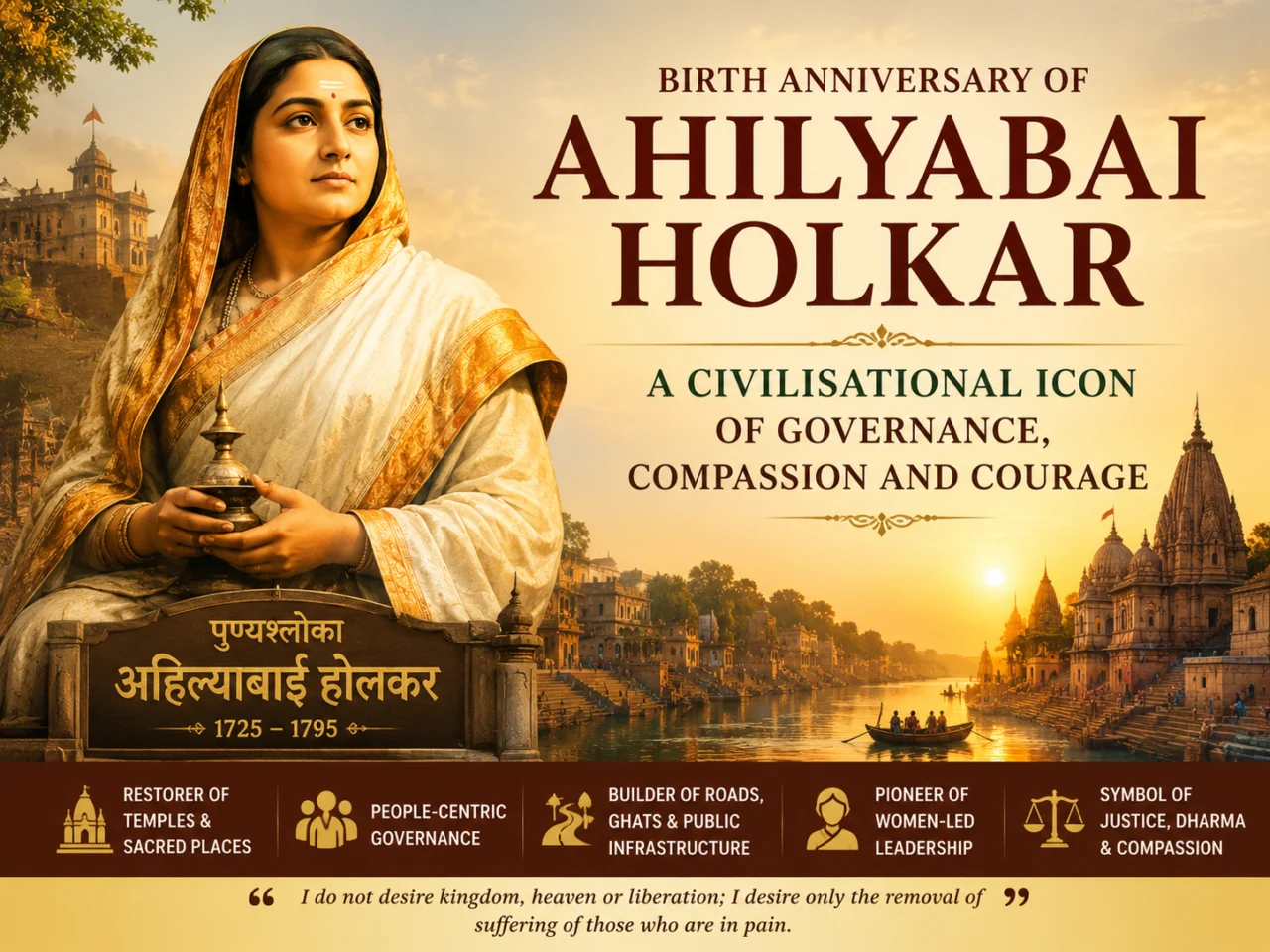
न त्वहं कामये राज्यं न स्वर्गं नापुनर्भवम्। कामये दुुःखतप्तानां प्राणिनामाणतभनाशनम्॥
I do not desire kingdom, heaven or liberation; I desire only the removal of suffering of those who are in pain.
Every age has its own noise. Our age has plenty of it. Loud politics, restless media, hurried opinions, instant outrage, rising aspirations and deep anxieties. Bharat is moving fast. It is building new highways, digital infrastructure, defence capability, semiconductor ambitions, AI missions and global partnerships. Yet in the middle of this speed, a deeper question stands before us what kind of leadership does Bharat truly need?
On May 31, when we remember Punyashlok Ahilyabai Holkar, we are not merely paying tribute to an eighteenth-century queen. We are returning to one of the finest examples of Indian governance, women-led leadership, dharmic administration, cultural restoration and people-centric development.
Ahilyabai Holkar was born in 1725 in Chondi, a small village in present-day Maharashtra. She did not inherit power in the easy sense. Her life was marked by personal loss, widowhood, political uncertainty and heavy responsibility. In an age when public authority for women was rare and difficult, she rose not through noise, but through courage, discipline and service.This is where her greatness begins.
Many rulers are remembered for conquest. Some are remembered for wealth. A few are remembered for monuments. Ahilyabai Holkar is remembered for trust. People called her Lokmata Ahilyabai Holkar because her power did not sit above society; it worked for society. Her rule was not built on fear. It was built on reliability, justice and compassion.
That one difference makes her timeless.
Ahilyabai Holkar – A Model of Good Governance Before the Term Became Popular
Today we often speak of good governance in India, women-led development, inclusive growth, public welfare, infrastructure development, heritage restoration and cultural revival. These are modern policy phrases. But Ahilyabai Holkar practised them centuries ago.
She built roads, wells, ghats, temples, dharmashalas and public facilities. She supported farmers, traders, artisans, pilgrims and ordinary families. She strengthened local economy and protected cultural life. She understood something that even modern systems sometimes forget: a state is not measured only by revenue or expansion. A state is measured by the confidence of its people.
Her capital, Maheshwar, was not merely a political centre. It became a living seat of administration, devotion, culture and livelihood. The Maheshwari weaving tradition carried beauty, dignity and economic opportunity. When a ruler protects both faith and livelihood,
society becomes stable. When governance respects both the temple and the marketplace, people feel rooted as well as productive. This is a lesson modern Bharat must revisit.
Why Ahilyabai Holkar Matters in Today’s
IndiaBharat today is building a new future. We are speaking of Atmanirbhar Bharat, Digital India, Viksit Bharat, Make in India, AI in India, semiconductor manufacturing, defence self-reliance, women empowerment and cultural confidence. These efforts are necessary. A weak nation cannot protect its civilisation. A poor nation cannot preserve dignity for its citizens. A dependent nation cannot speak with confidence in the world.
But development without compassion becomes dry. Technology without dharma becomes dangerous. Power without humility becomes arrogance.
This is where Punyashlok Ahilyabai Holkar’s leadership philosophy speaks directly to our time.
She was deeply spiritual, but never narrow. She rebuilt and supported sacred sites across Bharat – including places associated with Kashi, Somnath, Dwarka, Gaya and Rameswaram. For her, temples were not stone structures alone. They were centres of memory, continuity, community and national consciousness.
In today’s language, we may call this cultural infrastructure. But for Ahilyabai, it was simply dharma in action. She understood that a civilisation survives not only through armies and treasuries. It survives through sacred geography, public faith, social trust, honest administration and shared memory. This matters greatly today because Bharat is once again reclaiming its civilisational self-confidence. For decades, public discourse often treated faith as private embarrassment and tradition as backwardness. Ahilyabai’s life rejects that false divide. She shows that one can be modern in administration and deeply rooted in dharma. One can build public works and still bow before Shiva. One can encourage trade and still protect pilgrimage. One can be a strong ruler and a humble devotee.
Women-Led Leadership: What Ahilyabai Holkar Teaches Modern India
Ahilyabai Holkar’s story is often placed under the category of women’s history. That is correct, but not enough. She was not only a great woman ruler. She was a statesperson, administrator, cultural restorer, economic thinker and moral force.
Her life gives Indian women something very powerful.
It tells them that leadership does not require them to become harsh, rootless or disconnected from their inner nature. Ahilyabai did not abandon her feminine strength. She converted it into public power. Her compassion did not make her weak. Her devotion did not make her passive. Her widowhood did not make her invisible. Her grief did not end her life’s work.
This message is needed today, especially for young women in Bharat who are often told that success means becoming louder, colder and harder. Ahilyabai Holkar offers another model of women empowerment. She shows that a woman can lead with firmness and grace together. She can be spiritual and strategic. She can be soft-spoken and unshakeable. She can carry pain and still build for others.
There is also a lesson here for men, families and institutions. Ahilyabai’s rise was possible because Malhar Rao Holkar recognised her ability and trusted her with responsibility. A
society progresses when capable women are not blocked by insecure systems. This is as true in homes and offices today as it was in royal courts then.
Women do not need symbolic praise. They need trust, responsibility and space to lead.
Dharmic Governance: Ahilyabai’s Relevance for Viksit Bharat
If Ahilyabai Holkar were present in today’s Bharat, what would she ask?
She would ask whether development is reaching the last person. She would ask whether villages have water, whether cities are clean, whether farmers are heard, whether artisans are earning, whether women are safe, whether officials are honest, whether public money is used with discipline, and whether temples and public spaces are maintained with dignity. She would not oppose technology. But she would ask: is technology serving society or making people restless? Is artificial intelligence creating opportunity or only replacing human effort? Is data helping governance or weakening privacy? Are our children becoming skilled without becoming rootless? Are we building a powerful Bharat without losing the inner discipline that makes power meaningful? These questions are not old. They are urgent.
In the age of AI, data centres, digital governance, quantum technology and smart cities, Bharat needs not only innovation but also moral clarity. Ahilyabai Holkar’s model of governance reminds us that policy must have a human face. The last person must not be lost in the language of growth.
This is why her life is relevant to Viksit Bharat 2047. India’s development model cannot be a copy of the West. It must carry Indian wisdom, local livelihoods, family values, cultural confidence, women’s leadership and social harmony.
Cultural Revival and National Consciousness
One of Ahilyabai Holkar’s most important contributions was the restoration and support of sacred spaces across India. Her work connected different regions of Bharat through pilgrimage, devotion and civilisational memory. This is important because Bharat is not merely a political map. Bharat is also a sacred geography. From Kashi to Rameswaram, from Somnath to Gaya, from Dwarka to Maheshwar, the civilisational idea of Bharat is always travelled through temples, rivers, ghats, yatras, festivals, language, music, stories and shared faith. Ahilyabai understood this deeply.
Her temple restoration work was not only religious patronage. It was an act of civilisational reconstruction. It restored dignity after periods of destruction and neglect. It gave people confidence that dharma could rise again. It reminded society that memory is also a form of national strength.
Today, as Bharat restores temples, revives pilgrimage circuits, improves heritage cities and invests in cultural infrastructure, Ahilyabai’s work becomes even more relevant. She showed that heritage conservation and public welfare can go together. A clean ghat, a safe road, a dharmashala, a restored temple and a thriving local market are all parts of the same civilisational ecosystem.
Leadership Lessons from Ahilyabai Holkar for Today’s Public Life
Modern public life often rewards aggression more than steadiness. It rewards clever words more than clean intent. It rewards visibility more than service. Ahilyabai’s leadership was
different. She did not need drama to prove authority. She listened. She administered. She punished when required. She gave when needed. She carried herself as a guardian, not as a performer. This is an important reminder for today’s political, social and corporate leadership. Bharat does not need leaders who merely dominate the conversation. Bharat needs leaders who reduce the suffering of ordinary people.
Her governance was practical, compassionate and disciplined.
Ahilyabai Holkar and the Bharatiya Idea of Power
In the end, Ahilyabai’s greatness lies in the fact that she made power feel maternal. This is not a small thing. The state can often feel distant, cold and punitive. Under her, governance carried the warmth of responsibility. That is why people called her Lokmata. The title was not manufactured. It came from public memory. And public memory is rarely fooled for long.
This is why Ahilyabai Holkar must not be reduced to a statue, slogan or annual tribute. She should be studied as a model of Indian leadership, ethical governance, women-led administration, cultural nationalism, social welfare and civilisational resilience.
Schools should teach her story in depth. Administrative academies should study her governance. Women’s leadership programmes should study her courage. Urban planners should study her public works. Cultural ministries should study her restoration efforts.
Political workers should study her humility. Corporate leaders should study her restraint. Families should tell her story to daughters and sons alike.
Because the question before us is not whether Ahilyabai belongs to the past. The real question is whether we have the maturity to bring her wisdom into the present.
Why Bharat Needs Ahilyabai Holkar Today
On May 31, as Bharat remembers Punyashlok Ahilyabai Holkar Jayanti, let us not offer only ceremonial respect. Let us remember her as a living standard of leadership.
She showed that governance can be sacred work.
She showed that wealth can serve dharma.
She showed that grief can become service.
She showed that a woman rooted in faith can reshape history. She showed that development must carry compassion.
She showed that power must remain answerable to people.
Bharat today is ambitious, powerful and impatient to move ahead. That is good. But ambition needs a conscience. Power needs restraint. Development needs compassion. Civilisation needs memory. Ahilyabai gave us all four. That is why, nearly three centuries later, Punyashlok Ahilyabai Holkar does not feel distant. She feels necessary.