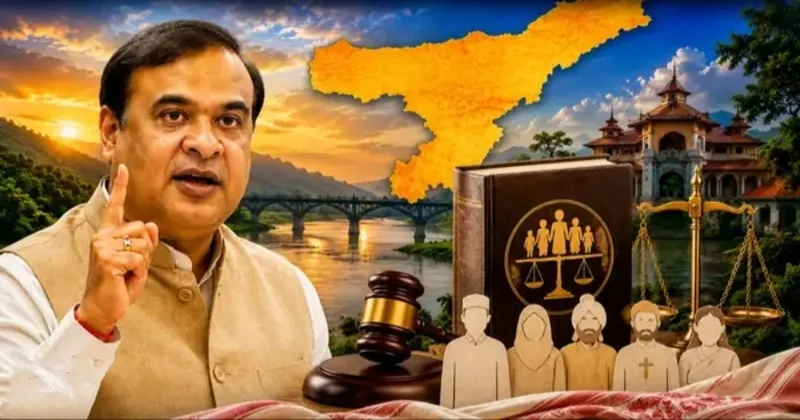
The Uniform Civil Code Bill introduced in the Assam Assembly this week is not merely a legal proposal. It represents one of the most significant attempts in recent years to reconcile constitutional modernity with India’s layered social realities. Unsurprisingly, the debate has already become intensely polarised. For some, the legislation is a long-overdue step towards gender justice and equality before the law. For others, it reflects the anxieties of cultural homogenisation in a deeply diverse society. Both responses contain elements of truth. Yet the larger constitutional question extends beyond political rhetoric.
At its core, the debate is about whether democratic India possesses the confidence to reform social practices while still respecting cultural diversity. That balance has always defined the success of the Indian republic.
Assam presents perhaps the most complex terrain imaginable for such a debate. This is not a socially uniform state governed by a single historical experience. Assam’s social fabric has evolved through migration, indigenous assertion, linguistic movements, tribal autonomy struggles and prolonged demographic anxieties. Questions surrounding identity here are rarely abstract. They are deeply emotional and historically rooted. Any legislation touching family structures, inheritance, marriage or social customs inevitably acquires political meanings beyond the legal text itself.
The State government has defended the proposed Bill as an effort to establish greater legal consistency in matters such as marriage, divorce, inheritance and live-in relationships. Among the reported provisions are restrictions on polygamy, compulsory registration of marriages and divorces, and legal oversight over live-in arrangements. Supporters argue that personal laws cannot remain permanently insulated from constitutional scrutiny when issues of women’s dignity and equal rights are involved. That argument carries undeniable force.
For decades, women across communities in India have faced unequal legal vulnerabilities within family structures shaped by patriarchy, social pressure and economic dependence. The debate surrounding the Uniform Civil Code is often reduced to communal binaries, but the reality is considerably more complicated. Polygamy, for instance, has historically existed across multiple social and tribal groups in India, though at varying levels. The issue is not confined to any one religion. Nor should reform be viewed exclusively through the prism of electoral politics.
India’s democratic evolution itself is built upon difficult social reform. The abolition of untouchability, legal action against child marriage, expansion of inheritance rights for women and protections against domestic violence were all interventions that challenged deeply entrenched social practices. Constitutional morality has repeatedly compelled Indian society to confront inequalities that tradition alone could no longer justify.
However, recognising the necessity of reform does not mean every form of reform automatically becomes wise or sustainable. Assam’s social structure is too layered for simplistic legal standardisation. The State is home to numerous indigenous and tribal communities whose customary systems continue to regulate marriage, inheritance and social authority. These are not museum relics preserved for symbolic purposes. They remain functioning social institutions shaped by generations of historical experience.
In fact, several tribal societies across the Northeast historically accorded women greater social participation and mobility than many orthodox patriarchal systems elsewhere in the subcontinent. This reality complicates the simplistic assumption that all customary systems are inherently regressive.
This is why the reported exemption granted to Scheduled Tribes under the proposed legislation has generated intense discussion. Critics argue that such exemptions weaken the very principle of uniformity being advocated. If equality before the law is the objective, why should uniformity apply selectively? Why should constitutional reform stop at ethnic boundaries? The question is legitimate. Yet Assam’s historical context makes the answer more nuanced than ideological absolutism allows.
The constitutional safeguards available to tribal communities in the Northeast did not emerge as political concessions. They were responses to historical fears of cultural erosion, demographic transformation and land alienation. Provisions such as the Sixth Schedule and Article 371A reflected the recognition that India’s unity could not be sustained through forced cultural assimilation. The Indian constitutional model has always rested upon negotiated accommodation rather than rigid uniformity, and that distinction remains vital.
India’s strength has never depended upon eliminating diversity. It has depended upon creating a civilisational framework within which diversity could coexist alongside national unity. The challenge, therefore, is not whether reform should occur, but how reform can proceed without generating insecurity among communities already shaped by historical anxieties.
At the same time, defenders of cultural autonomy must confront an equally important reality. No custom can remain permanently beyond scrutiny merely because it is inherited from the past. Traditions survive not because they are frozen in time, but because they adapt to changing moral and constitutional expectations. A democratic society cannot selectively defend women’s rights only where politically convenient.
The reported provision requiring registration of live-in relationships has similarly triggered debate. The government argues that such registration would strengthen legal protection for women and children within informal domestic arrangements. There is merit in ensuring accountability where vulnerable individuals are involved. Yet civil liberties concerns also deserve attention. Democracies must remain cautious that the language of protection does not gradually evolve into excessive State intrusion into private life.
The political environment surrounding the legislation has inevitably intensified these anxieties. Assam’s recent history has been shaped by migration disputes, communal polarisation and identity-based mobilisation. In such an atmosphere, debates surrounding personal law often acquire symbolic meanings larger than the law itself. Many citizens fear that the broader national discourse surrounding the Uniform Civil Code increasingly reflects not only constitutional reform, but also cultural majoritarianism. Such apprehensions cannot simply be dismissed as irrational.
At the same time, reducing the entire conversation to majoritarian politics alone would be equally dishonest. Many women within minority communities have consistently demanded stronger legal safeguards against discriminatory practices. Progressive politics loses credibility when it supports reform selectively depending upon electoral calculations. Patriarchy does not become acceptable merely because it exists within a minority framework.
Ultimately, the success or failure of Assam’s proposed Uniform Civil Code will depend less upon legislative triumphalism and far more upon political wisdom. Durable reform in a diverse society cannot be achieved through rhetoric alone. It requires trust, consultation and constitutional sensitivity. Tribal bodies, legal scholars, women’s organisations and minority representatives must all remain part of the conversation before irreversible legal restructuring is undertaken.
For Assam, the challenge has never been choosing between tradition and modernity alone. The deeper challenge has always been preserving social trust in a region where identity remains profoundly sensitive. Any reform that ignores this reality may achieve procedural uniformity while simultaneously widening emotional distance between communities and the State.
The real test of democratic maturity lies not in imposing sameness, but in reforming society without weakening the delicate balance that holds a diverse civilisation together.