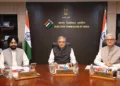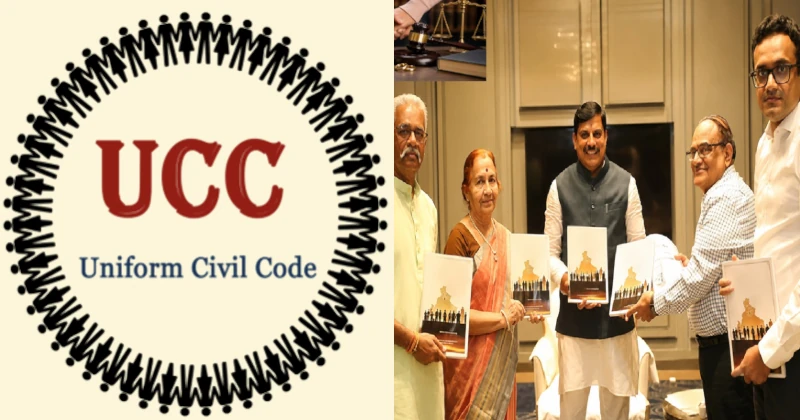
Madhya Pradesh has reached a decisive stage in the implementation of the Uniform Civil Code (UCC). A high-level committee, headed by retired Supreme Court Justice Ranjana Prakash Desai, has submitted the final report on the UCC to Chief Minister Dr Mohan Yadav. The proposed bill recommends bringing live-in relationships, alongside matters such as marriage, divorce, inheritance, adoption and maintenance, under a clear legal framework for the first time. Congratulating the committee chairperson and members for completing the task within the stipulated timeframe, Chief Minister Dr. Mohan Yadav described this as a significant step towards establishing a just and equitable civil system in the state.
Committee members Prof. Gopal Sharma, Budhpal Singh, and Shobha Paithankar, along with Committee Member-Secretary Ajay Katesaria, were present on this occasion.
UCC की रिपोर्ट समिति द्वारा प्राप्त हुई है। इसे हम विधानसभा में प्रस्तुत करेंगे।
कांग्रेस ने UCC पर अपनी बात तक स्पष्ट करना उचित नहीं समझा, यह उनका दोहरा रवैया है।#UniformCivilCode #UCC pic.twitter.com/NxVrj1JYaY
— Dr Mohan Yadav (@DrMohanYadav51) July 14, 2026
Notably, the most significant proposal is that the registration of live-in relationships in the state will be mandatory; cohabiting without registration will be considered a punishable offense. The high-level committee, constituted by the Madhya Pradesh government, prepared this report after nearly a year of study, extensive public consultation, and a comparative analysis of laws from various states and countries. The report has now been handed over to the Law Department, where, following necessary legal scrutiny and refinement, it will be placed before the Council of Ministers. Subsequently, the bill is likely to be introduced in the Legislative Assembly during the monsoon session.
Major proposal regarding live-in relationships
The provisions concerning live-in relationships are generating the most discussion within the UCC draft. The committee has recommended that every adult couple in a live-in relationship within the state must register their relationship within a prescribed timeframe. If a couple cohabits without registration and the administration becomes aware of it, provisions will be made for criminal action against them. Upon registration, the concerned police station and the families of both parties will be informed, ensuring that such relationships become a part of official legal records.
Should both parties wish to separate in the future, they will be required to submit an application to the Registrar, following a process similar to that of divorce. This initiative aims to minimize disputes and legal ambiguities arising from live-in relationships.
Rights of children born from live-in relationships to be safeguarded
The committee did not limit itself merely to the registration of relationships; it also recommended explicitly safeguarding the rights of children born from live-in relationships. Under the proposed law, such children would be entitled to all statutory rights, including inheritance rights. If property is held in the child’s name, both the mother and father would have equal rights over it. Additionally, efforts have been made to clearly define property-related rights in the event of the partner’s death. The objective of these provisions is to protect children from social and legal insecurity.
Comprehensive bill comprising 404 sections
The UCC draft prepared by the committee is extremely detailed. The report is structured into three distinct volumes. The first volume outlines the committee’s recommendations and the underlying legal and social rationale. It includes a comparative study of various legal frameworks at international, national and state levels and is divided into ten chapters.
The second volume contains the draft of the proposed bill, comprising four parts, 404 sections and seven schedules. It has been formulated with due regard for Madhya Pradesh’s social conditions, prevailing laws and administrative framework. The third volume details the extensive public consultation process.
Over 9.58 lakh suggestions received
Before drafting the UCC, the committee conducted widespread public consultations across the state. The committee received over 9.58 lakh suggestions and inputs through district-level and state-level forums as well as online platforms. An analysis of these suggestions, categorized by question, gender, and community, has also been incorporated into the report. This is considered one of the largest public consultation campaigns ever undertaken by a state in the country for a Uniform Civil Code draft.
Tribal communities excluded from UCC
The committee has recommended keeping Scheduled Tribes, nomadic and semi-nomadic tribes and converted tribal communities outside the ambit of the UCC. The committee holds the view that the Constitution itself grants special protection to the distinct cultural and traditional systems of these communities; therefore, it would be appropriate to maintain their traditional social systems intact.
Proposal for a uniform system for marriage and divorce
The proposed UCC suggests a uniform legal framework for all citizens regarding matters such as marriage, divorce, maintenance, inheritance and adoption. The committee has clarified that no citizen will be granted separate legal privileges based on religion. However, the committee has also endeavored to ensure that diverse religious and cultural rituals, as well as social traditions, are not unnecessarily affected. The report is grounded in the principles of gender equality, constitutional values and social justice.
Law to come into effect after presidential assent
If the proposed bill is passed by the Legislative Assembly, it will be sent for the President’s approval following the Governor’s assent. The law will come into effect only after receiving the President’s approval. The entire process could take approximately four to five months. Subsequently, the government will frame the rules and the UCC will be implemented.
Poised to become the fourth state to implement UCC
If this law is enacted, Madhya Pradesh will become the fourth state in the country to implement the Uniform Civil Code (UCC). The UCC has already been implemented in Uttarakhand, while legislative processes are underway in Gujarat and Assam. The Madhya Pradesh government believes that this law will ensure equal rights and obligations for all citizens and play a pivotal role in bringing uniformity to family laws.
The way forward
All eyes are now on the state government’s next course of action. The final shape of the law will become clear following scrutiny by the Law Department, approval by the Council of Ministers, and discussion in the Legislative Assembly. Widespread debate, at political, social, and legal levels, is anticipated regarding specific provisions such as the mandatory registration of live-in relationships and penal action for non-registration. If the UCC is implemented in its proposed form, it will bring about a significant transformation in Madhya Pradesh’s family law framework.