Recently, the Madras High Court quashed a Government order that permitted individuals who converted their religion to avail the benefits of reservation under the Backward Classes (BC) category, terming it unconstitutional. This is not merely a judicial decision; it brings to the forefront important questions about social justice, religious conversion, and Bharat’s reservation framework. The question of who qualifies for which category and who is entitled to reservation has long been a subject of debate.
While hearing the matter, a division bench comprising Justice GR Swaminathan and Justice PB Balaji clarified that the Tamil Nadu Government’s 2024 order was contrary to the legal principles already established by the High Court and the Supreme Court. The Court observed that once an individual embraces Islam, they are considered solely a “Muslim.” They cannot be placed in a specific community category defined by birth. The Court observed in its judgement: “As the Division Bench of the Madras High Court stated 75 years ago, upon embracing Islam, a person becomes a Muslim. The term ‘Just a Mussalman’ was used. They cannot be placed in a community whose identity is determined solely by birth. When the decision of the Division Bench is still effective today, it cannot be changed merely by issuing a government order.”
Based on this, the Madurai Bench of the Madras High Court, on June 24, 2026, in the case of Sameer Ahmed vs. District Collector (Writ Petition No. 7127 of 2022), declared the Tamil Nadu Government Order No. 31, dated 09.03.2024, as unconstitutional. The High Court also referenced the historic 1951 judgement in G Michael vs. S Venkateswaran (1952) 1 MLJ 239, which stated that a person who converts from Hinduism to Islam becomes “Just a Mussalman” — the expression used in the judgement. This principle was later reaffirmed by the Supreme Court in cases like Kailash Sonkar, KP Manu, and C Selvarani (2024).
The Court’s observation is not limited to conversion; it reiterates the fundamental constitutional principle that the Government cannot nullify the effect of established judicial precedents through executive orders alone. Addressing the duality arising between conversion and the demand for reservation, the Court remarked: “Christian missionaries and Islamic preachers have campaigned for decades that their religion offers social equality, whereas Hinduism has a caste system. If conversion was sought on this basis, then it is not appropriate to argue later that Islam also has social hierarchies. In our opinion, classifying some communities as ‘backward’ and others as ‘forward’ is contrary to the core spirit of the Quran.”
Questioning the legal validity of the Government order, the Court stated: “When an individual embraces Islam, the Jamaat certifies them as a Muslim. We have no option but to conclude that the Government has adopted a new method merely to nullify previous court decisions, which is not only unconstitutional but also non-Islamic.” Indeed, this observation reinforces the principle of Separation of Powers between the government, the legislature, and the judiciary under the Constitution.
Constitutional Foundations
This decision is rooted in the core principles of the Constitution rather than religion alone. Article 14 guarantees the right to equality before the law to all citizens. Articles 15(4) and 16(4) allow the state to make special provisions for backward classes in society and education. Similarly, under Article 162, the executive power of the state Government is subject to the Constitution and judicial pronouncements. Therefore, no government order can contradict legal principles already established by the courts.
In this context, the Supreme Court’s Indra Sawhney (1992) judgement is of particular importance, which clarified that the basis of backwardness is social and educational status, not religion alone. Likewise, according to Paragraph 3 of the Constitution (Scheduled Castes) Order, 1950, the constitutional status of Scheduled Castes is limited only to Hindus, Sikhs, and Bauddhas. It does not extend to Muslims or
Christians under the existing constitutional framework.
The framers of our Constitution established the system of reservation to provide equal opportunities to sections of society that had been lagging for a long time. Several members of the Constituent Assembly, including Dr BR Ambedkar, clarified that the purpose of reservation is to provide representation to historically deprived sections, not to provide special benefits based on religion.
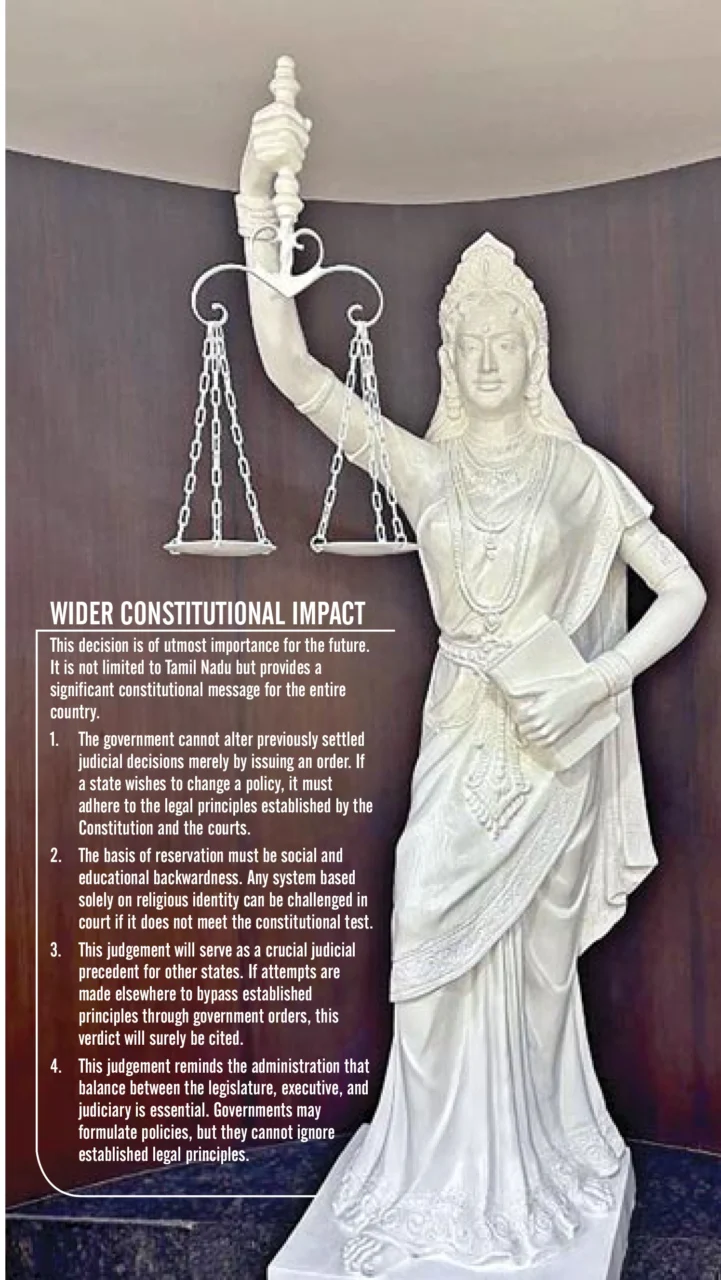
The Supreme Court has reiterated this principle in numerous judgements. In the landmark Indra Sawhney (1992) case, it was held that social and educational status, not religion, is the basis of backwardness. In subsequent rulings, such as M Nagaraj (2006) and Jarnail Singh (2018), the Court emphasised the importance of concrete data and actual social backwardness. It is also essential to understand that reservation is not merely a poverty alleviation scheme; its primary objective is to empower groups that have historically lagged in society and education. Hence, the constitutional provisions for Economically Weaker Sections (EWS) and social reservation are distinct.
Constitutional Ambiguity
Today, we face a significant question: who should be considered a ‘minority’? The term is used in the Constitution, but no clear, universally applicable definition is provided. The Supreme Court has, from time to time, outlined certain principles for identifying religious and linguistic minorities. This subject remains a matter of debate involving constitutional and government policy. Consequently, many experts believe that in the future, policies for minority welfare should be evaluated not just based on population, but by considering actual social, educational, and economic conditions.
Balancing Benefits
A natural question arises in the minds of common citizens in India: can an individual avail multiple benefits under the Constitution simultaneously? If an individual avails the benefits of minority institutions while also claiming benefits as a backward class or other categories, it becomes a matter of balancing for policymakers.
The Supreme Court has viewed cases where individuals convert religion solely to avail reservation benefits as contrary to the spirit of the Constitution, as this can undermine the objective of the reservation system designed for social justice. While it is not correct to say that such benefits are unconstitutional in every scenario, it is certainly necessary that such arrangements be periodically reviewed to maintain a balance between equal opportunity and social justice.
The Constitution of India is the supreme law of the land. Every citizen, institution, and government functions under it. While the Constitution grants religious freedom to all citizens, this freedom is subject to other constitutional provisions and fundamental rights. If any tradition, custom, or Government policy violates the constitutional principles of equality, dignity, and justice, the Constitution shall ultimately prevail. The Supreme Court has clarified that Personal Laws are not entirely exempt from judicial review. Where questions of fundamental rights, equality, and constitutional values arise, the Constitution remains supreme. This has contributed to the continuing national debate on a Uniform Civil Code.
Constitutional Balance
Article 25 of the Indian Constitution grants religious freedom to every citizen, but this freedom is subject to public order, morality, and health. If a government policy fosters a sense of inequality among various segments of society or creates widespread disputes regarding resource allocation, the Court can review the constitutional validity of that policy. Therefore, in a democratic system, it is essential that government policies remain consistent with constitutional equality and genuine social need.
Reforming Reservation Policy
The Madras High Court’s decision signals that matters related to reservation and social justice must be subjected to serious review from time to time. It is also necessary to ensure that the benefits of reservation truly reach those for whom the Constitution intended.
Madras High Court decision is not limited to quashing a government order. It reaffirms the supremacy of the Constitution, the independence of the judiciary, and the core spirit of reservation
When reviewing policies, criteria such as quantifiable data, the ‘creamy layer’ concept, and periodic social and educational surveys — as per the Indra Sawhney, M Nagaraj (2006), and Jarnail Singh (2018) judgements — must be considered. This will ensure that reservation benefits reach the deserving sections and the purpose of the Constitution is fulfilled. Similarly, Governments must thoroughly study previous judicial decisions, constitutional provisions, and social impacts before framing new policies to minimise litigation and ensure stability in governance.
Constitutional Lessons
In conclusion, this Madras High Court decision is not limited to quashing a government order. It reaffirms the supremacy of the Constitution, the independence of the judiciary, and the core spirit of reservation. It reminds us that the basis of social justice in Bharat is the Constitution, not administrative convenience or political expediency. Equality does not mean treating every citizen identically, but providing appropriate opportunities to those who have truly lagged behind in society and education for long.
This decision also clarifies that while both religious freedom and social justice are vital values of the Indian Constitution, maintaining a balance between them is equally essential. Whenever any Government policy affects this balance, the judiciary will inevitably review it against the constitutional benchmark. Ultimately, this verdict prompts a broader reflection on whether our policies align with the original vision of the framers of the Constitution. If social justice is to be truly effective, its foundation must be based on concrete data, actual social and educational backwardness, established judicial principles, and constitutional equality. This is the strength of Bharatiya democracy and the soul of the Constitution.
Viewed in this light, the Madras High Court’s decision will be seen not just as a State-level verdict, but as a reaffirmation of the supremacy of the Constitution, the Rule of Law, and fair governance. In the coming years, this judgement has the potential to become a vital reference point for many cases concerning reservation, religious conversion, and social justice.