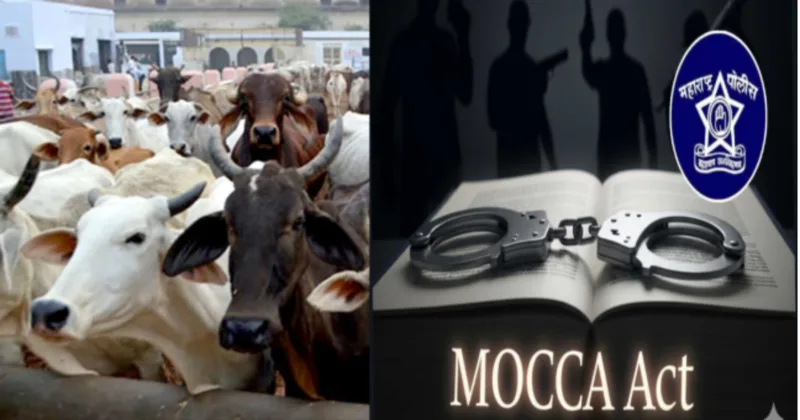
Mumbai/Nagpur: The Maharashtra government has signalled a tougher law-and-order approach to illegal cattle trade, with Chief Minister Devendra Fadnavis confirming that stringent provisions of the Maharashtra Control of Organised Crime Act (MCOCA) will be invoked against those involved in cattle smuggling, illegal transportation, and unauthorised slaughterhouses.
#WATCH | Mumbai: On the state government's action against cow smuggling, illegal cattle transportation, and illegal slaughterhouses, Maharashtra Chief Minister Devendra Fadnavis says, "For the first time, we have implemented the MCOCA law, and I believe it will be completely… pic.twitter.com/Ffh4rp0n6d
— ANI (@ANI) May 23, 2026
Speaking in Mumbai, Fadnavis said that for the first time, the state has implemented MCOCA in such cases and expressed confidence that its use would stand judicial scrutiny. “If anyone does this, MCOCA will be invoked against them,” he asserted, underlining a zero-tolerance stance against organised networks operating in the illegal cattle trade.
The Chief Minister’s remarks come months after Nagpur Police registered what is believed to be the first MCOCA case against a group of cattle smugglers in January 2026, setting a precedent for treating such offences as organised crime rather than isolated violations.
Minority Commission Chairman Endorses Move
Reacting to the government’s decision, Pyare Khan, a state-level official heading the Minority Commission, termed the step “commendable,” stating that stricter enforcement would address long-standing complaints of selective or inadequate action.
#WATCH | Nagpur | Maharashtra Minority Commission Chairman, Pyare Khan says, "This is a very commendable step by Maharashtra Chief Minister Devendra Fadnavis. Previously, a particular community would come to me and complain about injustice being done to them… But under the… pic.twitter.com/LFcdjJlQeI
— ANI (@ANI) May 25, 2026
Pyare Khan lauded Fadnavis’ decision. He highlighted that MCOCA will ensure that not just one person or any particular community but the entire network facilitating cow smuggling and slaughter will face the force of the law.
IN the current cow protection issue in Maharashtra, Pyare Khan emphasised that the law would apply uniformly. “Action will be taken against everyone involved, whether they are sellers, buyers, or slaughterers,” he said, backing the use of MCOCA to dismantle entire networks rather than targeting individuals in isolation.
Khan cited how in 1948, Zahir-ul-Hasan Lari a prominent Muslim leader in India’s Constituent Assembly had advocated for a national ban on cow slaughter.
“It’s better to come forward and incorporate a clause in Fundamental Rights that cow slaughter is henceforth prohibited, rather than it being left vague in the Directive Principles…,” Zahir-ul-Hasan Lari had told the Constituent Assembly, 24 November 1948. Khan said Lari had fought for the protection of the cow in India.
Incidentally, another prominent Muslim leader had joined forces with Lari and added his voice to the suggestion. “I do not also want to obstruct the framers of our Constitution, if they come out in the open and say directly: “This is part of our religion. The cow should be protected from slaughter and therefore we want its provision either in the Fundamental Rights or in the Directive Principles,” said Syed Muhammad Saadulla, in the same debate.
Pyare Khan highlighted that Islam says the Qurbani or sacrifice (sacrificial offering) should not hurt or inconvenience anyone else. “Allah Taala will not accept a Qurbani that is against the law of the land and hurts others,” Khan said, urging Muslims to refrain from carrying out the ceremonial slaughter of the Qurbani animal in any places other than the designated slaughter houses. He specifically urged all to avoid carrying out the slaughter in hosuing societies or open grounds which may shock, hurt, or upset others’ sentiments and sensibilities.
Appeal for Legal Compliance and Social Harmony
Khan made a direct appeal to members of the Muslim community to adhere to state laws prohibiting cow slaughter in Maharashtra. Referring to broader religious principles, he noted that individuals are expected to follow the laws of the land they reside in.
He urged that religious practices, particularly animal sacrifice, be carried out in a manner that does not cause inconvenience or hurt sentiments, adding that designated slaughterhouse facilities have been arranged by the administration for lawful observance.
“The government has issued instructions to all officials. We must cooperate with the administration and the police,” he said, framing compliance as both a civic and social responsibility.
Administrative Preparedness and Enforcement Push
Officials have indicated that directions have been issued across districts to step up enforcement against illegal slaughterhouses and cattle transport networks. The Home Department is also expected to monitor implementation closely, with the possibility of action against officers found lax in enforcing orders.
Alongside the crackdown, Fadnavis also noted that the state has prepared a comprehensive plan to deal with potential El Niño-related weather disruptions, including precautionary measures for heavy rainfall in vulnerable regions.
A Shift in Enforcement Strategy
The decision to invoke MCOCA marks a significant escalation in how Maharashtra intends to tackle cattle smuggling, treating it as organised crime with wider conspiratorial links rather than standalone offences. The relevance of the endorsement by Pyare Khan here is that he publicly backs Devendra Fadnavis’s crackdown, signalling institutional and minority-side support for the policy on a sensitive issue.
With political backing from the top leadership and public endorsement from a minority community representative, the move is being positioned as both a law enforcement measure and an attempt to maintain social order amid sensitive issues.