
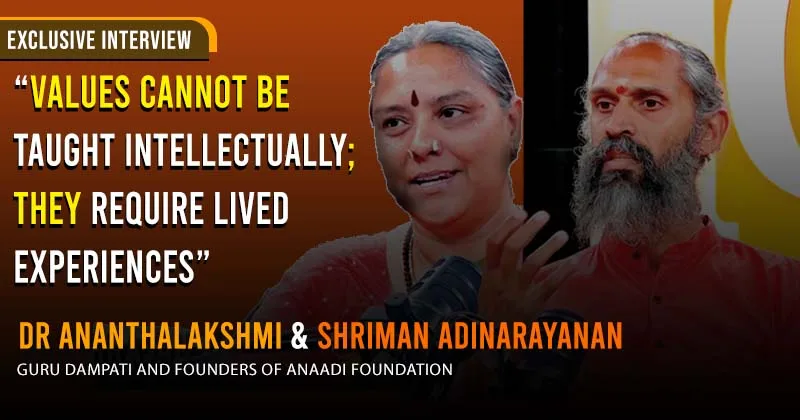
Organiser Weekly’s Editor Prafulla Ketkar speaks with Shriman Adinarayanan and Maatrushree Dr Ananthalakshmi aka Dr Smrithi Rekha, the Guru Dampati and founders of Anaadi Foundation.
Anaadi Foundation was started in 2015 for lok sangraha. The ashram is located near Palani in Tamil Nadu. It has started Dharma, Swadharma and Bala Gurukulams across Bharat to transform education through Bharatiya Knowledge Systems.
What is the idea behind Anaadi Foundation? Why this particular model of Gurukul that you are talking about — sadhana and also, in a way, science?
Shriman Adinarayanan: Anaadi Foundation emerged from the idea that Bharat is both Rishi Bhoomi and Deva Bhoomi, with a timeless knowledge tradition recorded in the Itihasas and Puranas. The challenge, according to the founders, is how to help the next generation understand, own, and contribute to this heritage as Bharatiyas in the modern world.
We realised that modern education largely focuses on artha and kama, while dharma and moksha remain absent from mainstream schooling. After experiencing a spiritual awakening and later working closely with thousands of students in academia, we felt there was a need to systematically introduce children to Bharatiya jnana parampara beyond festivals, temple visits, and rituals.
This led to courses, teacher training, workshops, graded textbooks, and finally the Gurukul model. The idea is that values like seva, dana, and samskara cannot be taught only intellectually; they require lived experiences and immersive environments. Activities such as seva and annadanam help children internalise these values through practice.
The name “Anaadi” itself reflects a concept found in both Sanskrit and Tamil spiritual traditions, referring to that which is beyond beginning and end.
Today, many women find it difficult to follow the Vedantic knowledge tradition while also living as grihasthas. What was your thought process behind Anaadi Foundation, and as a woman, how do you see your role in completing this vision?
Dr Smrithi Rekha: When we look at the Bharatiya tradition, women have played a crucial role throughout history. In the Itihasas and Puranas, we find women portrayed not as oppressed sufferers, but as strong and independent decision-makers.
Take Draupadi in the Mahabharata. In a famous samvad with Satyabhama in the Vanaparva, Draupadi explains that the Pandavas’ devotion did not come through “mantras or tantras”, but through the way she lived — being the first to wake up, the last to sleep, personally knowing and caring for everyone in the palace. In many ways, she was one of the greatest administrators in the Mahabharata.
What is the structure that you follow in your Gurukulam that makes it different?
Shriman Adinarayanan: One of the core foundations is purushartha — dharma, artha, kama, and moksha. The fulfilment of purushartha is considered central to human life. This is very different from modern education, where schooling is often reduced to preparation for jobs. In reality, school education is meant to provide values and general education, while professional education later focuses on specialised skills and employment.
Can you explain the different Gurukulam models?
Dr Smrithi Rekha: We have around three different structures in our Gurukulam system. The first is Bala Gurukulam, a preschool model for children from two-and-a-half to six years of age, where a completely Bharatiya paddhati is followed. Along with English, the curriculum includes Sanskrit shlokas, rhymes, and mother-tongue learning rooted in Bharatiya culture rather than borrowed nursery traditions. The second is Swadharma Gurukulam, a non-residential primary-level system for children above six years. The third is Dharma Gurukulam, which is residential. We also run a Vedapathashala in Prayagraj.
One of the key focus areas in our Gurukulam is what we call IKS-STEM — Indian Knowledge Systems in Science, Technology, Engineering, and Mathematics. Just as modern schools teach language, mathematics, science, and social science, our children study Bharatiya equivalents of these disciplines.
If “Indian” itself is not Bharatiya and the system is not rooted in parampara, are we trying to fit our traditional knowledge systems into Western parameters and merely calling it IKS?
Shriman Adinarayanan: The current approach to education is building multiple silos. At the school level, knowledge is divided into science, mathematics, social science, and language. Then it becomes physics, chemistry, mathematics, biology, commerce, and so on. At the undergraduate level, fragmentation increases further, and then comes the PhD level. Philosophy is ideally meant to integrate all streams of knowledge, which is why the highest degree is called a PhD. But even there, true integration is often not achieved because the fundamental drishti still leads to further fragmentation.
That is why, modern sciences are often described as reductionist. Integrative aspects become invisible. Intelligence itself emerges only through tight integration. Otherwise, you may have a tree, but not a forest. A forest ecosystem becomes important because integration creates something much more beautiful and alive.
Therefore, Darshana Shastras need to be introduced at the foundational level itself and not only at the highest level. If we reverse the current process, there is hope for children to develop in an integrated manner. So, the subjective dimensions such as dinacharya, upasana, and sampradayas become equally important alongside objective knowledge.
How do the students coming to IIT actually perceive this course? Is it just one of the electives, or do they genuinely find something fruitful in it?
Dr Smrithi Rekha: We have students ranging from BTech to PhD scholars enrolling in these courses. Some come for the scientific aspects, while others come for stress relief and self-understanding through integrated yogic practices. Students reflect not only on what they learned, but also on their anubhava of those frameworks. During the course, they go through self-assessment questionnaires to better understand their own prakriti, stress responses, behavioural tendencies, and mental patterns.
Where do you see this trajectory going, and what are the future plans? More importantly, how do you see the Gurukul vision — beyond merely reviving Gurukul institutions — as a way forward for Atmanirbhar and Viksit Bharat?
Shriman Adinarayan: The well-being of the lok is the core vision, and for that we need concrete pathways guided by Bharatiya drishti. That is the Gurukul vision. At the Anaadi Foundation level, we are focusing on institutionalising this model in more places and expanding its scope, including into South East Asia and Europe, so that Bharatiya drishti can be strengthened for Bharatiyas everywhere through this Gurukul pathway.
Practically, what we are investing in right now are more Bala Gurukulams, non-residential Gurukulams, and residential Gurukulams. The aim is to create grassroots-level acceptance of Bharatiyata, where more and more people begin to see this as a valid educational and career pathway, as well as a pathway to living well in every sense — including dharma, artha, kama, and moksha.
The vision is to integrate children into this larger civilisational purpose from an early age so that they grow into true Bharatiyas and contribute towards Bharat’s emergence as a world leader.
We have also set a concrete target. We are looking at establishing 108 institutions in the coming years. Currently, we are around 16 to 18 institutions, and more are beginning this year itself.