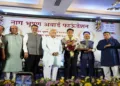
Mumbai/Nashik: The venue was the Sahyadri Guest House in the state capital. The occasion was the unveiling of the Nashik–Trimbakeshwar Simhastha Kumbh Mela logo at the hands of the three leaders of the MahaYuti alliance in Maharashtra – Chief Minister Devendra Fadnavis, Deputy CM Eknath Shinde and Deputy CM Sunetra Ajit Pawar.
https://twitter.com/CMOMaharashtra/status/2054471064231751728/photo/1
The event signalled the formal beginning of preparations for one of Sanatan Hinduism’s most significant gatherings – the Simhastha Kumbh Mela at Nashik.
🔸Unveiling of the Logo of 'Nashik-Trimbakeshwar Simhastha Kumbh Mela' at the hands of CM Devendra Fadnavis, DCM Eknath Shinde and DCM Sunetra Ajit Pawar.
Minister Girish Mahajan, Minister ShivendraSinh Raje Bhonsle, Minister Dadaji Bhuse, Minister Uday Samant, Minister Chhagan… pic.twitter.com/kwkuMwbuRo— CMO Maharashtra (@CMOMaharashtra) May 13, 2026
The emblem brings together elements that define Nashik’s spiritual identity. The temple form invokes the great Jyotirlinga at the Mahadeva Mandir at Trimbakeshwar, the Trishul trident reflects the Shaivite tradition, and the flowing lines evoke the Godavari, the river around which ritual purification and pilgrimage revolve.
The logo is not simply a design. It is a visual condensation of faith, geography, and continuity, presenting the Kumbh as a shared cultural and spiritual experience.
This moment of institutional articulation follows closely on the heels of a deeply symbolic religious event that unfolded at Nashik’s Kalaram Temple.
The Dharmadhwaj and the Ritual Beginning
The hoisting of the dharmadhwaj at Kalaram Temple, attended by former President Ram Nath Kovind and Chief Minister Devendra Fadnavis, was described as the religious beginning of the 2027 Simhastha Kumbh.
Dharma Dhwaja Hoisted at Shree Kalaram Mandir: A Divine Commencement of Preparations for Simhastha Kumbh 2027
It was an honour to hoist the historic Dharma Dhwaja at Shree Kalaram Mandir along with former President of India Hon. Ram Nath Kovind ji and Koshadhyaksh of the Shri… https://t.co/XIz15vJjZO pic.twitter.com/33JMrbYe6T
— Devendra Fadnavis (@Dev_Fadnavis) May 6, 2026
Vedic chants, the presence of saints and mahants, and participation across sections of society gave the ceremony both ritual depth and public significance. The event was presented not only as a revival of tradition but also as a statement of collective identity, with sections of the media framing Nashik as an emerging spiritual centre of national importance.
Yet the Kala Ram Temple is not merely a site of celebration. It is also a place marked by one of the most important social justice movements in modern India.
Remembering the 1930s and the Kalaram Mandir Satyagraha
In 1930, scholar, social reformer, and leader of the masses Dr BR Ambedkar led the Kalaram Temple Entry Satyagraha, demanding that Dalits be granted access to Hindu places of worship.
(Embed the photo of Ambedkar at Kalaram Mandir Satyagrah)
The movement challenged entrenched caste barriers and forced a wider social introspection. It was not only about entering a temple but about asserting dignity and equality within a religious framework that had excluded large sections of society.
The agitation marked a decisive moment in the struggle against untouchability and highlighted the contradictions within a civilisation that spoke of unity while practising exclusion.
Reform and the Idea of Social Cohesion
Alongside Ambedkar’s mobilisation, there were reformist efforts within Hindu society that sought to address caste divisions. Vinayak Damodar Savarkar advocated temple entry for all castes and promoted sahabhojan, or inter dining, as a means to break social barriers. BS Moonje also supported the idea that internal reform was necessary to strengthen society.
It is within this wider context that the Rashtriya Swayamsevak Sangh (RSS) developed its own approach to social cohesion.
The Sangh and the Practice of Samajik Samrasta
The origins of the RSS or the Sangh’s social vision lie in the thinking of its founder Dr KB Hedgewar. A doctor trained in Calcutta and influenced by revolutionary politics, Hedgewar believed that India’s subjugation was rooted in the fragmentation of its society. The colonial powers had misused the natural fracture lines within Sanatan Bharatiya society to divide and rule. The divisions of caste, region, and language, in his view, weakened collective strength.
The RSS was conceived as a space where these divisions could be addressed through lived practice. The daily shakha brought together individuals from different backgrounds to train, interact, and share experiences. Eating together and participating in collective activities became a means of dissolving social barriers. Reform was approached not through abstract declarations but through everyday discipline and interaction.
This approach was observed even by Mahatma Gandhi during his visit to an RSS camp in Wardha in 1934, where he noted the absence of caste distinctions in communal living.
Dr. BR Ambedkar had a similar happy experience of epiphany. During his visit to the RSS training camp (Sangh Shiksha Varga) in Pune in May 1939, he expressed surprise and satisfaction at the absence of caste discrimination, noting that volunteers were moving and eating together in absolute equality and brotherhood without knowing each other’s castes. He asked RSS founder Dr. KB Hedgewar about the number of “untouchables” among the volunteers, to which he was informed that in the camp, there were only Hindus, not touchables or untouchables.
Leadership and the Deepening of Reform
Successive leaders of the Sangh expanded this emphasis on social unity. Guruji or Shri MS Golwalkar focused on maintaining cohesion during the turbulent years of Partition. The Udupi conference of 1969 brought together religious leaders across sects and castes and called for the eradication of caste discrimination.
MD Deoras addressed the issue more directly. He described untouchability as a grave error that must be eliminated without compromise and rejected the idea that inherited practices should be preserved simply because they were traditional. His efforts led to the creation of the Samajik Samrasta Manch in 1983, institutionalising outreach and dialogue on social equality.
In the present, Shri Mohan Bhagwat (the current and sixth Sarsanghchalak or the Chief of the Sangh), continues to emphasise that an egalitarian society cannot be achieved without addressing caste based discrimination.
Expanding the Discourse
The Sangh’s engagement with social harmony has also extended into intellectual and political domains. Thinkers such as Dattopant Thengadi, KN Govindacharya, and Deendayal Upadhyaya contributed ideas that linked social cohesion with labour, governance, and philosophical frameworks like Integral Humanism and ‘antyodaya’.
These contributions reflect an attempt to situate social harmony not only within ritual life but also within broader national development.
From Temple Entry to Collective Participation
The events unfolding in Nashik today can be seen against this longer historical background. A temple that once stood at the centre of a struggle for access now hosts ceremonies that emphasise participation across society. The presence of Ram Nath Kovind, India’s second Dalit President after KR Narayanan, at the Dharmadhwaj ceremony adds a contemporary layer to this continuity.
The Kumbh Mela itself represents a collective expression of faith where distinctions of caste and region are expected to recede in the face of shared ritual. In this sense, it serves as a space where the idea of social unity is not only articulated but also performed.
From Dharmadhwaj to the Kumbh Logo
The sequence of events in Nashik reflects a progression from ritual to representation. The dharmadhwaj marks the religious beginning, while the Bodhchinha or the logo translates that momentum into a form that can be communicated and institutionalised. Together, they signal an effort to position Nashik as both a sacred geography and a symbol of collective identity.
A Continuing Narrative
The journey from the Kalaram Satyagraha of 1930 to the present moment is marked by struggle, reform, and reinterpretation. It reflects ongoing attempts to reconcile tradition with equality and to imagine a society that is both rooted and inclusive.
The unveiling of the Kumbh logo, seen in this context, is not an isolated event. It is part of a continuing narrative that seeks to present the Kumbh as a space where faith and social cohesion converge, and where the aspiration for unity remains central to the idea of a shared civilisational identity.
When is the Nashik-Trimbakeshwar Simhastha Kumbh Mela?
The Nashik-Trimbakeshwar Simhastha is held once in 12 years. The exact dates are determined according to a combination of alignment of stars and planets: the mela may be held when Jupiter is in Leo (Simha in Hindu astrology); or when Jupiter, Sun and Moon are in Cancer on lunar conjunction (Amavasya). The last fair was held in 2015; the next one will be held in 2027.
While the official Akhada council will finalize the exact muhurtas closer to the event, the primary Shahi Snan (Royal Bath) dates for the Nashik-Trimbakeshwar Simhastha Kumbh Mela are expected to fall in August and September 2027, coinciding with the Parvani days at Ram Kund in Nashik and Kushavarta Kund in Trimbakeshwar.