
The world has been in chaos since the conflict began, and the situation has exacerbated as a result of the blocking of the Straight of Hormuz, which has caused supply chain problems. This has resulted in a reduction in the supply of petroleum products and key commodities, affecting the entire planet. The situation in many countries has deteriorated due to a scarcity of petrol, diesel fuel, and fertilisers, which affects the general population as well as commerce and industry. The prices of petroleum goods and essential commodities have risen dramatically, putting pressure on the general populace and the government. Though the Bhartiya government is managing the crisis far better than the industrialised economies, we must consider and act to avoid a similar disaster.
Why foreign exchange reserve is significant?
A foreign exchange reserve is essential for any nation. It benefits the nation in a variety of ways. It aids the nation’s ability to conduct international trade because international trade necessitates the use of dominant currencies such as the USD. Additionally, it contributes to the stability of the local currency, in our case, rupees. The RBI monitors the value of the Bhartiya rupee, and if it falls, it sells some dollars to keep the currency stable. International loans are typically made in currencies such as the US dollar or the Euro, and must be repaid in the same currency. As a result, the foreign exchange reserve is critical, or international agencies may declare the nation to be in default. If the nation has economic turmoil or the world is in recession, the foreign exchange reserve serves as a buffer, keeping the country running and maintaining its reputation on the international stage. Investors are more inclined to invest in countries with bigger foreign exchange reserves because it provides them confidence that their money will be returned in the same currency in which they invested. In a nutshell, the foreign exchange reserve serves as a foundation for economic stability as well as a source of liquidity during difficult times.
Bharat, a nation of 1.4 billion people, is particularly susceptible to sudden spikes in the price of oil since decisions made by nations half a world away quickly affect fuel stations, the bottom lines of its farmers and truckers, and its cost-of-living indices. Even though over 85% of the nation’s crude is now imported, refineries are continuously working to refine crude oil in the background.
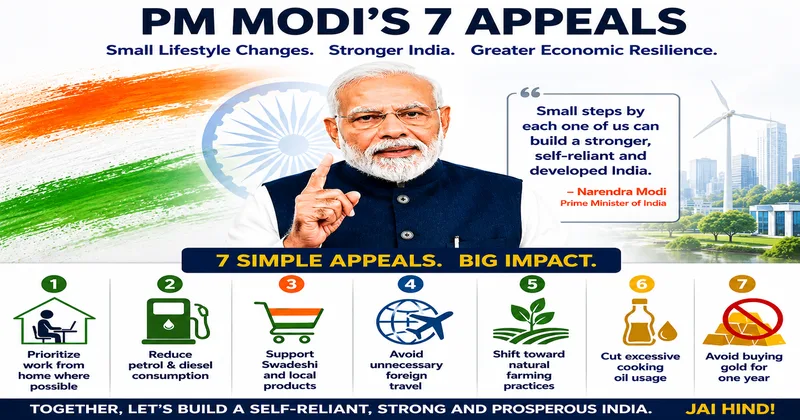
7 Points on Which Prime Minister Modi Requested Restraint
1. Reduce fuel consumption
When global oil prices jump, Bharat feels it quickly. Import bills soar, refinery margins tighten, and the currency weakens. The FY 2024-25 crude import bill touched roughly USD 137 billion, a figure that influences inflation and logistics costs across industries. Analyse how much pressure is placed on foreign currency reserves. To save fuel, we should use public transport such as the metro, trains, buses, or carpooling.
For everyday citizens, this means higher transport fares and commodity prices. For refineries, it means constant attention to crude selection, process efficiency, and maintenance reliability areas where engineering plays a direct role in cost control.
For a huge nation like Bharat, the long-term strategy for energy supply must be built on indigenous resources and require the deployment of an optimal balance of different energy sources. Aside from the environmental difficulties involved with large-scale coal consumption, it is important to highlight that coal deposits are limited. Solar and other non-conventional renewable energy sources play a vital role and should be utilized to the greatest extent possible. The objective is to lessen the risks associated with excessive reliance on oil, not to completely stop using it. One step at a time, Bharat is constructing a more resilient and independent energy future by combining smart imports with cleaner energy bets.
2. Gold
Bharat purchases more gold than nearly any other country in the world. Every year, the country uses between 700 and 800 tonnes of gold, driven by high demand from homes, weddings, festivals, investment purchases, and rural savings. However, with domestic output restricted to 1 to 2 tonnes per year, Bharat continues to rely on imports for more than 90% of its gold requirements. In 2025, Bharat imported about 72 billion dollars in gold, putting a strain on the foreign exchange reserves. Can we forgo buying gold for a year, as Prime Minister Modi has proposed?
3. Fertilisers
In 2025, we imported about $15 billion worth of fertiliser. It affects not only the foreign reserves, but also the environment and farmers, so we must transition to Bharatiya farming, which is both financially necessary and beneficial to the ecology and living creatures.
4. Edible oil
In 2025, we imported about $19 billion in edible oil. PM requested a 10% cut, which would be beneficial even for health.
5. Foreign travel
In 2025, 3.27 crore Bharatiyas visited overseas, spending 15 to 16 billion USD. Another strain on foreign reserves, which lead to travel within our own country, which has beautiful destinations, cultural heritage sites, and natural attractions. The destination wedding should only take place in Bharat.
6. Work from home
Another method to cut fuel use is to resume the ‘work from home’ practice that we adopted during the corona pandemic. Virtual meetings and videoconferencing have previously been created. I hope that the industry take the Prime Minister’s call seriously.
7. Why is self-reliance in Bharat necessary for growth?
Let us clarify things on a larger scale. For a long time, we were economically and socially decimated by the Mughals, followed by the British. Even after gaining independence, we were misled into believing that we couldn’t compete with China and other wealthy countries in the manufacturing and service sectors. We gradually became addicted to Chinese products; just look around our home to see how many commodities are made in China; we even began purchasing idols and worshipping material, a form of mental slavery and dependence on China for our survival and other needs, a country that has always betrayed us, supporting our enemy nation Pakistan and its terrorists in their attempts to kill our civilians and soldiers. China fosters and promotes naxalism in India. Never supported Bharat on a global scale, but instead opposed and participated in terrorising our people. They never consider regions of the Northeast and Kashmir to be part of Bharat. Nonetheless, the regulations and institutions established by our previous governments produced tough situations and actually mental anguish for anyone wishing to start a manufacturing or service sector, keeping our economy significantly weaker than China’s. Thanks to the tenacity and determination of our pioneers such as Tata, Ambani, Adani, Mahindra, and many more, who instilled pride and faith in Bharatiya about our capabilities even under tough circumstances.
The situation is changing, and more of these products are being encouraged to be produced in-house and promoted with strong emotional linkages to “Make in India” products. People’s patriotic feelings and pride in Bharatatva have increased, as has their resentment toward adversary nations China and Pakistan. The better the bond between buyer and seller of Bharatiya-made products, the stronger the economy will be year after year, resulting in more jobs. This will essentially make us net exporters. The changing global dynamics will see Bharat play a larger role on the economic front in the coming years, in addition to spiritual and holistic growth oriented approaches for the benefit of all and balancing and nurturing the environment. The current government’s pro-business policies, as well as skilled and knowledgeable workforce, will strengthen each sector and propel the economy to new heights in order to compete with China. Simultaneously, Prime Minister Narendra Modi launched the “Aatmanirbhar Bharat” (Self-Reliant India) program by announcing “Vocal for Local.” We are now heading in the correct path toward India’s self-sufficiency by assisting in the in-house manufacturing of various products.
Though our journey to self-reliance in Bharat is bearing fruit thanks to remarkable measures by the central government and a few states, resulting in increased exports, expanding manufacturing, and service activities, we still have a larger market internally and a larger worldwide market awaits us. Central government initiatives require the backing of all states, bureaucracy, enterprises, industrialists, researchers, scientists, and society as a whole.
Working on these topics will assist preserve the environment and prevent damage
Bharat, one of the world’s fastest growing economies, is at a crossroads. On the one hand, there is an urgent need for economic growth, as millions of people rely on development to improve their level of living. On the other hand, there is a pressing need to address environmental issues like pollution, climate change, and resource depletion. Environmental issues in India are escalating at an alarming pace. The environmental issues are profound and extensive, ranging from suffocating urban air pollution to widespread water contamination and increased soil erosion.
These challenges not only imperil millions of Bharatiyas health and livelihoods, but they also impede long-term development and economic growth. They exacerbate income and social inequality, causing people to relocate from rural areas to cities at a rapid pace. This exacerbates challenges in cities that lack the necessary infrastructure to accommodate growth. Bharat has very high greenhouse gas emissions and is vulnerable to natural calamities and extreme weather events. Its population and economic growth both contributed to environmental degradation. The various governments, society at large, and citizens should take more decisive action to address environmental challenges.