Uttar Pradesh has a peculiar and painful political history. In the 75 years since Independence, it has had more than 20 Chief Ministers. Most served incomplete terms because they were victims of coalition collapses, President’s Rule, defections and the sheer volatility of a political ecosystem shaped by caste arithmetic, communal polarisation, and the ambitions of national parties for whom UP is the ultimate prize. A Chief Minister who completes one full term in UP is the exception. A Chief Minister who completes two consecutive terms back to back, with a fresh electoral mandate has been essentially unknown in the modern era.
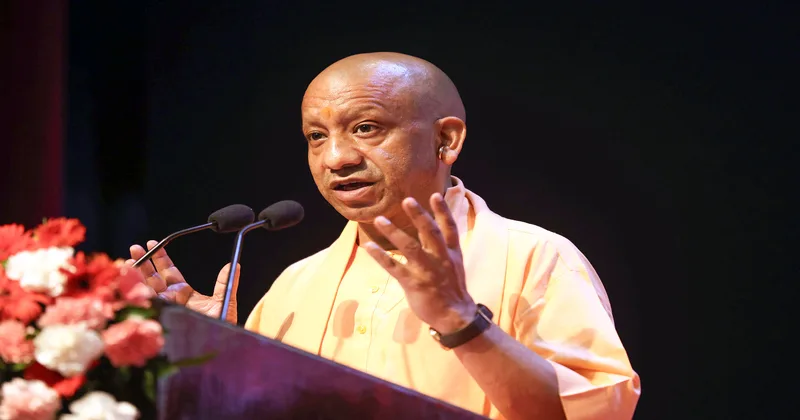
That is the threshold Yogi Adityanath is now crossing. It is not only a political milestone. It is a civilisational statement about what becomes possible when governance is grounded in clarity of purpose, consistency of delivery and the trust of the people. This final article in four-part series draws together the threads of law and order, infrastructure, cultural revival and welfare to ask the defining question what does this two-term legacy means for UP, for the BJP and for Bharat?
Why Two Terms Matter
To appreciate the success of Yogi Adityanath achievement, one must understand how rare political stability has been in Uttar Pradesh. Between 2002 and 2017 alone, UP had four Chief Ministers from three different parties Mayawati (BSP), Mulayam Singh Yadav (SP) and then Akhilesh Yadav (SP). Each came to power with promises, each left without having structurally transformed the state. The reasons were always the same coalition compulsions, caste patronage network that distorted governance, law and order failures that eroded public trust. An administrative machinery too captured by political interests to function efficiently.
Akhilesh Yadav’s single term from 2012 to 2017 was a case study in this pattern. Despite genuine energy and some real achievements, the SP government was unable to escape the structural constraints of its own political coalition. The Muzaffarnagar riots of 2013, the mafia patronage networks, the welfare delivery failures and the perception of community-based discrimination all conspired to produce the historic change in 2017, when SP was reduced to 47 seats in a 403-seat assembly.
What Yogi Adityanath has done is fundamentally different. He has governed without the constraints of coalition with a legislative majority so large that it removed, for the first time in UP politics. He has used that majority not to consolidate patronage but to restructure the state through its law enforcement, its economic infrastructure, its cultural identity and its welfare delivery architecture. The 2022 re-election in which BJP won 255 seats despite eight years in power and the natural weight of anti-incumbency was the electorate verdict on that restructuring.
One Term vs. Two: The Definitive Comparison
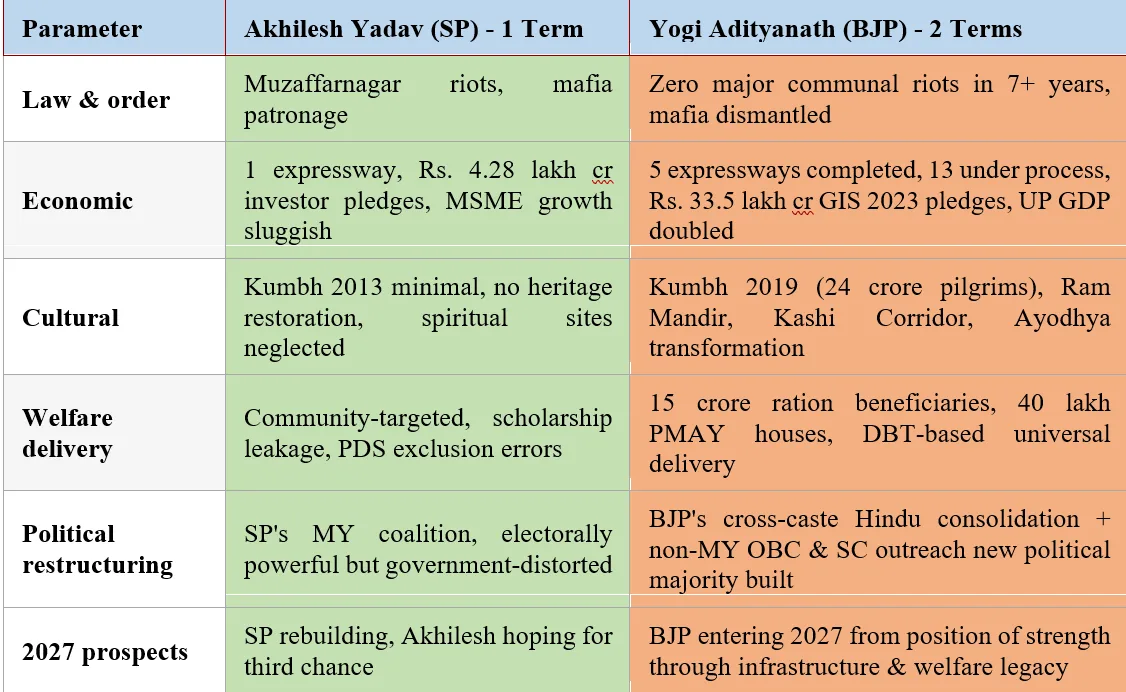
When we compare Akhilesh Yadav’s single term with Yogi Adityanath’s two terms, the contrast is not simply quantitative it is qualitative. Akhilesh’s tenure was characterised by reactive governance were reacting to coalition pressures, communal tensions, investor scepticism. Yogi’s tenure has been characterised by proactive state-building setting the agenda, forcing the pace, and refusing to be diverted by political opposition or media criticism.
Consider the electoral arithmetic alone. Akhilesh won in 2012 with 224 seats on 29.3% of the vote a strong majority built on the MY coalition. By 2017, that coalition had collapsed under the weight of governance failures and SP lost. Yogi won in 2017 with a record 325 seats and then retained power in 2022 with 255 seats the first time in UP’s post-Independence history that a sitting government of the same party won back-to-back elections with a clear majority. This is not just a statistic it is a transformation of UP’s political culture.
The policy contrast is equally stark. In law and order where Akhilesh could not contain either mafia power or communal riots, Yogi has recorded over seven consecutive years without a major riot and has dismantled criminal empires that had operated for three decades. In infrastructure, where Akhilesh built one expressway, Yogi has inaugurated 5, 13 are to be developed, has transformed UP’s airport network. In cultural governance where Akhilesh left Ayodhya underdeveloped and Kashi neglected, Yogi has delivered the Ram Mandir consecration with central government and the Kashi Vishwanath Corridor civilisational achievements that will outlast any government.
The New Political Architecture: A Majority Beyond the MY Formula
Perhaps the most consequential political legacy of Yogi Adityanath’s two terms is the construction of a new governing majority in UP. For decades UP politics was structured around a simple equation whichever party could lock up the Muslim vote in combination with a large OBC caste group Yadavs for SP, Jatavs for BSP could form government. This equation produced unstable, patronage-driven governance because its logic demanded that the governing party serve its coalition base above all others.
Yogi Adityanath has broken this equation. By delivering governance that demonstrably reached every community through DBT-based welfare, religion-neutral policing, universal ration distribution and infrastructure. It has connected Purvanchal’s most backward districts to the national economy, BJP has assembled a cross-caste Hindu consolidation supplemented by significant support from non-Yadav OBCs, non-Jatav SCs and even segments of communities that had historically voted against it. The 2022 election results confirmed this new coalition BJP won seats across virtually every region of UP, including many that had never returned a BJP MLA in living memory.
This is Yogi Adityanath most durable political legacy. By demonstrating that UP can be governed without community-based patronage that a government committed to Sabka Saath, Sabka Vikas can build both a majority and a state he has shifted the burden of proof onto every future claimant to UP chief ministership. Any future government will now be measured against the standard of universal delivery that the Yogi era has established.
Looking to 2027: The Road Ahead
As Yogi Adityanath approaches the completion of his second term, the question of 2027 is inevitable. The Samajwadi Party, under Akhilesh Yadav has been working to rebuild its coalition reaching out to smaller OBC groups, strengthening its PDA (Pichhda, Dalit, Alpsankhyak) formulation and framing the next election as a contest between social justice and majoritarian governance. It is a credible political strategy and UP’s sheer demographic complexity ensures that no outcome is predetermined.
But BJP enters 2027 from a position of unprecedented structural strength. The infrastructure legacy expressways, airports, metro networks, the Defence Corridor is physical and irreversible. The cultural legacy such as Ram Mandir, Kashi Corridor, Ayodhya’s transformation resonates at a civilisational frequency that transcends electoral cycles. The welfare legacy of 15 crore ration beneficiaries, 40 lakh PMAY homes, universal DBT has created a direct relationship between citizen and state that bypasses the patronage intermediaries on whom opposition parties have historically depended.
Most significantly, Yogi Adityanath himself enters 2027 with a national stature that no previous UP Chief Minister has enjoyed. Whatever the verdict of 2027, the Yogi era will have permanently raised the bar of what UP’s citizens expect from their government.
The National Significance: UP as the key centre of Hindu Governance
Uttar Pradesh has always mattered disproportionately to Indian national politics. With 80 Lok Sabha constituencies, it is the single largest determinant of parliamentary majorities. But beyond electoral arithmetic, UP matters because it is where the civilisational questions of modern India about identity, the relationship between state and religion, the politics of caste and community are most visibly contested.
The Yogi Adityanath experiment has been, in a very real sense a case for a new model of governance: one that unapologetically embraces Hindu cultural identity while delivering universal welfare, one that asserts civilisational pride while building modern infrastructure, one that rejects communal appeasement while maintaining law and order for every community. Whether one calls it the Hindutva model of governance or the development plus identity model, it has demonstrably worked in the world’s most complex state.
The success of the Yogi model has demonstrated that a government need not choose between cultural assertion and developmental delivery that, on the contrary, these are mutually reinforcing. The Ram Mandir draws pilgrims who generate revenue, the expressways connect those pilgrims to the temple, the law-and-order environment makes the journey safe. The DBT system ensures that the economic benefits of the pilgrimage economy reach the local population. This is integrated governance and it is the model that the BJP is studying for replication across India.
A Tradition in the Making
The governance has replaced politics as the primary activity of the UP government. It means that delivery has replaced patronage as the currency of political legitimacy. It means that UP for the first time in a generation has a Chief Minister whose legacy is measured not in electoral coalitions assembled but in lives tangibly improved. With the farmer in Bijnor who has 24-hour electricity, the woman in Gorakhpur who has a pucca house and a bank account, the artisan in Varanasi whose chikankari now reaches customers in Tokyo and New York, the devotee in Ayodhya who can offer prayers at the Ram Mandir that generations before her could only dream of.
Akhilesh Yadav had a term. He had ambition, intelligence and a genuine vision for a modern UP. But the structural constraints of his political inheritance prevented that vision from being realised.
Yogi Adityanath has had two terms and has used both to build not just a record, but a tradition. A tradition of accountability. A tradition of universal delivery. A tradition of governance rooted in civilisational confidence. That tradition, once established, is the most durable legacy any Chief Minister can leave. Uttar Pradesh has finally found its stability. And in that stability, it has found its future.