West Asia Conflict: War from a soldier's perspective
August 10, 2026
  • Read Ecopy
  • Circulation
  • Advertise
  • Careers
  • About Us
  • Contact Us
Android AppiPhone AppArattai
Organiser
  • ‌
  • Bharat
    • Assam
    • Bihar
    • Chhattisgarh
    • Jharkhand
    • Maharashtra
    • View All States
  • World
    • Asia
    • Europe
    • North America
    • South America
    • Africa
    • Australia
  • Editorial
  • International
  • Opinion
  • RSS @ 100
  • More
    • Op Sindoor
    • Analysis
    • Sports
    • Defence
    • Politics
    • Business
    • Economy
    • Culture
    • Special Report
    • Sci & Tech
    • Entertainment
    • G20
    • Azadi Ka Amrit Mahotsav
    • Vocal4Local
    • Web Stories
    • Education
    • Employment
    • Books
    • Interviews
    • Travel
    • Law
    • Health
    • Obituary
  • Subscribe
    • Subscribe Print Edition
    • Subscribe Ecopy
    • Read Ecopy
  • ‌
  • Bharat
    • Assam
    • Bihar
    • Chhattisgarh
    • Jharkhand
    • Maharashtra
    • View All States
  • World
    • Asia
    • Europe
    • North America
    • South America
    • Africa
    • Australia
  • Editorial
  • International
  • Opinion
  • RSS @ 100
  • More
    • Op Sindoor
    • Analysis
    • Sports
    • Defence
    • Politics
    • Business
    • Economy
    • Culture
    • Special Report
    • Sci & Tech
    • Entertainment
    • G20
    • Azadi Ka Amrit Mahotsav
    • Vocal4Local
    • Web Stories
    • Education
    • Employment
    • Books
    • Interviews
    • Travel
    • Law
    • Health
    • Obituary
  • Subscribe
    • Subscribe Print Edition
    • Subscribe Ecopy
    • Read Ecopy
Organiser
  • Home
  • Bharat
  • World
  • Operation Sindoor
  • Editorial
  • Analysis
  • Opinion
  • Culture
  • Defence
  • International Edition
  • RSS @ 100
  • Magazine
  • Read Ecopy
Home Bharat

West Asia Conflict: War from a soldier’s perspective

The escalating tensions between Iran, the United States, and Israel are more than a regional crisis. This conflict has also created an impact on Bharat, which needs urgent strategic lessons

Maj Paramjeet SinghMaj Paramjeet Singh
May 19, 2026, 10:30 pm IST
inBharat, Opinion
Follow on Google News
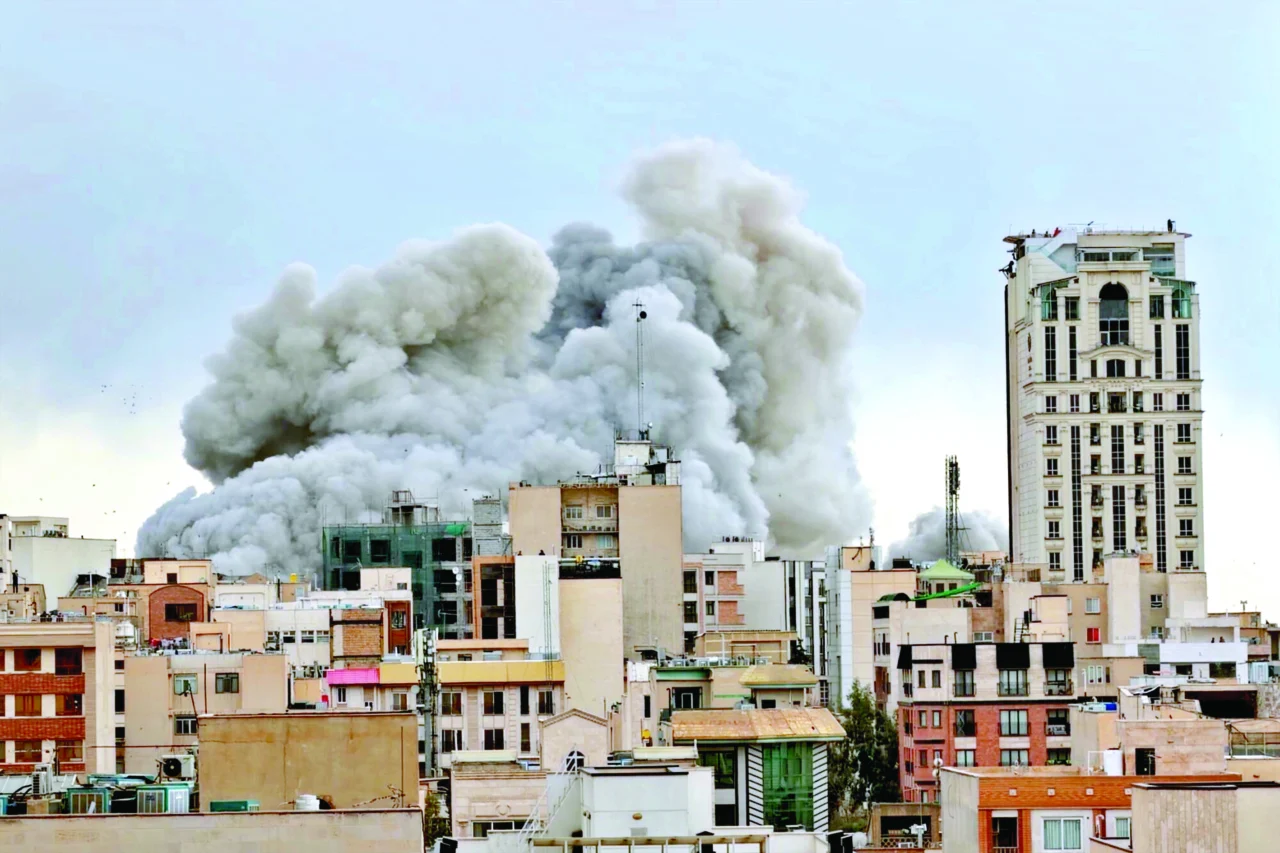
A plume of smoke rises after a strike in Tehran

A plume of smoke rises after a strike in Tehran

Facebook
Twitter
WhatsAppTelegramEmail

The recent mess involving Iran, the United States, and Israel is not just another boring story in a history book about the Middle East. It is a real-life lesson in how war is changing right now. For a country like Bharat—stuck with a neighbourhood that is toxic on one side and a giant on the other—this conflict gives us some hard-earned lessons which cannot be ignored.

If you look at Iran’s military on paper, it looks weird. Their air force is basically a collection of old, rusty planes held together by sheer grit. Their navy cannot even dream of beating a US carrier group in a straight fight. Their economy has been choked by sanctions for longer than most of their soldiers have been alive. But any infantryman will tell you: you do not win wars with fancy parades or shiny boots. You win by being prepared, knowing exactly what you want to do, and most importantly, having the guts to take a beating without breaking.

Iran has built its whole military strategy around one thing: surviving a total attack. The West likes “top-down” command, where everything comes from the big boss. Iran does the opposite. They use something we call “mosaic defense.” In plain soldier talk, this means the body is built to keep fighting even if you cut off the head.

If the leaders in Tehran are killed, or if a cyber-attack fries their phones, the local commanders on the ground do not just sit around waiting for orders. They already know their jobs and have the power to just go do them. This is not just theory. It is exactly what we did during counter-insurgency work in the Valley. You could take out a top terrorist leader, but the group would not stop because the small “cells” were made to run themselves. Iran has taken that small-scale logic and applied it to a whole country. Even after being hit hard, they kept launching drones. Their war machine does not have one big “off switch.” It has a thousand tiny switches spread across a rough landscape.

20-Year Mindset vs. 20-Day Plan

One of the biggest lies in modern military thinking is that a war starts when the first shot is fired. That is wrong. The war was won or lost ten years ago in the factories and the bunkers. Iran started preparing the moment they saw the US invade Iraq and Afghanistan. They were not just watching, they were taking notes. They saw the “Shock and Awe” and realised they could never win a “fair” conventional fight. So, they spent twenty years building a backup plan.

They focused on things Bharat needs to look at very closely. First, the Underground Fortress. They did not just build regular bases; they dug “missile cities” hundreds of meters under solid rock. Today, missiles can hit a tiny window from a thousand miles away, so the only real way to hide is to go deep. It makes it incredibly slow and expensive for an enemy to  actually stop them.

Then, there is the Logic of Mass. Iran built drones and missiles that are “cheap” and “simple” compared to Western stuff. But they built thousands of them. In a big fight, quantity matters more than quality. If you throw fifty drones that cost $20,000 each at a billion-dollar ship, eventually, the math wins. You do not need the fanciest weapon; you just need enough to make the enemy run out of ammunition. Finally, they used a Proxy Shield. By making friends with armed groups all over the region, Iran moved the “front line” far away from its own borders. This forces the enemy to fight in five different places at once, which wastes their time and energy.

The Economic Chokehold

Iran’s smartest move was using geography as a weapon. The Strait of Hormuz is a tiny, cramped waterway. Most of the world’s oil goes through it. Iran knows it cannot beat the US Navy in a big sea battle, but it does not need to. Just by having the power to mess with shipping using mines or fast boats, it holds the whole world’s economy hostage. Just a rumour that they might close the strait makes oil prices go crazy.

This is the ultimate sneaky strategy. You don’t hit the enemy’s teeth; you hit his stomach. Back when I was in uniform, we talked about “multi-domain” war. We’re seeing it now. The battlefield is not just a patch of dirt; it’s the stock market, the internet, and the price of gas.

Don’t get me wrong: the US and Israel are incredibly good at what they do. They are the gold standard. But even the sharpest knife cannot cut through smoke. From a soldier’s view, the big powers struggled because they made bad guesses. They think technology can replace patience.

First, they relied too much on “surgical strikes.” Air power is great, but it does not win a war against an enemy who is ready to suffer and keep going. If the enemy is buried under a mountain, a perfect strike is just a temporary annoyance. Second, they misunderstood depth. Iran is not just a country; it is a whole network. You cannot just fight them in one spot. It spreads to Lebanon, Yemen, and Iraq. Lastly, they expected a short war. Today, quick wins are rare. Iran prepared for a marathon, while their enemies were looking for a sprint. When the “knockout punch” does not work, the guy who can take the most pain wins.

We have to realise that our economy is our national security. Our growth depends on the sea. The Indian Ocean is our backyard. We have to treat our ports and internet cables like the “front lines.” Security is not just about the Line of Control (LoC) anymore; it is about the power grid and the internet. We need cheap, high-impact tech. Drones and cyber-warfare are the “great equalisers.” Iran proved that a low-budget force can stall a superpower if they get creative.

I remember an exercise years ago where our radios were jammed. The young officers were lost, just waiting for someone to tell them what to do. My CO, a man of very few words, looked at us and said: “Intent samajh lo, orders ki zarurat nahi padegi.” (Understand the intent, and you won’t need orders.)

That is the heart of a tough military. We need a culture where even the lowest-ranking soldier knows the “Commander’s Intent” so well that they can keep fighting all alone. The big lesson from the Iran mess is simple: You do not have to be the strongest to avoid losing. You just have to be the hardest to break. n
Topics: Economic ChokeholdIran’s military on paperand IsraelUnited StatesNational SecurityLine of ControlSurgical StrikesWest Asia Conflict
Share
Tweet
SendShareSend
✮ Subscribe Organiser YouTube Channel. ✮
✮ Join Organiser's WhatsApp channel for Nationalist views beyond the news. ✮
Previous News

Telangana: Police reports 17 X accounts over alleged communal narratives linked to cargo truck incident in Mehdipatnam

Next News

ABVP Tamil Nadu submits 16-point memorandum to CM Joseph Vijay on education reforms

Related News

FCRA Amendment Bill 2026: Strengthening accountability, Protecting assets and safeguarding India’s national interests

Helicopter crashes while fighting Utah wildfire; 2 firefighters onboard dead

Utah wildfire kills 2 firefighters in helicopter crash; Catastrophic firestorm ravages 8,000sq miles across US

PoJK: The call for unfinished justice and India’s unwavering resolve to secure sovereignty

US President Donald Trump and Fed Governor Lisa Cook

US President Trump Reopens Fed Fight: Governor Lisa Cook faces fresh removal threat over mortgage fraud allegations

India's FCRA, US FARA and China's Foreign NGO Law reflect different legal approaches to foreign funding, united by a common emphasis on transparency and national security

Foreign Funding and Transparency: How India’s FCRA, US FARA and China’s Foreign NGO Law prioritise national security?

The Amritsar arrests expose a troubling new face of proxy warfare, low-cost, digitally recruited and built around vulnerable young recruits (AI generated image)

Amritsar Arrests Expose the New Face of Proxy War: Petrol bombs, online handlers & vulnerable teen recruits

Load More

Latest News

(Left) RSS Sarsanghchalak Dr Mohan Bhagwat (Right) RSS Sarkaryavah Dattatreya Hosabale

RSS Akhil Bharatiya Samanvay Baithak to be held in Visakhapatnam from August 19–21, 2026

US President Donald Trump seals executive order restricting birthright citizenship

Trump Restricts Birthright Citizenship: US constitution & SC rulings vs President’s protectionism amid fierce backlash

Kerala's Left-Liberals Manufactured 'Rape Call' Lie Against TG Mohandas: What He Actually Said About CJP NEET Protest?

Kerala’s Left-Liberals Manufactured ‘Rape Call’ Lie Against TG Mohandas: What He Actually Said About CJP NEET Protest

Two decades after Mamata Banerjee drove Tata out of Singur, Bengal is now seeking the industrial giant's return. (AI-generated Image)

From ‘Tata go back’ to ‘Tata come back’: Bengal begins undoing Mamata’s Singur disaster

T G Mohandas

Keralam’s Witch Hunt Against TG Mohandas? Weekend arrest, media drama & Congress’ political spectacle

Ex-JPSC Chairman L Khiangte arrested as students intensify protest

JPSC-JSSC Exam Row: Ex-JPSC Chairman L Khiangte arrested as students intensify protest

Former MP Shahid Siddiqui

RSS School Controversy: Shahid Siddiqui faces backlash over claims that Northeast girls are trained to hate minorities

Shivakumar GV (Left) tears into Shama Mohamed (Right) over Gayatri Mantra remark

IIT Delhi Row: Shivakumar GV tears into Shama Mohamed over Gayatri Mantra remark, says ‘Bharat’s wisdom beyond chants’

OM Modi with the winning contingent of the Commonwealth Games team

‘You have not just increased medals, you have prepared a generation’: Modi to CWG 2026 medallists

More than 20,000 evacuated from British Columbia; PM Carney extends relief support

Canada Wildfire: 20,000 evacuated from British Columbia; PM Carney assures relief support as properties damaged

Load More
  • Privacy
  • Terms
  • Cookie Policy
  • Refund and Cancellation
  • Delivery and Shipping

© Bharat Prakashan (Delhi) Limited.
Tech-enabled by Ananthapuri Technologies

  • Home
  • Search Organiser
  • Bharat
    • Assam
    • Bihar
    • Chhattisgarh
    • Jharkhand
    • Maharashtra
    • View All States
  • World
    • Asia
    • Africa
    • North America
    • South America
    • Europe
    • Australia
  • Editorial
  • Operation Sindoor
  • Opinion
  • Analysis
  • Defence
  • Culture
  • Sports
  • Business
  • RSS @ 100
  • Entertainment
  • More ..
    • Sci & Tech
    • Vocal4Local
    • Special Report
    • Education
    • Employment
    • Books
    • Interviews
    • Travel
    • Health
    • Politics
    • Law
    • Economy
    • Obituary
  • Subscribe Magazine
  • Read Ecopy
  • Advertise
  • Circulation
  • Careers
  • About Us
  • Contact Us
  • Policies & Terms
    • Privacy Policy
    • Cookie Policy
    • Refund and Cancellation
    • Terms of Use

© Bharat Prakashan (Delhi) Limited.
Tech-enabled by Ananthapuri Technologies