West Asia Conflict: War from a soldier's perspective
June 10, 2026
  • Read Ecopy
  • Circulation
  • Advertise
  • Careers
  • About Us
  • Contact Us
Android AppiPhone AppArattai
Organiser
  • ‌
  • Bharat
    • Assam
    • Bihar
    • Chhattisgarh
    • Jharkhand
    • Maharashtra
    • View All States
  • World
    • Asia
    • Europe
    • North America
    • South America
    • Africa
    • Australia
  • Editorial
  • International
  • Opinion
  • RSS @ 100
  • More
    • Op Sindoor
    • Analysis
    • Sports
    • Defence
    • Politics
    • Business
    • Economy
    • Culture
    • Special Report
    • Sci & Tech
    • Entertainment
    • G20
    • Azadi Ka Amrit Mahotsav
    • Vocal4Local
    • Web Stories
    • Education
    • Employment
    • Books
    • Interviews
    • Travel
    • Law
    • Health
    • Obituary
  • Subscribe
    • Subscribe Print Edition
    • Subscribe Ecopy
    • Read Ecopy
  • ‌
  • Bharat
    • Assam
    • Bihar
    • Chhattisgarh
    • Jharkhand
    • Maharashtra
    • View All States
  • World
    • Asia
    • Europe
    • North America
    • South America
    • Africa
    • Australia
  • Editorial
  • International
  • Opinion
  • RSS @ 100
  • More
    • Op Sindoor
    • Analysis
    • Sports
    • Defence
    • Politics
    • Business
    • Economy
    • Culture
    • Special Report
    • Sci & Tech
    • Entertainment
    • G20
    • Azadi Ka Amrit Mahotsav
    • Vocal4Local
    • Web Stories
    • Education
    • Employment
    • Books
    • Interviews
    • Travel
    • Law
    • Health
    • Obituary
  • Subscribe
    • Subscribe Print Edition
    • Subscribe Ecopy
    • Read Ecopy
Organiser
  • Home
  • Bharat
  • World
  • Operation Sindoor
  • Editorial
  • Analysis
  • Opinion
  • Culture
  • Defence
  • International Edition
  • RSS @ 100
  • Magazine
  • Read Ecopy
Home Bharat

West Asia Conflict: War from a soldier’s perspective

The escalating tensions between Iran, the United States, and Israel are more than a regional crisis. This conflict has also created an impact on Bharat, which needs urgent strategic lessons

Maj Paramjeet SinghMaj Paramjeet Singh
May 19, 2026, 10:30 pm IST
in Bharat, Opinion
Follow on Google News
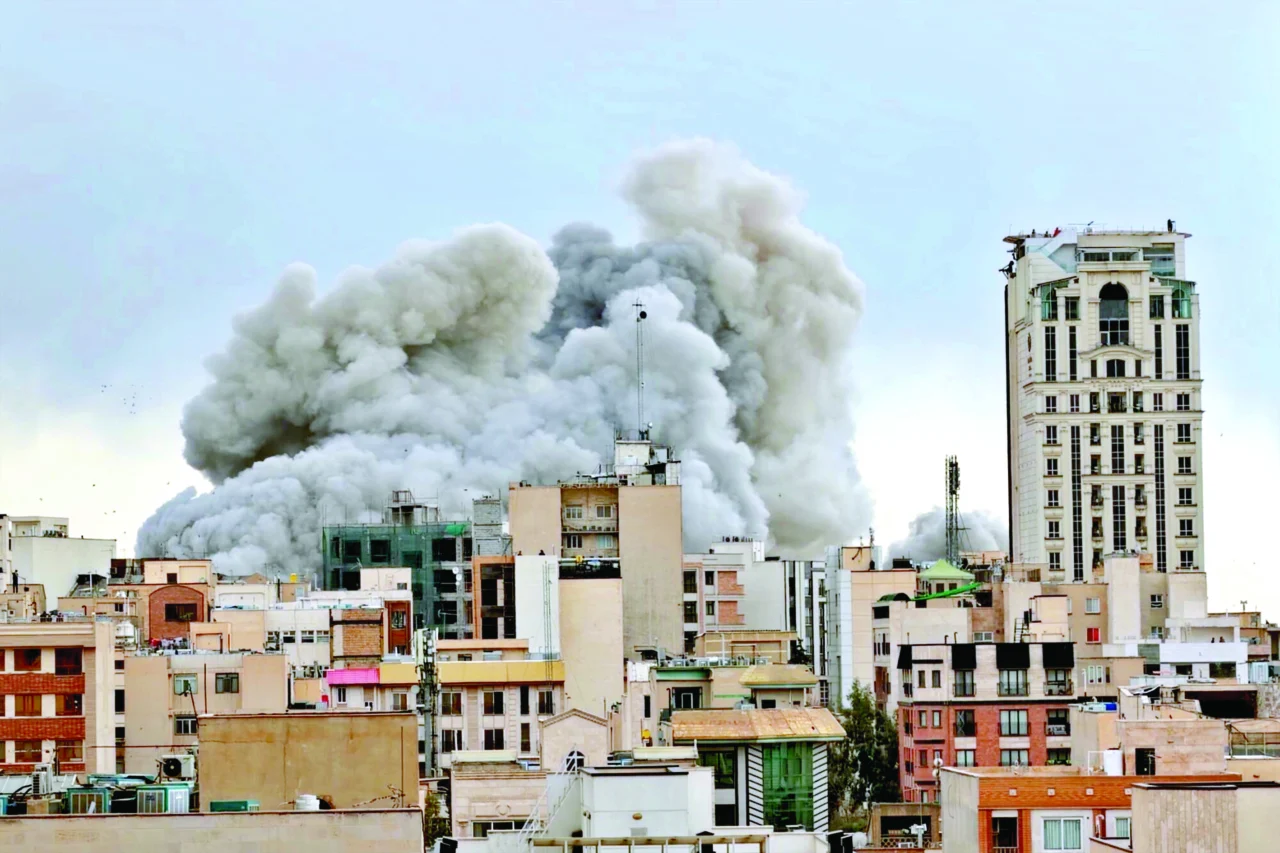
A plume of smoke rises after a strike in Tehran

A plume of smoke rises after a strike in Tehran

FacebookTwitterWhatsAppTelegramEmail

The recent mess involving Iran, the United States, and Israel is not just another boring story in a history book about the Middle East. It is a real-life lesson in how war is changing right now. For a country like Bharat—stuck with a neighbourhood that is toxic on one side and a giant on the other—this conflict gives us some hard-earned lessons which cannot be ignored.

If you look at Iran’s military on paper, it looks weird. Their air force is basically a collection of old, rusty planes held together by sheer grit. Their navy cannot even dream of beating a US carrier group in a straight fight. Their economy has been choked by sanctions for longer than most of their soldiers have been alive. But any infantryman will tell you: you do not win wars with fancy parades or shiny boots. You win by being prepared, knowing exactly what you want to do, and most importantly, having the guts to take a beating without breaking.

Iran has built its whole military strategy around one thing: surviving a total attack. The West likes “top-down” command, where everything comes from the big boss. Iran does the opposite. They use something we call “mosaic defense.” In plain soldier talk, this means the body is built to keep fighting even if you cut off the head.

If the leaders in Tehran are killed, or if a cyber-attack fries their phones, the local commanders on the ground do not just sit around waiting for orders. They already know their jobs and have the power to just go do them. This is not just theory. It is exactly what we did during counter-insurgency work in the Valley. You could take out a top terrorist leader, but the group would not stop because the small “cells” were made to run themselves. Iran has taken that small-scale logic and applied it to a whole country. Even after being hit hard, they kept launching drones. Their war machine does not have one big “off switch.” It has a thousand tiny switches spread across a rough landscape.

20-Year Mindset vs. 20-Day Plan

One of the biggest lies in modern military thinking is that a war starts when the first shot is fired. That is wrong. The war was won or lost ten years ago in the factories and the bunkers. Iran started preparing the moment they saw the US invade Iraq and Afghanistan. They were not just watching, they were taking notes. They saw the “Shock and Awe” and realised they could never win a “fair” conventional fight. So, they spent twenty years building a backup plan.

They focused on things Bharat needs to look at very closely. First, the Underground Fortress. They did not just build regular bases; they dug “missile cities” hundreds of meters under solid rock. Today, missiles can hit a tiny window from a thousand miles away, so the only real way to hide is to go deep. It makes it incredibly slow and expensive for an enemy to  actually stop them.

Then, there is the Logic of Mass. Iran built drones and missiles that are “cheap” and “simple” compared to Western stuff. But they built thousands of them. In a big fight, quantity matters more than quality. If you throw fifty drones that cost $20,000 each at a billion-dollar ship, eventually, the math wins. You do not need the fanciest weapon; you just need enough to make the enemy run out of ammunition. Finally, they used a Proxy Shield. By making friends with armed groups all over the region, Iran moved the “front line” far away from its own borders. This forces the enemy to fight in five different places at once, which wastes their time and energy.

The Economic Chokehold

Iran’s smartest move was using geography as a weapon. The Strait of Hormuz is a tiny, cramped waterway. Most of the world’s oil goes through it. Iran knows it cannot beat the US Navy in a big sea battle, but it does not need to. Just by having the power to mess with shipping using mines or fast boats, it holds the whole world’s economy hostage. Just a rumour that they might close the strait makes oil prices go crazy.

This is the ultimate sneaky strategy. You don’t hit the enemy’s teeth; you hit his stomach. Back when I was in uniform, we talked about “multi-domain” war. We’re seeing it now. The battlefield is not just a patch of dirt; it’s the stock market, the internet, and the price of gas.

Don’t get me wrong: the US and Israel are incredibly good at what they do. They are the gold standard. But even the sharpest knife cannot cut through smoke. From a soldier’s view, the big powers struggled because they made bad guesses. They think technology can replace patience.

First, they relied too much on “surgical strikes.” Air power is great, but it does not win a war against an enemy who is ready to suffer and keep going. If the enemy is buried under a mountain, a perfect strike is just a temporary annoyance. Second, they misunderstood depth. Iran is not just a country; it is a whole network. You cannot just fight them in one spot. It spreads to Lebanon, Yemen, and Iraq. Lastly, they expected a short war. Today, quick wins are rare. Iran prepared for a marathon, while their enemies were looking for a sprint. When the “knockout punch” does not work, the guy who can take the most pain wins.

We have to realise that our economy is our national security. Our growth depends on the sea. The Indian Ocean is our backyard. We have to treat our ports and internet cables like the “front lines.” Security is not just about the Line of Control (LoC) anymore; it is about the power grid and the internet. We need cheap, high-impact tech. Drones and cyber-warfare are the “great equalisers.” Iran proved that a low-budget force can stall a superpower if they get creative.

I remember an exercise years ago where our radios were jammed. The young officers were lost, just waiting for someone to tell them what to do. My CO, a man of very few words, looked at us and said: “Intent samajh lo, orders ki zarurat nahi padegi.” (Understand the intent, and you won’t need orders.)

That is the heart of a tough military. We need a culture where even the lowest-ranking soldier knows the “Commander’s Intent” so well that they can keep fighting all alone. The big lesson from the Iran mess is simple: You do not have to be the strongest to avoid losing. You just have to be the hardest to break. n
Topics: United StatesNational SecurityLine of ControlSurgical StrikesWest Asia ConflictEconomic ChokeholdIran’s military on paperand Israel
ShareTweetSendShareSend
✮ Subscribe Organiser YouTube Channel. ✮
✮ Join Organiser's WhatsApp channel for Nationalist views beyond the news. ✮
Previous News

Telangana: Police reports 17 X accounts over alleged communal narratives linked to cargo truck incident in Mehdipatnam

Next News

ABVP Tamil Nadu submits 16-point memorandum to CM Joseph Vijay on education reforms

Related News

West Asia Conflict: Collective response to energy crisis

West Asia Conflict: India issues advisory to citizens in Iran & Israel; Urges to avoid tarvel & exercise utmost caution

India-flagged vessel attacked near Strait of Hormuz; Seafarers send distress signal; All crew members rescued safely

Kurla resident Huzaifa Ansari held by Delhi police and ATS in alleged ISI-linked terror recruitment case

Delhi Police and Thane ATS arrest Kurla mechanic Huzaifa for alleged role in ISI-linked terror recruitment network

Demographic changes in Bharat’s border districts have raised concerns about migration, security, and social cohesion

Demographic Shift in Border Areas of Bharat: The dangerous design

Myanmar President U Min Aung Hlaing and Prime Minister Narendra Modi

PM Modi pushes for democracy in Myanmar; Naypyidaw vows action against insurgents threatening India’s national security

Load More

Latest News

PM Narendra Modi

‘The problem was Congress, not Hindus’: PM Modi’s blistering attack, lists India’s milestones in last 12 years

Leader of Opposition R. Ashoka files complaint with Karnataka governor over scam in awarding tender for waste management

Karnataka Garbage Scam: BJP alleges Rs 36,000-crore of scandal, seeks CBI probe; Files complaint to governor

Assam: Auto driver Monowar Hussain arrested for molesting, attempting to rape tribal woman passenger in Guwahati

The world recognises unprecedented growth in digital infrastructure during the 12 years of Modi's government

12 Years of Modi Government: How India built one of the world’s largest digital public infrastructure ecosystems

The image of alleged "Kolkotta Bayee" Jewel King living at Pathanamthitta

Keralam: WhatsApp status reveals illegal Bangladeshi who lived in Pathanamthitta for five years as ‘Kolkotta Bayee’

Following TMC’s defeat in 2026 West Bengal Assembly election, speculation grew that its MPs were moving towards the NDA under BJP pressure

Why TMC MPs are looking towards the NDA: Examining the electoral arithmetic behind the political shift

Father dies on the day of daughter's Nikah over dispute over Mehar amount in Uttarakhand

Uttarakhand: Bride’s father dies of heart attack amid pressure and dispute over mehar amount in nikah

India has been transformed by major advances in digital governance, financial inclusion, and global influence under Modi govt

India After 12 Years of Modi: A record, revolution and remaining challenges

Will CM Joseph Vijay preserve Tamil Nadu’s priceless temple heritage as artefacts decay in Egmore museum

Book Review | Zubeen Garg: 'The Voice That Bridged Worlds' by Prosenjit Nath

Book Review | Zubeen Garg: ‘The Voice That Bridged Worlds’ by Prosenjit Nath

Load More
  • Privacy
  • Terms
  • Cookie Policy
  • Refund and Cancellation
  • Delivery and Shipping

© Bharat Prakashan (Delhi) Limited.
Tech-enabled by Ananthapuri Technologies

  • Home
  • Search Organiser
  • Bharat
    • Assam
    • Bihar
    • Chhattisgarh
    • Jharkhand
    • Maharashtra
    • View All States
  • World
    • Asia
    • Africa
    • North America
    • South America
    • Europe
    • Australia
  • Editorial
  • Operation Sindoor
  • Opinion
  • Analysis
  • Defence
  • Culture
  • Sports
  • Business
  • RSS @ 100
  • Entertainment
  • More ..
    • Sci & Tech
    • Vocal4Local
    • Special Report
    • Education
    • Employment
    • Books
    • Interviews
    • Travel
    • Health
    • Politics
    • Law
    • Economy
    • Obituary
  • Subscribe Magazine
  • Read Ecopy
  • Advertise
  • Circulation
  • Careers
  • About Us
  • Contact Us
  • Policies & Terms
    • Privacy Policy
    • Cookie Policy
    • Refund and Cancellation
    • Terms of Use

© Bharat Prakashan (Delhi) Limited.
Tech-enabled by Ananthapuri Technologies