The recent court verdict regarding the Bhojshala in Dhar, Madhya Pradesh, serves as a reaffirmation of that ‘Sanatan’ cultural consciousness which, for thousands of years, has guided human civilization along the path of knowledge, education, art and culture. On one hand, within India, evidence of the ancient worship of Maa Vagdevi (Saraswati) at the Bhojshala has once again become a subject of discourse; on the other, Indonesia, the world’s largest Muslim-majority nation, has conveyed a profound message to the entire globe by installing a magnificent 16-foot-tall statue of Maa Saraswati in Washington D.C., the capital of the United States: that knowledge knows no boundaries.
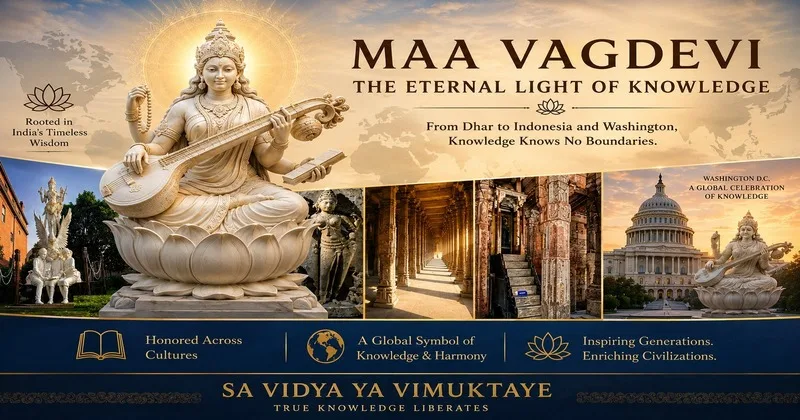
Situated just a short distance from the White House, the statue of Maa Saraswati, seated upon a lotus and playing the ‘Veena’- stands, in the truest sense, as a proclamation of the global prestige of the Indian tradition of knowledge. This imagery also carries a profound message for India itself, a land that once served as the epicenter of great traditions of learning such as Nalanda, Taxila, Vikramshila and Bhojshala.
Bhojshala: A Question of Cultural Memory
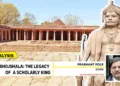
Regarding the Bhojshala in Dhar, a significant consensus among historians, archaeologists and local traditions identifies it as a temple dedicated to Maa Vagdevi, as well as a center for Sanskrit learning, established by the illustrious King Bhoja of the Parmar dynasty. Beyond being a valiant ruler, King Bhoja is revered as a preeminent patron of the Indian tradition of knowledge.
His capital, Dhar, served as a vibrant hub for scholars, poets and philosophers during that era. Within the precincts of the Bhojshala, the Goddess of Learning, Maa Saraswati- was worshipped and the venue regularly hosted scholarly debates (Shastrarth) and intellectual assemblies. It is for this very reason that it came to be hailed as the “Sanctum of Learning” (Vidya ki Tapobhumi). The Sanskrit inscriptions, architectural styles, lotus motifs and remnants of temple architecture discovered at the site collectively reinforce the historical fact that the Bhojshala was, in its original essence, a Temple of Knowledge.
Judicial Verdicts and Emerging Archaeological Evidence
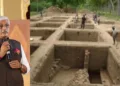
Recent judicial pronouncements, coupled with reports from the Archaeological Survey of India (ASI), have once again brought to the fore several significant facts pertaining to the Bhojshala. The survey has yielded evidence of temple architectural styles, iconography of deities, Sanskrit inscriptions and Hindu religious symbols. It has also become evident that numerous parts of the structure are rooted in the indigenous Hindu temple architectural style.
For years, attempts were made to portray Bhojshala merely as a disputed site; however, archaeological and historical evidence now indicates that this place served as a pivotal center for India’s ancient learning and cultural consciousness. Consequently, the issue of Bhojshala has evolved into a matter concerning the reclamation of India’s cultural identity and intellectual heritage.
Maa Saraswati: Not Merely a Goddess, but the Embodiment of Knowledge
In the Sanatan tradition, Maa Saraswati is not merely a deity to be worshipped; she represents the very essence, the consciousness- of knowledge, wisdom, art and moral refinement. The ‘Veena’ held in her hands symbolizes art and music; the book represents knowledge; the ‘Akshamala’ signifies spiritual discipline and the continuous process of learning; while the white lotus is regarded as a symbol of purity and serenity.
Thousands of years ago, Indian culture embraced the profound realization that education is not merely a means to secure employment, but rather a transformative process aimed at cultivating moral character and refinement within an individual. This is precisely why, in India, a child’s formal education traditionally commences with the writing of the sacred syllable “Om” and why Maa Saraswati is invoked before the pursuit of knowledge begins. Today, as the world engages in discourse regarding technology, artificial intelligence and economic competitiveness, Indian philosophy offers a timeless perspective: true knowledge is meaningful only when it is imbued with ethics, empathy and cultural depth.
Muslim-Majority Indonesia Delivers a Powerful Message
Approximately 88 percent of Indonesia’s population adheres to Islam, while the Hindu community constitutes a mere three percent. Notwithstanding this demographic reality, the Indonesian government’s decision to gift a statue of Maa Saraswati to the United States serves as a compelling testament to the fact that a civilized society does not confine the pursuit of knowledge within the narrow boundaries of any specific religion. The Indonesian Embassy explicitly stated that this statue serves as a medium to foster education, facilitate cultural dialogue and strengthen people-to-people connections. This very ethos, this shared vision, is what has enabled the preservation of Hindu cultural heritage in Bali.
The statue was sculpted by a team of five Balinese artists, led by I Nyoman Sudarwa. The sculpture depicts Saraswati Maa with four arms. One hand holds an ‘akshamala’, which symbolizes the continuous process of learning. The ‘veena’ represents art and culture, while the manuscript signifies the source of knowledge. This entire composition is a magnificent fusion of Indian philosophy and Balinese art.
The Cultural Message of the Saraswati Statue in Washington
The statue of Maa Saraswati- installed in Washington DC., situated in front of the Indian Embassy and the statue of Mahatma Gandhi, stands today as a symbol of the presence of the Indian knowledge tradition at the very epicenter of global politics and culture. At the time of its unveiling, the President of Indonesia remarked that this statue would serve to open the hearts and minds of people, thereby dispelling hatred and misunderstandings.
Indeed, this sentiment holds immense significance in our contemporary era, as the world grapples with religious fundamentalism, ideological conflicts and cultural clashes. Fundamentally, the message embodied by Maa Saraswati is one of dialogue, coexistence and knowledge. It is for this very reason that this statue is emerging as a focal point of attraction, even within a modern nation like the United States.
The Saraswati Tradition: From India to the World
It is pertinent to note here that the worship of Maa Saraswati has not remained confined solely within the borders of India. The tradition of the Goddess of Knowledge, manifesting in various forms, can be observed across a wide geographical expanse, including Nepal, Myanmar, Cambodia, Thailand, Indonesia, Japan, China, Sri Lanka, Mauritius, Suriname, Guyana, Fiji, Trinidad, Tobago, Dominica, Jamaica, several other Caribbean nations and even Tibet. Some scholars draw parallels between the Indian Goddess Saraswati, as the deity of knowledge, arts and wisdom and her Western counterparts: the Roman Goddess “Minerva” or the Greek Goddess “Athena.”
In Japan, Maa Saraswati is revered as “Benzaiten” and is worshipped as the Goddess of knowledge, arts, and prosperity. In Thailand, artists and musicians pay homage to her as “Surasawadee.” In Myanmar, the Goddess of Knowledge is acknowledged under the name “Thurathadi.” Furthermore, statues and artistic motifs associated with Saraswati can be found within the temples of Angkor Wat in Cambodia. In essence, these facts underscore the vast scope of Indian culture, demonstrating the profound influence it has exerted upon global civilization.
Education: The True Strength of a Nation
History bears witness to the fact that only those civilizations that prioritized education and culture were able to endure and sustain themselves over the long term. India has gifted the world universities such as Nalanda, Takshashila and Vikramshila. The Bhojshala stands as a vital link in this very glorious tradition. Today, the need of the hour is for India to present its cultural heritage to the world not with diffidence, but with self-confidence. The issue of the Bhojshala is inextricably linked to this very self-confidence. If a Muslim-majority nation like Indonesia can revere Goddess Saraswati as a global symbol of knowledge, then India, too, should harbor no hesitation in reconnecting with its own roots.
The Future of Civilization Will Be Determined by Knowledge
The Bhojshala in Dhar and the statue of Goddess Saraswati standing in Washington appear to convey a singular message: that the future of civilizations is determined not by weaponry, but by knowledge. Amidst the cultural instability and ideological strife that the world is currently navigating, the message inherent in the Indian knowledge tradition, that education not only endows human beings with wisdom but also cultivates humility and sensitivity, assumes profound relevance.
Indeed, centuries ago, India’s ‘Sanatan’ tradition established the principle: “Sa Vidya Ya Vimuktaye”- meaning, true knowledge is that which liberates the human soul. The historical truth embodied by the Bhojshala, alongside the statue of Goddess Saraswati installed in Washington, serves, one might say, as a global echo of this very eternal stream of knowledge.