
The Upanishads are the philosophical essence of the Vedas and the foundation of Vedanta. They explore the deepest truths about existence, consciousness, and liberation. Below is a detailed, numbered explanation, with expanded paragraphs under each Upanishad for deeper understanding.
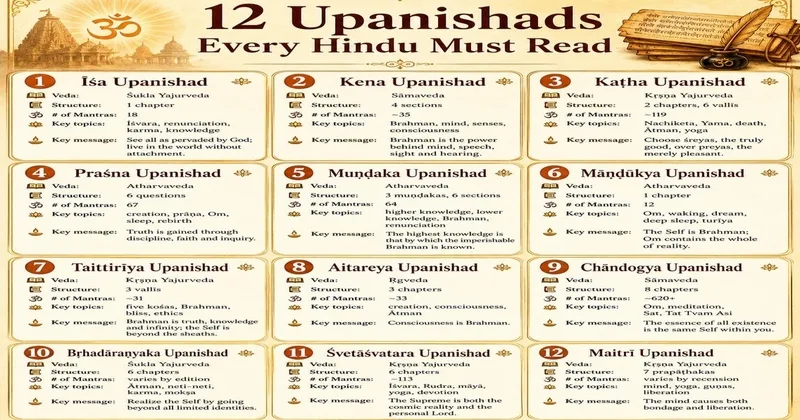
🚨 TOP 12 Upanishads that every Hindu must read.
The Upanishads are not just “religious texts.”
They are the philosophical heart of Sanātana Dharma — the texts that ask:
Who am I?
What is the Self?
What is the final truth?
What survives death?
What is liberation?These are… pic.twitter.com/QxYHlr9Ln6
— Sarfarosh 🚩🕉️ (@Sarfarosh_IND) May 12, 2026
Isa Upanishad
* Veda: Sukla Yajurveda
* Structure: 18 mantras
* Core Idea: Divine presence pervades everything
The Isa Upanishad presents one of the most balanced visions of spiritual life. It begins with the assertion that the entire universe is enveloped by the divine (Isa), meaning nothing exists outside the scope of sacred reality. This idea dissolves the divide between worldly life and spiritual pursuit.
What makes this Upanishad unique is its emphasis on detached action. It does not encourage abandoning responsibilities, but instead teaches that one should engage fully in life while remaining inwardly unattached. This approach anticipates later teachings of karma yoga, where action is performed without desire for results. It also warns against falling into extremes—neither ignorance nor mere intellectual knowledge is sufficient. True wisdom lies in harmonising both action and realisation.
Kena Upanishad
* Veda: Samaveda
* Structure: 4 sections
* Core Idea: Brahman is the force behind all perception
The Kena Upanishad is deeply introspective, asking fundamental questions about the source of human experience. It challenges the assumption that the mind and senses are autonomous, instead revealing that there is a deeper principle, Brahman, that empowers them.
A central theme is that Brahman cannot be grasped as an object of knowledge. It is not something you “know” in the conventional sense; rather, it is that by which all knowing occurs. The Upanishad uses paradoxical language to convey this idea, stating that those who think they know Brahman do not truly know it, while those who recognise its unknowable nature come closer to understanding it. This leads to a profound humility in the seeker and a shift from intellectual arrogance to contemplative awareness.
Kaṭha Upanishad
* Veda: Krsṇa Yajurveda
* Structure: 2 chapters, 6 sections
* Core Idea: The nature of the Self and life after death
The Kaṭha Upanishad stands out for its narrative style, centred on the young seeker Nachiketa and his encounter with Yama, the god of death. Through this dialogue, the text explores what happens after death and what constitutes the eternal Self.
One of its most important teachings is the distinction between Sreyas (the good) and Preyas (the pleasant). While most people are drawn toward immediate gratification, the wise choose what is ultimately beneficial, even if it is difficult. The Upanishad also presents the famous chariot metaphor, illustrating how the senses, mind, and intellect must be disciplined for the Self to be realised. It emphasises that the Self is eternal, beyond birth and death, and can only be known through inner control and wisdom.
Prasna Upanishad
* Veda: Atharvaveda
* Structure: 6 questions
* Core Idea: Knowledge through disciplined inquiry
The Prasna Upanishad is structured as a series of six questions posed by earnest students to a realised teacher. Each question addresses a different aspect of existence, including creation, the nature of life force (prāṇa), the role of Om, and the states of consciousness. What makes this text significant is its emphasis on preparation and discipline before seeking knowledge. The students are required to live a life of austerity, celibacy, and faith before their questions are answered. This highlights the idea that spiritual knowledge is not merely intellectual; it requires the transformation of one’s character. The Upanishad presents inquiry not as casual curiosity, but as a sacred and rigorous pursuit.
Mundaka Upanishad
* Veda: Atharvaveda
* Structure: 3 sections
* Core Idea: Higher vs lower knowledge
The Muṇḍaka Upanishad clearly distinguishes between two kinds of knowledge: lower knowledge, which includes all worldly sciences and rituals, and higher knowledge, which leads to the realisation of Brahman. This distinction is crucial in understanding the Upanishadic shift away from ritualism toward inner realisation.
The text uses powerful imagery, such as the metaphor of two birds sitting on the same tree. One bird eats the fruits (symbolising the individual experiencing life), while the other simply observes (representing the higher Self). This illustrates the dual perspective within human existence—the active participant and the silent witness. The Upanishad teaches that liberation comes when one identifies with the witnessing consciousness rather than the experiencing ego.
Mandukya Upanishad
* Veda: Atharvaveda
* Structure: 12 mantras
* Core Idea: Reality explained through Om
The Mandukya Upanishad, though brief, is extraordinarily profound. It explains the entire nature of reality using the syllable Om, which is seen as the sound-symbol of the universe. It describes four states of consciousness: waking, dreaming, deep sleep, and Turiya, the fourth state that transcends all others. Turīya is pure awareness, beyond subject-object division, and represents the true Self. The Upanishad teaches that by understanding these states and meditating on Om, one can realise the unity of the individual Self and Brahman. It is considered one of the most direct and philosophical texts in all of Vedanta.
Taittiriya Upanishad
* Veda: Krsna Yajurveda
* Structure: 3 sections
* Core Idea: The five layers of the Self
The Taittiriya Upanishad presents a layered understanding of human existence through the concept of the five koshas (sheaths). These range from the physical body to subtler levels like the mind and intellect, culminating in the bliss sheath.
The text teaches that the true Self lies beyond all these layers and cannot be reduced to any single aspect of human experience. It also places strong emphasis on ethical conduct, respect for teachers, and gratitude toward nature, especially food, which is seen as sacred. This Upanishad integrates philosophical insight with practical guidance for living a disciplined and meaningful life.
Aitareya Upanishad
* Veda: Ṛgveda
* Structure: 3 chapters
* Core Idea: Consciousness as the ultimate reality
The Aitareya Upanishad offers a profound perspective on creation, presenting consciousness as the origin and essence of the universe. It challenges materialistic views by asserting that reality is not fundamentally physical, but conscious.
The text explores how the Self manifests as the universe and enters into living beings as awareness. Its famous declaration, “Prajnanam Brahma” (Consciousness is Brahman), is one of the Mahāvākyas (great statements) of Vedanta. It emphasises that understanding consciousness is the key to understanding existence itself.
Chandogya Upanishad
* Veda: Samaveda
* Structure: 8 chapters
* Core Idea: Unity of the Self and the universe
The Chāndogya Upanishad is rich in stories, analogies, and symbolic teachings. It communicates deep philosophical truths in an accessible manner, often through dialogues between teachers and students.
Its most famous teaching, “Tat Tvam Asi” (Thou art That), encapsulates the idea that the individual Self is identical to the universal reality. The Upanishad repeatedly emphasises that the essence of all existence (Sat) is present within every individual. It encourages seekers to look inward rather than outward in their search for truth.
Brhadaranyaka Upanishad
* Veda: Sukla Yajurveda
* Structure: 6 chapters
* Core Idea: The infinite nature of the Self
This is one of the most extensive and philosophically rich Upanishads. It explores the nature of reality through dialogues, debates, and introspective teachings.
Its method of “Neti, Neti” (Not this, not this) is a process of negating all limited descriptions to arrive at the infinite nature of Brahman. It also presents the declaration “Aham Brahmasmi” (I am Brahman), affirming the identity of the individual Self with the absolute. The Upanishad delves deeply into concepts of karma, rebirth, and liberation, making it a cornerstone of Vedantic thought.
Svetasvatara Upanishad
* Veda: Krsna Yajurveda
* Structure: 6 chapters
* Core Idea: Personal God and cosmic reality
The Svetasvatara Upanishad introduces a more theistic dimension to Upanishadic philosophy. While earlier texts often emphasise the impersonal nature of Brahman, this one presents the ultimate reality as a personal God (Īśvara), often associated with Rudra.
It also discusses concepts like Māyā (illusion), the role of yoga, and the importance of devotion. This Upanishad serves as a bridge between philosophical inquiry and devotional practice, showing that both paths can lead to the same ultimate truth.
Maitri Upanishad
* Veda: Krsna Yajurveda
* Structure: 7 sections
* Core Idea: The mind as the cause of bondage and liberation
The Maitri Upanishad focuses on the psychological and practical aspects of spiritual life. It highlights the central role of the mind in shaping human experience.
According to this text, the mind can either bind a person to the cycle of suffering through attachment and ignorance or lead them to liberation through discipline and meditation. It discusses the three guṇas, sattva, rajas, and tamas, and how they influence behaviour and perception. The Upanishad emphasises self-control, introspection, and meditation as essential tools for achieving freedom. The 12 major Upanishads together form a complete philosophical map of human existence, offering a unified vision of reality and liberation.