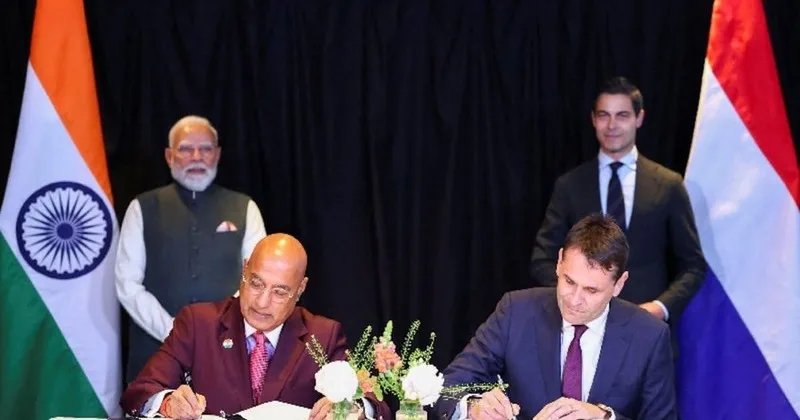
The Hague: India took a major step in its semiconductor ambitions on May 16 as Tata Electronics and ASML signed an agreement to build the country’s first front-end semiconductor fabrication plant in Gujarat during Prime Minister Narendra Modi’s visit to the Netherlands.
The agreement was signed in the presence of Prime Minister Modi and Dutch Prime Minister Rob Jetten, according to India’s Ministry of External Affairs. The partnership will support Tata Electronics’ planned 300-millimetre semiconductor fabrication facility in Dholera, Gujarat, which is being developed with an investment of $11 billion.
The companies said ASML’s semiconductor equipment technology would support the fabrication plant, which is expected to manufacture chips for sectors including automotive, mobile devices and artificial intelligence.
Christophe Fouquet, Chief Executive Officer of ASML, said India’s rapidly expanding semiconductor sector presented “many compelling opportunities” and added that the Dutch company was committed to establishing long-term partnerships in the country.
India has been intensifying efforts to build a domestic semiconductor manufacturing ecosystem by offering billions of dollars in subsidies for chip fabrication and related manufacturing projects. According to Reuters, eight semiconductor-related projects are currently underway in the country, including another Tata Electronics semiconductor facility in Gujarat valued at $14 billion.
India pushes Semiconductor diplomacy during Europe visit
During the visit, Modi also met King Willem-Alexander and Queen Maxima of the Netherlands at the Royal Palace in The Hague. The discussions focused on strengthening India–Netherlands cooperation in sustainability, climate action, digital technology, innovation, fintech and the blue economy.
The Ministry of External Affairs said Modi encouraged Dutch companies to invest in India in areas such as semiconductors, renewable energy, digital technologies and healthcare. Both sides also called for the early implementation of an India-European Union free trade agreement.
The agreement reflects growing economic and technological cooperation between India and the Netherlands at a time when global semiconductor supply chains are being reshaped by geopolitical tensions and export restrictions linked to the U.S.-China technology rivalry.Dutch semiconductor companies are increasingly seeking geographical diversification and new markets, while India is attempting to position itself as a major manufacturing and technology hub through large-scale investments and policy incentives.
The semiconductor agreement came as Prime Minister Modi continued the second leg of his five-nation diplomatic tour from May 15 to 20. Before arriving in the Netherlands, Modi had visited the United Arab Emirates.