
“First of all, our young men must be strong. Religion will come afterwards. Be strong, my young friends; that is my advice to you. You will be nearer to Heaven through football than through the study of the Gita. These are bold words; but I have to say them, for I love you. …You will understand the mighty genius and the mighty strength of Krishna better with a little of strong blood in you. You will understand the Upanishads better and the glory of the Atman when your body stands firm upon your feet… “.
– Swami Vivekananda, Vedanta in its Application to Indian Life, Complete Works of Swami Vivekananda, Vol 3, Lectures from Colombo to Almora
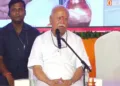
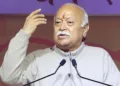
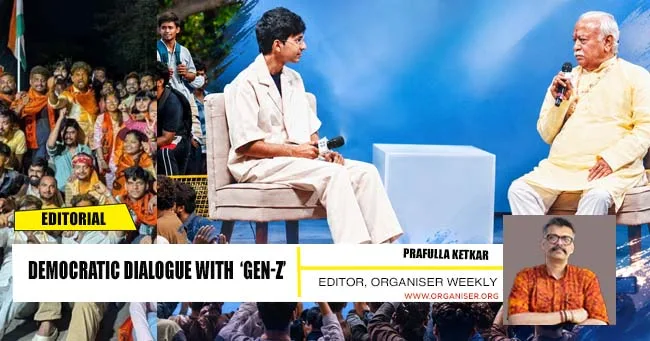
The Sarsanghachalak of Rashtriya Swayamsevak Sangh (RSS), Dr Mohan Bhagwat, answered the questions that the young, tech-savvy generation would generally ask an elderly person who is seen as a friend, philosopher and guide of the largest voluntary organisation of the world. The event was organised by a youth-run initiative called I.I.M.U.N. (India’s International Movement to Unite Nations). However, it was presented as an RSS initiative to reach out to so-called Gen-Z, against the backdrop of Jantar-Mantar protest. Though the event was scheduled months in advance, and the Sarsanghachalak have been attending such events for years, the media discussion naturally revolved around the students’ protests. Gen-Z has become the buzzword for the same, without realising the connotation of the term. Hence, we need to decode the interactive dialogue of the Sarsanghchalak, which was originally planned as an address.
In the true spirit of democratic dialogue, Sarsanghachalak ji took up a range of questions without being in preaching or dictating mode. The basic precondition for dialogue is to be ready to listen to all views, accept and respect them, and then logically draw conclusions. That is what Dr Bhagwat referred to as Shastrarth – the deliberation in search of truth. His fundamental premise was that protest is also a mode of dialogue, but the ultimate objective is to evolve consensus. Though he did not endorse the ‘CJP hijacking’ method, he refrained from labelling all protesters as anti-nationals. The root cause of the problem is the commercialisation of education and expecting the Government to do everything, without society taking constructive responsibility. Making education affordable and accessible with participation of all social actors is the primary condition he has set. If logically and lovingly explained, the young generation is ready to engage and understand.
On other issues, such as algorithms and influencers, Sarsanghachalak called for attitudinal and institutional changes. The reel models need to realise the responsibility of being role models, and youngsters should develop their reasoning; choosing their idols is critical. The same is true when it comes to binary debates such as the relationship with China and Pakistan. While standing with the Government and Armed Forces during conflicts, the purpose is not to obliterate others. Similarly, while accepting the place for diverse sexual orientations, differentiating marriage as a social institution from individual companionship and the need to evolve some system is a new perspective which even ‘Gen-Z’ can ponder over. The questions of employability and equality of access are deeply rooted in the development model and the absence of dignity of labour. Without addressing these core concerns, inequalities cannot be reduced, and employability cannot be assured. The question of reservation is politicised, missing the original objective of creating social harmony and fraternity and not acrimony. When another protest is initiated in the name of removing the constitutional method of positive discrimination, this yardstick is important. The participation of women in nation building is equal, and man and woman are complementary to each other; this unequivocal position of RSS was reiterated. On the debate over sustainability versus development, individual lifestyle issues and evolving balanced models can encourage moving in the opposite direction from the prevalent trends of capitalism and communism as the only alternatives. He connected with the ‘Gen-Z’ and ‘Gen-Alpha’ through his conviction and conversation, while explaining the true meaning of leadership that goes beyond politics. His approach was: “Your concerns are right, but they have multiple dimensions, other than what you perceive.”
RSS has a continuous process of induction through training. This year’s 95 Sangh Shiksha Varg – the training programmes of RSS – had more than 70 per cent new Swayamsevaks from the age group of 15 to 40. In the last hundred years, RSS has devised mechanisms to establish inter-generational dialogue and evolve new training methods without diluting the original patriotic spirit of preparing yourself for national reconstruction. Hence, without being preachy, the Sarsanghachalak could give them diverse angles on pressing problems. Amidst the cacophony of real and fake protests, the Sarsanghachalak has beautifully demonstrated the consensus-building dialogue process with the true spirit of Sangh – the national collective.
The generation gap is not a new social problem. Every older generation finds younger ones over-smart and undisciplined, while younger ones consider them progressive, and elders dictatorial, and there is nothing wrong in it. The only differentiating factor is the speed due to digital penetration. The earlier remote-control or Nokia-mobile-using generation of Gen Z is not the same as the Instagram- or Snapchat-driven generation; in between the layers of Google, Facebook, and X (earlier Twitter) hooked generations are there. Tech companies, their algorithms, and financial interests are creating categories that may not be real. Historically, every young generation is revolutionary in nature. Even Bhagat Singh, Sukhdev and Rajguru, who defied the Satyagraha method of the freedom struggle, can be considered as Gen Zs of their times. So were the youth who fought against the Emergency. That does not mean rejection and rebellion are the only solution. The economic uncertainties, climate change issues, and the COVID-19 pandemic are considered defining events that shaped the consciousness of present ‘Gen-Z’. Are they really unique to the present generation? Yes, technology and social media have shaped and amplified their consciousness, which needs to be factored in.
The CJP is just another political experiment in the name of Gen-Z, amplified by social media platforms. Besides the youngsters who are attracted to the CJP kind of agitation, the ones who are protesting in Jharkhand or Punjab are also Gen-Zs of a different kind. There was another layer of Gen-Z who was contesting in sporting events to win medals for Bharat – in the Commonwealth Games, in the International Yogasana Championship or even Maths and Physics Olympiads. There are innovators, change-makers, start-ups, and social entrepreneurs who prefer finding solutions rather than agitating with a subversive agenda of failed ideologies like communism. There are youth who genuinely want Bharat rising for the good of humanity. They are health-conscious and multitaskers. For them, patriotism is not an abuse and history is not a baggage. And all of them represent the so-called Gen-Z. The sudden technological transformation has created a social and cultural jerk, leading to inter-generational communication gaps, which we need to reconnect as a society, and family is the starting point for the same.
When Swami Vivekananda said, “If you play football, you will understand Bhagwat Gita better,” some tried to misrepresent it as if Swamiji rejected the Gita and asked to play only football. This mischievous interpretation misses the spirit behind physical fitness as a complementary force for spiritual evolution. The same is the treachery of the hijacking forces behind the CJP, who neither want educational reforms nor democratic dialogue for long-term solutions. As Dr Mohan Bhagwat’s message goes, we need to differentiate between the real and artificial issues and address them with a 360-degree perspective and re-establish inter-generational dialogue – understanding each other’s lingo and concerns. Otherwise, it will lead to social fragmentation, without finding any long-lasting solutions to any of the concerns that are bothering the data-defined ‘Gen-Z’.