
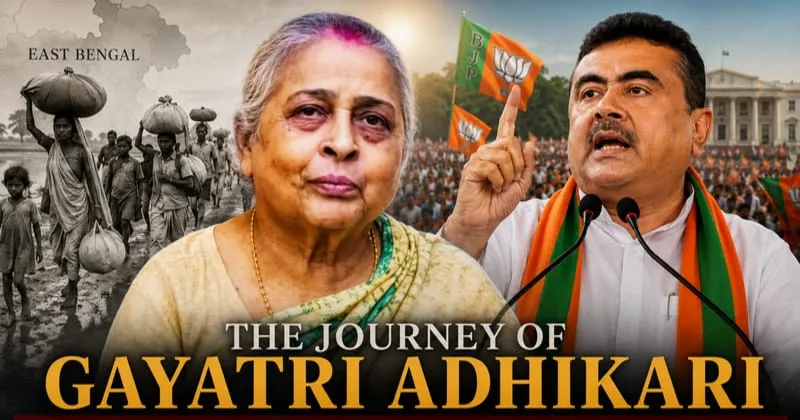
Kolkata: Gayatri Adhikari (born Gayatri Bhattacharya) is associated with a lineage that traces back to erstwhile East Bengal, now part of Bangladesh. Like thousands of Hindu families during the turbulent mid-20th century, her early life is believed to have been shaped by the broader socio-political upheavals that accompanied Partition-era migrations. This period saw large-scale movement of families across the newly drawn borders, with many seeking refuge in West Bengal amid fears, uncertainty, and displacement.
✨ From East Bengal's tears to West Bengal's highest office ✨
This is GAYATRI ADHIKARI- many of you might have already guessed who she is the moment you saw her name.
Yes, she is the blessed mother of Suvendu Adhikari, who, in just a few hours, will take oath as the Chief… pic.twitter.com/fwcDKe4fQK
— Toofani 🇧🇩 (@Ekattor_71) May 8, 2026
Migration and Resettlement in West Bengal
Her family eventually settled in the coastal regions of the present-day Purba Medinipur district in West Bengal. This region became one of the many rehabilitation zones for displaced families from East Bengal, where new livelihoods were built from scratch in unfamiliar surroundings. Such migrations were not just geographic shifts but profound emotional ruptures, involving loss of ancestral homes, cultural anchors, and community ties.
Marriage into the Adhikari Family
Gayatri Bhattacharya later became part of the Adhikari family of Karkuli village in the Contai (Kanthi) region. The Adhikari family is a well-known political and social lineage in Purba Medinipur, with involvement in public life spanning multiple decades. Her husband, Sisir Kumar Adhikari, is a prominent political figure, and the family has been active in regional politics for years.
The Adhikari household has long been associated with political participation in West Bengal. Over time, the family became influential in the region’s political landscape, particularly in Purba Medinipur.
Their son, Suvendu Adhikari, emerged as a significant political leader in West Bengal politics, known for his shift from regional to national political platforms and his role in legislative and electoral processes in the state. Within this larger public narrative, Gayatri Adhikari’s role is primarily understood in the context of family and upbringing within a politically active household.
A Family Rooted in Public Life and Political Continuity
Within this environment of political engagement, Gayatri Adhikari’s children grew up closely observing public life, leadership, and grassroots organisation. Her son, Suvendu Adhikari, emerged as one of the most prominent political leaders in West Bengal. Known for his strong organisational base and deep influence in regional politics, he built his career through grassroots mobilisation, electoral strategy, and legislative roles. Over time, he became a central figure in Bengal’s political landscape, shaping both governance debates and opposition narratives.
The Nandigram Battle and the 2021 Electoral Upset Against Mamata Banerjee
One of the most defining moments in Suvendu Adhikari’s political journey came during the 2021 West Bengal Assembly elections, when he contested from the high-profile Nandigram constituency against incumbent Chief Minister Mamata Banerjee.
The contest quickly became the most closely watched electoral battle in the state, symbolising a direct political confrontation between two figures in Bengal politics. Nandigram, already politically sensitive due to its historical movements and activism, turned into the epicentre of intense campaigning, massive voter mobilisation, and national attention. In a dramatic, closely fought result, Suvendu Adhikari was declared the winner of Nandigram by a narrow margin. The outcome was widely interpreted as a major political upset, marking one of the most significant defeats of Mamata Banerjee’s electoral career. The result reshaped political narratives in West Bengal, strengthening the opposition’s position and establishing Suvendu Adhikari as a key leader in the state’s evolving political landscape.
Suvendu Adhikari Set to Take Oath as First BJP Chief Minister of West Bengal
In a major political development reported in 2026, Suvendu Adhikari, the Leader of the West Bengal BJP Legislative Party, is set to take oath as the Chief Minister of West Bengal after a decisive electoral victory.
Following a sweeping mandate in the Assembly elections, in which the BJP secured a strong majority, Adhikari was formally elected as the legislative party leader. The announcement was made after a key meeting chaired by senior party leadership in Kolkata. Shortly after his selection, he met the Governor and staked a claim to form the government.
The swearing-in ceremony, scheduled in Kolkata, is expected to be attended by several top national leaders, including Union Ministers and Chief Ministers from BJP-ruled states, marking a significant political moment for the party in West Bengal. Adhikari’s elevation is being described as a landmark shift in the state’s political history, ending a long phase of previous regimes and ushering in a new political era. After his selection, he expressed gratitude to the party leadership and emphasised development, governance, and fulfilment of electoral promises.
At the heart of Suvendu Adhikari’s political journey lies the quiet strength of his mother, Gayatri Adhikari, whose life reflects the larger story of Partition-era displacement, resettlement, and rebuilding from hardship. From those early experiences of loss and survival emerged a family deeply connected to Bengal’s evolving political landscape. While Suvendu’s rise has been shaped by electoral battles, organisational strength, and high-stakes political moments, it also carries the imprint of a mother’s resilience and a household rooted in perseverance. Together, their stories reflect two intertwined journeys, one of silent endurance and another of public leadership, shaping a legacy that continues to influence West Bengal’s political narrative.