Tadmetla attack probe under scrutiny after verdict
June 5, 2026
  • Read Ecopy
  • Circulation
  • Advertise
  • Careers
  • About Us
  • Contact Us
Android AppiPhone AppArattai
Organiser
  • ‌
  • Bharat
    • Assam
    • Bihar
    • Chhattisgarh
    • Jharkhand
    • Maharashtra
    • View All States
  • World
    • Asia
    • Europe
    • North America
    • South America
    • Africa
    • Australia
  • Editorial
  • International
  • Opinion
  • RSS @ 100
  • More
    • Op Sindoor
    • Analysis
    • Sports
    • Defence
    • Politics
    • Business
    • Economy
    • Culture
    • Special Report
    • Sci & Tech
    • Entertainment
    • G20
    • Azadi Ka Amrit Mahotsav
    • Vocal4Local
    • Web Stories
    • Education
    • Employment
    • Books
    • Interviews
    • Travel
    • Law
    • Health
    • Obituary
  • Subscribe
    • Subscribe Print Edition
    • Subscribe Ecopy
    • Read Ecopy
  • ‌
  • Bharat
    • Assam
    • Bihar
    • Chhattisgarh
    • Jharkhand
    • Maharashtra
    • View All States
  • World
    • Asia
    • Europe
    • North America
    • South America
    • Africa
    • Australia
  • Editorial
  • International
  • Opinion
  • RSS @ 100
  • More
    • Op Sindoor
    • Analysis
    • Sports
    • Defence
    • Politics
    • Business
    • Economy
    • Culture
    • Special Report
    • Sci & Tech
    • Entertainment
    • G20
    • Azadi Ka Amrit Mahotsav
    • Vocal4Local
    • Web Stories
    • Education
    • Employment
    • Books
    • Interviews
    • Travel
    • Law
    • Health
    • Obituary
  • Subscribe
    • Subscribe Print Edition
    • Subscribe Ecopy
    • Read Ecopy
Organiser
  • Home
  • Bharat
  • World
  • Operation Sindoor
  • Editorial
  • Analysis
  • Opinion
  • Culture
  • Defence
  • International Edition
  • RSS @ 100
  • Magazine
  • Read Ecopy
Home Bharat

Justice in Question: How Tadmetla attack case exposed flaws in investigation & left 76 CRPF martyrs without closure

The acquittal of 10 accused in the 2010 Tadmetla attack has reignited questions over investigative failures and delayed justice for the 76 security personnel killed in one of India’s deadliest Maoist ambushes. The verdict has once again placed the spotlight on gaps in evidence collection and prosecution

WEBDESKWEBDESK
May 16, 2026, 02:30 pm IST
in Bharat, Chhattisgarh
Follow on Google News
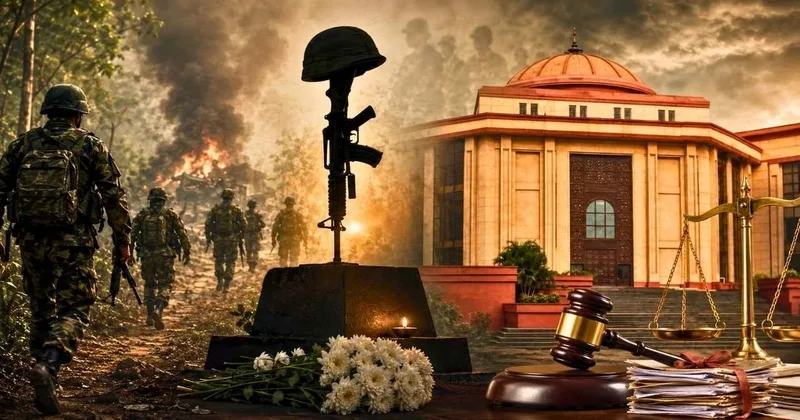
Ten accused in the Tadmetla attack have been acquitted, raising serious questions about the failure of the investigation

Ten accused in the Tadmetla attack have been acquitted, raising serious questions about the failure of the investigation

FacebookTwitterWhatsAppTelegramEmail

Who is ultimately responsible for the killing of 76 security personnel in the 2010 Tadmetla attack? That question has once again come into focus after the Chhattisgarh High Court acquitted 10 accused in the case, citing a lack of credible and legally admissible evidence nearly 16 years after one of India’s deadliest Maoist ambushes. The judgment has reopened a long-standing debate over investigative failures, prosecution weaknesses, and whether justice has truly been delivered for the families of the slain personnel.

The incident, known as the Tadmetla attack, took place on April 6, 2010, in the dense forests of Sukma district, Chhattisgarh. A team of the Central Reserve Police Force (CRPF) and state police was engaged in routine area domination patrol when they were ambushed by Maoists. The attackers opened heavy fire and used explosives in a carefully planned assault, killing 76 personnel, 75 CRPF jawans and one state police officer. The insurgents also looted weapons and escaped after planting improvised explosive devices in the area.

The case that followed became one of the most closely watched Naxal-related trials in India. Initially, 10 individuals were charged in connection with the attack. However, the legal process stretched over more than a decade, and significant evidentiary gaps began to surface during judicial scrutiny.

On May 5, 2026, a division bench of the Chhattisgarh High Court comprising Chief Justice Ramesh Sinha and Justice Ravindra Agrawal upheld the earlier acquittal by a trial court (2013), dismissing the state government’s appeal under Section 378 of the CrPC. The High Court observed that the prosecution had failed to establish guilt beyond a reasonable doubt and had not produced credible evidence linking the accused to the attack.

The court’s findings highlighted several major deficiencies in the investigation. First, there were no eyewitnesses who could directly identify the accused as participants in the ambush. Despite the scale of the attack, no test identification parade was conducted, weakening the prosecution’s ability to establish identity.
Second, the court found that alleged confessional statements attributed to the accused could not be treated as reliable evidence in the absence of corroboration. In criminal law, such statements require strong supporting material, which was missing in this case.

Third, although explosives and weapons were recovered from the attack site, the prosecution failed to connect these materials to the accused individuals. Crucially, forensic science laboratory reports were either not properly submitted or not relied upon in a manner that could establish ownership or use by the accused.
Fourth, procedural lapses were also noted. The court pointed out that mandatory sanctions required under provisions of the Arms Act were not placed on record. Additionally, contradictions in witness testimonies further weakened the prosecution’s case, creating doubts about reliability. Fifth, and most significantly, the court concluded that the prosecution had failed to prove any direct involvement of the accused in planting, handling, or using explosives during the ambush. Without this linkage, the chain of circumstantial evidence remained incomplete.

Also Read: Journey of Suvendu Adhikari’s Mother Gayatri Adhikari: From partition displacement to Bengal’s political legacy

The High Court also expressed concern over the quality of the investigation in a case involving such a grave national security incident. It was observed that if investigative agencies continue to handle serious offences with such procedural and evidentiary lapses, public confidence in the criminal justice system could be seriously undermined.

From the perspective of the prosecution, the case relied heavily on circumstantial evidence rather than direct proof, a factor that ultimately proved insufficient in court. Over time, witness reliability weakened, forensic gaps remained unresolved, and critical procedural requirements were not fulfilled.

The acquittal has now raised uncomfortable questions: If the accused are not proven guilty in court, then who exactly carried out one of the deadliest attacks on security forces in India’s history? And if the investigation failed to establish the truth, does it reflect a deeper systemic breakdown in handling insurgency-related cases?

For the families of the 76 personnel who lost their lives, the judgment brings renewed pain and uncertainty. While the attack itself remains undisputed, the inability of the justice system to conclusively identify and convict the perpetrators has left a void between sacrifice and accountability.

More than a decade and a half later, the Tadmetla case stands as a reminder of both the brutality of the Maoist insurgency and the challenges faced by India’s investigative and prosecuting agencies in translating complex security operations into legally sustainable convictions.


Topics: Maoist insurgencyChhattisgarh violenceTadmetla attackCRPF martyrsNaxal attack Indiacriminal investigation failureIndian Judiciary
ShareTweetSendShareSend
✮ Subscribe Organiser YouTube Channel. ✮
✮ Join Organiser's WhatsApp channel for Nationalist views beyond the news. ✮
Previous News

Tamil Nadu 2026 Election Row: ECI begins probe into ‘Illegal Voting’ by foreign passport holders

Next News

From Community Spirit to Political Structure: The transformation of West Bengal’s club culture over decades

Related News

Is India on the brink of ending Left-Wing Extremism?

Amit Shah’s Naxal deadline: How close is India to ending the Left Wing Extremism?

Representative image

Colours Replace Fear in Bastar: Villagers in Abujhmad celebrate Holi after decades of Maoist shadow

Chhattisgarh Finance Minister OP Choudhary & Chief Minister Vishnu Deo Sai before presenting the budget (Representative image)

Rs 100 crore boost for Bastar: Abujhmad & Jagargunda to become ‘Education cities’ in post-Naxal push by CG Govt

Representative image

Chhattisgarh: In a major crackdown in South Bastar, security forces demolish five Maoist memorials, neutralise IEDs

51 Maoists surrender in Sukma and Bijapur

Chhattisgarh: 51 Maoists surrender across Sukma and Bijapur as insurgency weakens ahead of 2026 deadline

Maoists surrender in Odisha

Odisha records major breakthrough against Maoist insurgency; 19 cadres surrender in Rayagada and Kandhamal

Load More

Latest News

Union Home Minister Amit Shah addressing BSF personnel at the Lankamura Border Outpost along the India-Bangladesh border in West Tripura district on June 5, 2026

Amit Shah at Bangladesh Border: “India will have an impregnable security grid soon”

India slams Pakistan’s bid to hold elections in Gilgit-Baltistan, demands end to illegal occupation

Maharashtra government approves central wage structure for Pune Metro Contract Workers; Major victory for BMS

India seals robust 7.7% GDP Growth in FY26: Reflects economic resilience amid West Asia crisis & other global headwinds

A representative image

After TCS, Corporate Jihad allegations reach SBI: Married Hindu employee conversion claims trigger FIR in Mumbai

MEA spokesperson Randhir Jaiswal highlights India's resolve to deport illegal Bangladeshi migrants via bilateral mechanisms

India reiterates strong resolve to deport illegal Bangladeshis; Flags delay of bilateral procedures from Dhaka

Kerala HC rejects CMRL appeal, clears way for ED probe against Pinarayi Vijayan’s daughter in money laundering case

Uttar Pradesh leads in Bharat's green transformation

World Environment Day 2026: On his birthday, Yogi Adityanath’s green vision powers Uttar Pradesh’s transformation

As Khalistani networks seek new platforms beyond the West, Azerbaijan has emerged as a key venue for conferences, campaigns and narratives aligned with the Pakistan-Turkey axis against India.

Khalistan’s New Grazing Ground: Azerbaijan emerges as new hub for Turkey-Pakistan backed anti-India networks

Kochi IPL Mystery: Why Did Sunanda Pushkar Surrender Stake Amid Benami Claims Tied to Shashi Tharoor, Sonia Gandhi?

Kochi IPL Mystery: Why Did Sunanda Pushkar Surrender Stake Amid Benami Claims Tied to Shashi Tharoor, Sonia Gandhi?

Load More
  • Privacy
  • Terms
  • Cookie Policy
  • Refund and Cancellation
  • Delivery and Shipping

© Bharat Prakashan (Delhi) Limited.
Tech-enabled by Ananthapuri Technologies

  • Home
  • Search Organiser
  • Bharat
    • Assam
    • Bihar
    • Chhattisgarh
    • Jharkhand
    • Maharashtra
    • View All States
  • World
    • Asia
    • Africa
    • North America
    • South America
    • Europe
    • Australia
  • Editorial
  • Operation Sindoor
  • Opinion
  • Analysis
  • Defence
  • Culture
  • Sports
  • Business
  • RSS @ 100
  • Entertainment
  • More ..
    • Sci & Tech
    • Vocal4Local
    • Special Report
    • Education
    • Employment
    • Books
    • Interviews
    • Travel
    • Health
    • Politics
    • Law
    • Economy
    • Obituary
  • Subscribe Magazine
  • Read Ecopy
  • Advertise
  • Circulation
  • Careers
  • About Us
  • Contact Us
  • Policies & Terms
    • Privacy Policy
    • Cookie Policy
    • Refund and Cancellation
    • Terms of Use

© Bharat Prakashan (Delhi) Limited.
Tech-enabled by Ananthapuri Technologies