
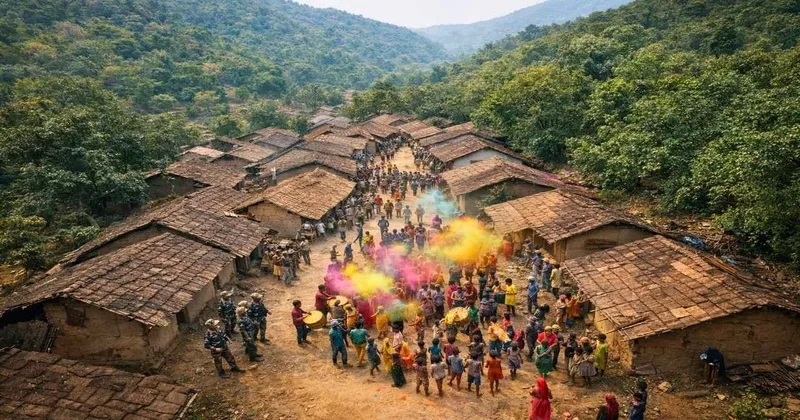
Abujhmad: For decades, the remote forests of Bastar lived under the constant shadow of Maoist violence. Today, however, signs of change are beginning to emerge from one of its most isolated regions, Abujhmad. This year, villagers celebrated Holi openly for the first time in decades, marking a symbolic shift in a region once gripped by fear.
The festival unfolded with colours, music, and laughter, an unfamiliar sight in an area where the threat of guns, landmines, and insurgent control once dictated daily life. Villagers, children, and security personnel participated together in the celebrations, reflecting a growing sense of normalcy in a region that had long remained inaccessible and troubled.
Abujhmad has historically been one of the strongest strongholds of the Maoists. Its dense forests, rugged terrain, and limited administrative presence made it a safe haven for Maoist groups for years. Armed cadres frequently held so-called “people’s courts,” carried out extortion, and imposed violent punishments. In such an environment, public celebrations and community gatherings were rare, as villagers lived under constant intimidation.
Festivals were often discouraged or informally banned in many villages under Maoist influence. Traditional cultural events gradually disappeared from public life, and social interactions were restricted by fear.
In recent years, however, the central and state governments have adopted a multi-pronged strategy to address the insurgency in Bastar. Increased deployment of security forces, establishment of new camps, expansion of road networks, and improvements in communication infrastructure have gradually begun to alter the situation on the ground. At the same time, surrender and rehabilitation policies have encouraged several insurgents to return to mainstream society.
As part of these efforts, new security and public utility camps have been set up in the Abujhmad region of Narayanpur district. In January 2026, one such camp was established in Jatwar village to support anti-Maoist operations and facilitate road construction and development work. The presence of these camps has gradually improved access to education, healthcare, and communication services in surrounding villages.
Officials say that the permanent presence of security forces in several parts of Narayanpur district has strengthened villagers’ confidence in their safety. Areas where community gatherings were once difficult are now witnessing festivals and cultural activities again.
Kutul village in Abujhmad is one such example. Once considered a heavily Naxalite-affected area that was difficult for the administration to reach, it witnessed vibrant Holi celebrations this year. The sounds of drums echoed through the village as children laughed and villagers smeared each other with colours.
Students from the Ramakrishna Mission Ashram in the village went door-to-door carrying gulal and sought blessings from elders, reviving a tradition that had remained dormant for years.
Local residents say that due to Maoist dominance in the past, festivals were rarely celebrated openly, and fear was a constant presence in everyday life. However, the establishment of security camps and the construction of roads have gradually transformed the situation.
Teachers in the region note that just a few years ago, nights in the village were marked by silence and anxiety. Today, signs of normal life are returning, children are attending school regularly, villagers are gathering for community events, and traditional festivals are once again being celebrated.
According to Jairam Das, a member of the Bastar Peace Committee, the transformation seen in the region is not only due to security operations but also the gradual restoration of trust within local communities. When villagers celebrate festivals freely, and children play without fear, it reflects a bigger social change, he says.
The union government has also emphasised its commitment to ending Maoism. Union Home Minister Amit Shah has repeatedly stated that Maoism has fueled decades of violence and underdevelopment, and he has set a deadline of March 31, 2026, for eliminating Maoism from the country.
Security analysts note that the influence and operational strength of maoist groups have declined significantly in recent years. The so-called Red Corridor, which once stretched across several states, has now been reduced to a few limited pockets.
Rehabilitation programs are another key component of the government’s approach. In states such as Chhattisgarh, surrendered Maoists are provided financial assistance, housing support, and skill training to help them reintegrate into society.
Several former insurgents who have returned to mainstream life say they are experiencing festivals and family life for the first time in years. Inside the organisation, they recall, there was little room for normal social activities as the focus remained on armed struggle.
The Holi celebrations in Kutul village are being viewed by locals as a symbol of this gradual transformation. In a region that once lived under constant fear, children playing with colours and villagers gathering freely suggest that Bastar may be slowly moving toward peace and normalcy.
Experts caution that the fight against Maoism is not yet over. However, the social and administrative changes visible across parts of Bastar indicate a shifting landscape, one where development, governance, and community life are beginning to reclaim space from decades of conflict.