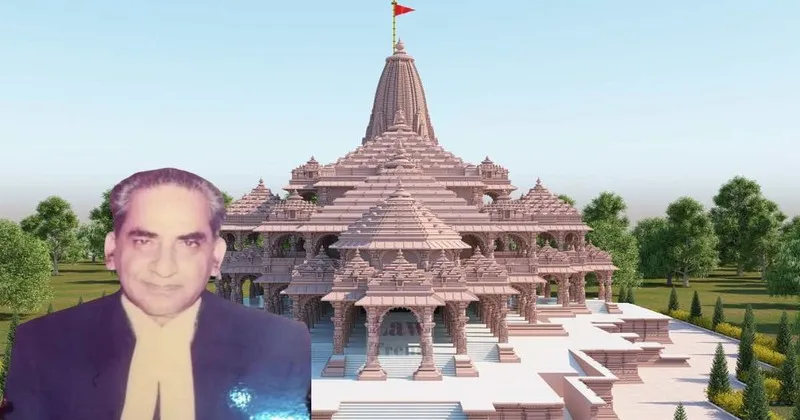
Justice Krishna Mohan Pandey: Man behind the Ayodhya verdict
July 11, 2026
  • Read Ecopy
  • Circulation
  • Advertise
  • Careers
  • About Us
  • Contact Us
Android AppiPhone AppArattai
Organiser
  • ‌
  • Bharat
    • Assam
    • Bihar
    • Chhattisgarh
    • Jharkhand
    • Maharashtra
    • View All States
  • World
    • Asia
    • Europe
    • North America
    • South America
    • Africa
    • Australia
  • Editorial
  • International
  • Opinion
  • RSS @ 100
  • More
    • Op Sindoor
    • Analysis
    • Sports
    • Defence
    • Politics
    • Business
    • Economy
    • Culture
    • Special Report
    • Sci & Tech
    • Entertainment
    • G20
    • Azadi Ka Amrit Mahotsav
    • Vocal4Local
    • Web Stories
    • Education
    • Employment
    • Books
    • Interviews
    • Travel
    • Law
    • Health
    • Obituary
  • Subscribe
    • Subscribe Print Edition
    • Subscribe Ecopy
    • Read Ecopy
  • ‌
  • Bharat
    • Assam
    • Bihar
    • Chhattisgarh
    • Jharkhand
    • Maharashtra
    • View All States
  • World
    • Asia
    • Europe
    • North America
    • South America
    • Africa
    • Australia
  • Editorial
  • International
  • Opinion
  • RSS @ 100
  • More
    • Op Sindoor
    • Analysis
    • Sports
    • Defence
    • Politics
    • Business
    • Economy
    • Culture
    • Special Report
    • Sci & Tech
    • Entertainment
    • G20
    • Azadi Ka Amrit Mahotsav
    • Vocal4Local
    • Web Stories
    • Education
    • Employment
    • Books
    • Interviews
    • Travel
    • Law
    • Health
    • Obituary
  • Subscribe
    • Subscribe Print Edition
    • Subscribe Ecopy
    • Read Ecopy
Organiser
  • Home
  • Bharat
  • World
  • Operation Sindoor
  • Editorial
  • Analysis
  • Opinion
  • Culture
  • Defence
  • International Edition
  • RSS @ 100
  • Magazine
  • Read Ecopy
Home Bharat

Ayodhya’s Historic 1986 Judgment: The legacy of Justice Krishna Mohan Pandey & challenges his family says they faced

Justice Krishna Mohan Pandey's 1986 order allowing Hindu worship at the disputed Ayodhya structure became a landmark moment in the Ram Janmabhoomi movement. While the verdict shaped history, his family claims it came at a high personal and professional cost, including stalled promotions, alleged threats, and social hardships

Nandini NairNandini Nair
Jul 11, 2026, 03:00 pm IST
in Bharat, Uttar Pradesh
Follow on Google News
Justice Krishna Mohan Pandey's 1986 order opening the locks at the disputed Ayodhya structure became a pivotal legal milestone in Ram Janmabhoomi movement

Justice Krishna Mohan Pandey's 1986 order opening the locks at the disputed Ayodhya structure became a pivotal legal milestone in Ram Janmabhoomi movement

FacebookTwitterWhatsAppTelegramEmail

Ayodhya: Long before the grand Ram Mandir was built in Ayodhya, a series of legal and judicial developments shaped the path toward its construction. Among the most significant was the 1 February 1986 order by District Judge Justice Krishna Mohan Pandey (then District and Sessions Judge, Faizabad), directing that the locks at the disputed structure be opened to allow Hindu devotees to worship. While the judgment became a defining moment in the Ram Janmabhoomi movement, Justice Pandey’s family later claimed that the decision came at an enormous personal and professional cost.

The Bhavya Ram Mandir constructed in Ayodhya after the sacrifices and struggles of many people.

One such person is Justice Krishna Mohan Pandey, who allowed Hindus to worship at the disputed structure. The turmoil that his life took following the decision is unimaginable. After… pic.twitter.com/H93BcFMYBw

— KV Iyyer – BHARAT 🇮🇳🇮🇱 (@BanCheneProduct) July 6, 2026

The 1986 Judgment

When Justice Krishna Mohan Pandey took charge as the District Judge of Faizabad (now Ayodhya), one of the oldest pending matters before him was the decades-long dispute over the locked structure at the Ram Janmabhoomi site.

According to accounts shared by his daughter, Dr Madhu Pandey, her father believed that long-pending cases should not remain unresolved indefinitely. He therefore prioritised the matter and spent nearly three to four months examining every available record before delivering his verdict. His research reportedly included historical gazetteers, court records, documentary evidence, administrative files, and previous legal proceedings related to the disputed site. After examining the available material, he concluded that there was no legal basis for keeping the locks at the disputed structure closed.

After reviewing the material, Justice Pandey reportedly concluded that there was no legal justification for keeping the locks on the disputed structure closed.

On February 1, 1986, he ordered that the locks be opened, enabling Hindu devotees to offer prayers at the site. The order marked a major turning point in the Ram Janmabhoomi dispute and significantly altered the legal and political landscape surrounding the issue.

According to Dr Madhu Pandey, her father reached the decision independently after examining the evidence before him. She has maintained that no political authority pressured him to pass a judgment favouring either side. Instead, she said, Justice Pandey believed that justice required deciding the matter based solely on the facts and legal records before the court.

The Consequences of the Decision

Although the judgment became historic, the Pandey family has alleged that its aftermath proved extremely difficult. According to family accounts and later legal proceedings, Justice Pandey’s promotion to the Allahabad High Court did not move forward despite being recommended.

Also Read: From Vietnam to Bahrain: Inside the Modi government’s mission to restore ancient Hindu Mandir across Asia

Dr Madhu Pandey has also spoken publicly about the impact the judgment had on her personal life. She has alleged that while studying medicine at King George’s Medical College (KGMC), Lucknow, fellow students from a particular community allegedly harassed her after learning that her father had ordered the opening of the locks.

According to her account, the atmosphere became so hostile that she was forced to miss several examinations. These allegations reflect the intense social and communal tensions surrounding the Ayodhya dispute during that period.

Members of Justice Pandey’s family have also claimed that after the judgment, he began receiving threats, including alleged threats originating from Pakistan. While these claims have been repeated in interviews by family members, detailed official documentation regarding the nature and source of the threats remains limited in the public domain.

The “Black Monkey” Incident Described in His Autobiography

One of the most widely discussed portions of Justice Pandey’s autobiography, Voice of Conscience (1991), recounts an unusual incident on the day he delivered the judgment.

Justice Pandey wrote that throughout the hearing, a black monkey sat on the roof of the courtroom holding the flagpole. According to his account, thousands of people gathered outside, offering the animal fruits and groundnuts, but it did not touch any of them. He further wrote that after he pronounced the order at approximately 4:40 pm, the monkey disappeared from the court premises. Later, when the District Magistrate and Senior Superintendent of Police escorted him to his residence, he claimed the same monkey was sitting in the verandah of his bungalow. Justice Pandey described saluting the monkey, writing that he regarded it as a manifestation of a divine power. The account reflects his personal spiritual interpretation of the events and forms part of his autobiography rather than an independently verified historical fact.

A Judgment That Became Part of Ayodhya’s Legal History

The 1986 order allowing Hindu worship at the disputed structure became one of several landmark legal developments that shaped the Ram Janmabhoomi litigation over the following decades. The dispute ultimately culminated in the Supreme Court’s unanimous 9 November 2019 judgment, which awarded the disputed land for the construction of the Ram Mandir while directing that an alternative five-acre plot be allotted for the construction of a mosque. Following that verdict, the Shri Ram Janmabhoomi Mandir was constructed in Ayodhya, with the consecration ceremony held on 22 January 2024.

For many supporters of the Ram Janmabhoomi movement, Justice Krishna Mohan Pandey remains one of the lesser-known judicial figures whose 1986 order altered the trajectory of the dispute. It marked the first major judicial opening in the modern phase of the Ram Janmabhoomi movement and remains an important chapter in the legal history that eventually led to the construction of the Ram Mandir in Ayodhya.


 

Topics: Justice Krishna Mohan PandeyBabri DisputeAyodhya Verdict 1986Voice of ConscienceRam Mandir HistoryRam JanmabhoomiIndian JudiciaryAyodhya Ram Mandir
Nandini Nair
Nandini Nair
Nandini Nair is a Subeditor-cum-Content Manager at Organiser Digital with more than 3.5 years of experience covering international, national, cultural and current affairs. Also tracks and develops impactful stories emerging from social media discourse, delivering engaging digital reporting [Read more]
ShareTweetSendShareSend
✮ Subscribe Organiser YouTube Channel. ✮
✮ Join Organiser's WhatsApp channel for Nationalist views beyond the news. ✮
Previous News

World Population Day: India’s demographic dividend drives growth, while Europe, China & US battle ageing crises

Related News

A series of viral claims about thefts and donation irregularities at Ram Mandir have been countered by official clarifications & fact-checks

Propaganda Demolished: Every single fake narrative targeting the Ram Mandir utterly smashed by facts!

Uttar Pradesh Yogi Adityanath

Ayodhya: CM Yogi slams SP, Congress over Hanumangarhi Namaz, asks if they can hold Hanuman Chalisa at Jama Masjid

RSS Sarkaryavah Dattatreya Hosabale

“Unfortunate and painful, true Dharmikta must be restored”: Dattatreya Hosabale

Gujarat HC has ruled that a Hindu marriage is not legally valid without essential rites like Saat Pheras (AI-generated image)

Gujarat HC rules registration alone cannot validate Hindu marriage unless sacred ‘Saptapadi’ is performed

Vishva Hindu Parishad's International President Alok Kumar

Ram Mandir Donation Row: VHP’s Alok Kumar seeks fast-track trial; says culprits must be punished by court

Suhail arrested for plotting terror attack on Ayodhya Ram Mandir

Karnataka: Terror plot targeting Ayodhya Ram Mandir unearthed after arrest of suspected terrorist Suhail

Load More

Latest News

Justice Krishna Mohan Pandey's 1986 order opening the locks at the disputed Ayodhya structure became a pivotal legal milestone in Ram Janmabhoomi movement

Ayodhya’s Historic 1986 Judgment: The legacy of Justice Krishna Mohan Pandey & challenges his family says they faced

World Population Day: India’s demographic dividend drives growth, while Europe, China & US battle ageing crises

Bharat's timeless civilisation continues to transcend borders through its enduring culture, values, and soft power

Beyond Borders: Why Bharat’s ancient civilisational legacy still influences nations across Asia and beyond

INS Mahendragiri commissioned into Indian Navy; Indigenous stealth frigate marks a milestone in maritime security

Bharat Jodo Yatra has faced scrutiny over participation of several individuals later linked to arrests, FIRs & major criminal controversies

From Hate Speech to Crime: How Rahul Gandhi’s Bharat Jodo Yatra became a haven for radical and disreputable elements

Ayodhya Ram Mandir: All construction to conclude by July 30; Storyline for Ram Katha Sangrahalay finalised

Namaste is a timeless Indian greeting that symbolises respect, humility, and harmony

The Art of Namaste: Exploring the ancient Indian greeting that symbolises respect, humility & human connection

Vice-President of India, CP Radhakrishnan

Sardar Patel united not only territories but also hearts of Indians: VP Radhakrishnan in virtual address at IIAS Shimla

Bible-related prosecutions, church raids and mass arrests have become central to a new report on the treatment of Christians in Iran.

Iran’s anti-Christian crackdown escalates with Bible bans, church seizures and mass arrests: Report

UP govt to replace Shop act with OSH Code

Uttar Pradesh to scrap 60-year-old shop act and align the state’s rules with the OSH Code framework

Load More
  • Privacy
  • Terms
  • Cookie Policy
  • Refund and Cancellation
  • Delivery and Shipping

© Bharat Prakashan (Delhi) Limited.
Tech-enabled by Ananthapuri Technologies

  • Home
  • Search Organiser
  • Bharat
    • Assam
    • Bihar
    • Chhattisgarh
    • Jharkhand
    • Maharashtra
    • View All States
  • World
    • Asia
    • Africa
    • North America
    • South America
    • Europe
    • Australia
  • Editorial
  • Operation Sindoor
  • Opinion
  • Analysis
  • Defence
  • Culture
  • Sports
  • Business
  • RSS @ 100
  • Entertainment
  • More ..
    • Sci & Tech
    • Vocal4Local
    • Special Report
    • Education
    • Employment
    • Books
    • Interviews
    • Travel
    • Health
    • Politics
    • Law
    • Economy
    • Obituary
  • Subscribe Magazine
  • Read Ecopy
  • Advertise
  • Circulation
  • Careers
  • About Us
  • Contact Us
  • Policies & Terms
    • Privacy Policy
    • Cookie Policy
    • Refund and Cancellation
    • Terms of Use

© Bharat Prakashan (Delhi) Limited.
Tech-enabled by Ananthapuri Technologies