Bastar: For decades, the name Bastar evoked images of dense forests, Maoist insurgency and isolated tribal villages caught in the crossfire of one of India’s longest internal security challenges. Stretching across southern Chhattisgarh, the Bastar region was home to some of the country’s richest tribal traditions, yet remained deprived of basic infrastructure, quality education and healthcare due to prolonged violence.
𝐅𝐨𝐫 𝐝𝐞𝐜𝐚𝐝𝐞𝐬, 𝐁𝐚𝐬𝐭𝐚𝐫'𝐬 𝐜𝐡𝐢𝐥𝐝𝐫𝐞𝐧 𝐠𝐫𝐞𝐰 𝐮𝐩 𝐡𝐞𝐚𝐫𝐢𝐧𝐠 𝐠𝐮𝐧𝐟𝐢𝐫𝐞. 𝐓𝐨𝐝𝐚𝐲, 𝐭𝐡𝐞𝐲 𝐚𝐫𝐞 𝐫𝐞𝐚𝐝𝐢𝐧𝐠 𝐛𝐨𝐨𝐤𝐬 𝐢𝐧 𝐭𝐡𝐞𝐢𝐫 𝐨𝐰𝐧 𝐦𝐨𝐭𝐡𝐞𝐫 𝐭𝐨𝐧𝐠𝐮𝐞. 𝐓𝐡𝐚𝐭 𝐢𝐬 𝐭𝐡𝐞 𝐝𝐢𝐟𝐟𝐞𝐫𝐞𝐧𝐜𝐞 𝐩𝐞𝐚𝐜𝐞 𝐚𝐧𝐝… pic.twitter.com/C4UNO0xnVp
— BJP (@BJP4India) July 14, 2026
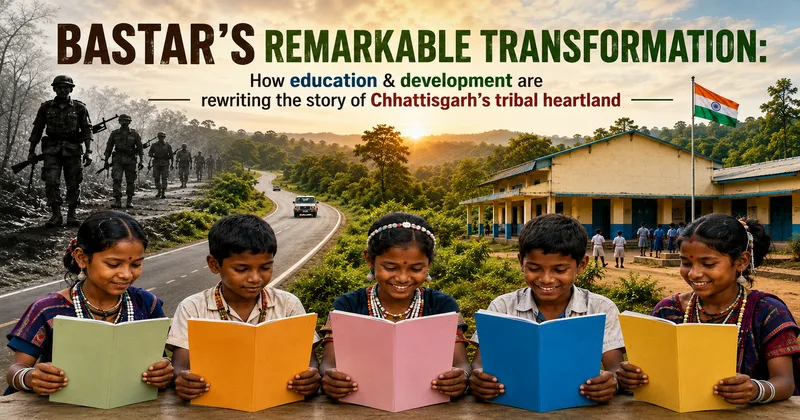
Today, Bastar is undergoing a remarkable transformation. Roads are reaching villages that were once inaccessible, schools are functioning more regularly, mobile connectivity is expanding, and children are learning in their own tribal languages under the National Education Policy (NEP) 2020. The government’s intensified security operations against Maoism, coupled with a renewed focus on development, have altered the region’s trajectory. The story of Bastar is no longer only about conflict. Increasingly, it is becoming a story of education, opportunity, connectivity and hope.
Bastar: A Region Rich in Culture, Yet Long Affected by Conflict
Located in southern Chhattisgarh, Bastar is home to several indigenous communities, including the Gond, Muria, Maria, Halba, Bhatra and Dhurwa tribes. The region possesses immense natural wealth, dense forests and unique cultural traditions that have survived for centuries. However, beginning in the late twentieth century, Bastar became one of the principal centres of Maoist insurgency in India. Over time, violence spread across large forested areas, affecting daily life and slowing development. Government institutions often struggled to function in remote villages, and infrastructure projects were frequently disrupted.
Schools, healthcare centres and roads were among the sectors most affected. In many places, teachers found it difficult to reach villages, construction work was delayed, and tribal communities remained isolated from essential public services.
In recent years, the Central Government, together with the Chhattisgarh Government, intensified its efforts to address Maoist violence through a combination of security operations and development initiatives. The strategy extended beyond counterinsurgency. It focused on restoring governance, expanding infrastructure, improving welfare delivery and strengthening public institutions in previously inaccessible regions.
In 2024, Union Home Minister Amit Shah announced the government’s target of eliminating Maoist terrorism by March 31, 2026. According to the government, that objective has been achieved within the announced timeline, marking what it describes as the successful conclusion of a prolonged campaign against Maoism. Government leaders have characterised this milestone as not merely a security achievement but as the beginning of a new development-oriented phase for the affected regions.
For decades, many villages in Bastar remained disconnected because roads could not be constructed safely. Contractors often abandoned projects due to security threats, while public services struggled to reach remote populations. With improved security conditions, infrastructure development has accelerated. Roads are connecting villages to district headquarters, reducing travel time and improving access to hospitals, schools and markets. Electricity, banking facilities, mobile networks and digital services are also expanding their reach, enabling greater participation in the formal economy.
Better connectivity is helping farmers transport agricultural produce, improving access to government welfare schemes and opening new opportunities for entrepreneurship.
Education: The Most Visible Sign of Change
Perhaps the most powerful symbol of Bastar’s transformation is the revival of education. For years, violence disrupted schooling in many areas. Some schools remained closed, while others operated irregularly due to security concerns.
Today, classrooms are reopening, student attendance is improving, and educational infrastructure is expanding. One of the most significant reforms has come through the implementation of the National Education Policy 2020, which encourages children to receive foundational education in their mother tongue.
In Bastar, textbooks are increasingly available in tribal languages alongside Hindi, enabling children to learn concepts in a language they naturally understand.
Educational research across the world has consistently shown that children grasp foundational concepts more effectively when taught in their first language. Mother-tongue education also reduces dropout rates, improves classroom participation and strengthens cultural identity. For tribal children, this approach is particularly meaningful because it validates their language and heritage while improving learning outcomes.
Development in Bastar is increasingly being linked with cultural preservation rather than cultural replacement. The tribal communities of Bastar possess distinctive languages, folklore, art forms, festivals and traditional knowledge systems that form an important part of India’s civilisational diversity.
Providing education in local languages allows children to remain connected with their heritage while acquiring the skills necessary to participate in modern education and employment. This balanced approach seeks to ensure that development strengthens rather than weakens indigenous identities.
Expanding Healthcare and Public Services
Improved security has also enabled healthcare services to reach previously inaccessible areas. Primary health centres, vaccination campaigns, maternal healthcare programmes and ambulance services are becoming more accessible to remote tribal populations.
Government welfare schemes, banking services and digital governance initiatives have also expanded, helping residents obtain identity documents, pensions, food security benefits and financial assistance more efficiently. The growing presence of government institutions reflects an effort to integrate remote villages more closely with mainstream governance while respecting local traditions.
Economic Opportunities Beyond Conflict
Peace has also created opportunities for economic growth. Improved roads reduce transportation costs for forest produce and agricultural goods. Better connectivity attracts investment and facilitates tourism in culturally and ecologically significant areas.
Skill development programmes, entrepreneurship initiatives and livelihood projects aim to create employment opportunities for local youth, reducing dependence on traditional subsistence activities and providing alternatives to conflict. As infrastructure improves, Bastar’s abundant natural resources and cultural richness could contribute to sustainable economic development while ensuring that local communities remain key stakeholders.
Despite significant progress, Bastar’s transformation remains a work in progress. Many remote villages still require improved healthcare, quality education, reliable internet connectivity and employment opportunities. Long-term development will depend on continued investment in infrastructure, effective governance and meaningful participation of tribal communities in decision-making.
Ensuring that economic development remains environmentally sustainable and culturally sensitive will also be essential. Peace creates opportunities, but lasting prosperity depends upon consistent implementation of development programmes and inclusive growth.
The transformation taking place in Bastar represents more than the decline of insurgency. It reflects a broader attempt to replace decades of conflict with education, infrastructure, governance and opportunity. While the region’s journey is still unfolding, visible changes in schools, roads, healthcare and public services suggest that Bastar is entering a new chapter. For generations that grew up amid uncertainty, the emergence of classrooms filled with children reading in their mother tongue stands as a powerful symbol of hope.
The future of Bastar will ultimately be measured not only by the absence of violence, but by the presence of opportunity, where every child can attend school without fear, every village can access essential services, and every family can participate in India’s ongoing development story.