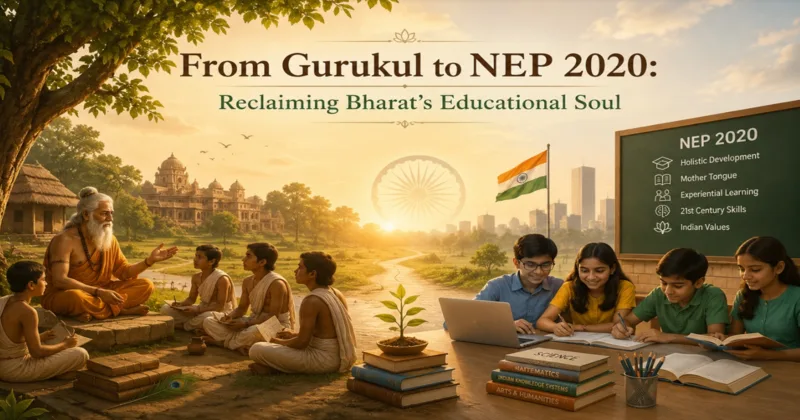
There is a Sanskrit shloka that has guided Bharatiya thought for millennia “विद्या ददाति विनयं विनयाद्याति पात्रताम्।” Knowledge gives rise to humility, humility to worthiness and worthiness to prosperity, and through prosperity one attains righteousness and lasting happiness. This was not a verse recited in ancient Gurukuls. It was a philosophy where a complete architecture of human development that preceded by centuries anything the modern world claims to have invented about holistic education.
Today India stands at the threshold of its centenary of Independence, Viksit Bharat @2047, the question is no longer whether we have schools enough. We have over 14.71 lakh schools serving more than 24.69 crore students as reported by UDISE 2024-25. The question that confronts us now is far more fundamental, Are those schools truly educating or schooling? While asking this, we find ourselves returning, inevitably to where we began.
The Civilisational Roots of Bharatiya Education
In ancient Bharat, Vidya was not a certificate to be earned but a dharma to be lived. The Gurukul system was not simply a pedagogical model, it was a moral ecosystem. The student lived with the teacher, learned through observation and experience, engaged with nature and internalised knowledge along with character. Education was Brahmavidya and Lokvidya both, the pursuit of the transcendent and the practically unified.
The concept of Vidya parañ daivataṃ where education as the highest deity, elevated learning to the sacred. This civilisational understanding produced mathematicians like Aryabhatta, grammarians like Panini, philosophers like Shankaracharya and strategists like Chanakya. The Nalanda and Takshashila universities were not accidents, they were the institutional flowering of a society that had placed knowledge at the centre of its civilisational project. Then came the colonial disruption from Christians.
The Colonial Wound and Its Aftermath
Macaulay’s Minute on Education (1835) did not only introduce English-medium instruction. It systematically dismantled the indigenous knowledge ecosystem, replacing Gurukul wisdom with clerical competence. The goal was explicit to create, in Macaulay’s own words a class of persons “Indian in blood and colour, but English in taste, in opinions, in morals and in intellect.” Elphinstone Minutes of 1823 had already set the stage. Together they succeeded in severing the organic connection between education and culture that had sustained Bharat for centuries.
Post-Independence India inherited this broken system and had to rebuild under conditions of severe poverty, inadequate infrastructure and deep social inequities. Yet the spirit of the nation refused to surrender. Swami Vivekananda calls “If the poor boy cannot come to education, education must go to him” the constitutional commitment that placed elementary education at the heart of Article 45.
The last decades that followed and saw determined efforts. The Mudaliar Commission in 1952, the landmark Kothari Commission (1964-66) which declared that “India’s destiny is being made in its classrooms”, the National Policy on Education of 1968 and its revised version in 1986 each added a layer to the rebuilding project. The three-language formula, the call for 6% of national income for education, the introduction of Operation Blackboard and Navodaya Vidyalayas for rural talent these were not just policy measures. They were expressions of a nation will to recover its educational soul.
Long March Towards Universalisation
The millennium opened a new chapter. Sarva Shiksha Abhiyan (2001-02) under Atal Bihari Vajpayee government, brought school education to the doorstep of every child between 6 and 14 years. The Mid-Day Meal Scheme, introduced in 1995 and later expanded has transformed attendance figures by addressing hunger and acknowledging in a practical way that learning is impossible on an empty stomach. The Right of Children to Free and Compulsory Education Act (2009) made education a justiciable fundamental right for the first time, mandating 25% reservation in private schools for children from economically weaker sections.
The Rashtriya Madhyamik Shiksha Abhiyan (RMSA) extended the universalisation agenda to secondary education. Samagra Shiksha (2018) then unified the fragmented approaches of SSA, RMSA and Teacher Education under a single integrated framework finally treating education as a continuum rather than a series of disconnected stages. By this time, India had also aligned itself with the global Sustainable Development Goal 4 which ensures inclusive, equitable and quality education for all by 2030.
Between independence and today, India has moved from abysmal literacy rates to over 77% literacy. Enrolment in primary schools now approaches near-universalisation. Girls who once sat outside the walls of opportunity are today enrolled in record numbers. These are genuine achievements, hard-won over decades. But enrolment is not education. Attendance is not learning, it is here that the deeper reckoning begins.
NEP 2020: Bharat’s Educational Renaissance
The National Education Policy 2020 is, arguably the most significant educational reform since Independence and perhaps more importantly, it is the first major policy that explicitly reaches back into Bharat’s civilisational heritage rather than looking westward for inspiration. The resonance with the Gurukul ideal is unmistakable.
NEP 2020 replaces the rigid 10+2 structure with a 5+3+3+4 framework covering ages 3-18, aligning school stages with the natural arc of child development much as ancient systems of learning were calibrated to the ashrama stages of life. The policy mandates that the medium of instruction until at least Grade 5 and till Grade 8 shall be the mother tongue or home language. This is not only a linguistic preference, it is a civilisational statement. It says that a child learns best in the language of her heart, home and community, a truth that every Gurukul understood and every colonial system rejected.
The polices emphasised on the experiential, inquiry-based and application-oriented learning, by integrating arts, music, craft and vocational skills into the mainstream curriculum. It is a direct echo of the Gurukul pedagogy that saw no distinction between intellectual formation and practical wisdom. The ancient student who learned astronomy while tending to the Gurukul agricultural land was not wasting time, he was understanding the cosmos through the soil.
The NIPUN Bharat Mission, mandated under NEP 2020 to achieve universal foundational literacy and numeracy by Grade 3 by 2025, addresses perhaps the most alarming failure of the post-independence system that millions of children were completing primary school without being able to read a simple sentence or solve a basic sum. For a civilisation that once produced the decimal system and the concept of zero, this is not just a policy problem. It is a civilisational emergency.
Assessment reform through PARAKH the National Assessment Centre for Performance Assessment, Review and Analysis of Knowledge for Holistic Development, signals a shift away from the rote-and-recall model that colonial education bequeathed to us, towards competency-based assessment that measures genuine understanding. The policy also mandates that teachers must hold a four-year integrated B.Ed. degree, have merit-based recruitment and receive continuous professional development through platforms like NISHTHA and DIKSHA, as the ancient tradition always did that the quality of education is ultimately the quality of the teacher.
Early Childhood Care and Education (ECCE) for children aged 3-6 years, to be universalised by 2030, represents yet another alignment with Bharatiya wisdom. The Panchamahabhuta principle where formation begins at the very earliest stage of life is now finding proper place in state policy.
From Policy to Practice: The Road Ahead
Five years since NEP 2020’s adoption, implementation progress is uneven as it always is in a federation as vast and diverse as Bharat. Some States have moved swiftly, others are still finding their footing. The National Curriculum Frameworks have been released, the school complex model is being piloted, NIPUN targets are being tracked and PARAKH has begun its work. But the transformation of a system touching over 24 crore children is not the work of a single election cycle. It is the work of a generation.
What NEP 2020 has done is restore the correct philosophical foundation. It has been said explicitly that education in Bharat must be rooted in Bharatiya values, Bharatiya languages, Bharatiya ways of knowing, while remaining fully equipped for the demands of the 21st century. This is not a retreat from modernity. It is the confidence of a civilisation that knows it has something to offer the world, not just to absorb from it.
As India moves towards 2047, the measure of success will not be the number of schools on a map or the percentage of enrolled children in a register. It will be whether a child in a village in Uttar Pradesh or a tribal area in Jharkhand can read, think, question and contribute, whether she leaves her school not merely with a certificate, but with Vinaya or humility and worthiness that the ancient tradition promised. The Gurukul is not dead. It is being reimagined. And in that reimagining lies Bharat’s best hope.