The Karnataka government has formally withdrawn the 2022 classroom restrictions introduced under the previous BJP administration, permitting students to wear hijab, janivara (sacred thread), turbans and other religious symbols along with prescribed school uniforms in educational institutions across the state.
Announcing the revised guidelines on May 13, Karnataka Education Minister Madhu Bangarappa said no student would be denied entry into classrooms or examinations for wearing permitted faith-based symbols as long as they complied with the broader uniform code.
The move effectively marks a major policy shift in the state’s approach to the hijab controversy that had triggered nationwide protests, court battles and intense political debate in 2022 after the BJP government enforced restrictions on religious attire inside classrooms.
“Children should not face inconvenience because of traditional and religious practices. We have framed guidelines to ensure there is clarity,” Bangarappa said while announcing the decision.
Saffron Shawls not allowed
Saffron shawls will not be allowed in schools, Chief Minister Siddaramaiah has said, in what has snowballed into a fresh flashpoint with the opposition BJP a day after the Congress government allowed students to wear hijab, sacred thread, turban, and other religious symbols.
Speaking to reporters in Mysuru on May 14, the CM said that the religious attire already in practice will continue to be allowed.
“Saffron shawls are not allowed. Those shawls cannot be worn. Turbans, sacred thread, Shiva dhara, rudraksha, and hijab can be worn according to the beliefs. These are allowed up to Class 12,” Siddaramaiah said.
“When we say turbans, we mean the practices that already exist. Nothing new can be introduced. Only those practices and beliefs that already exist till now are allowed,” he added.
How the Karnataka hijab controversy began?
The controversy began in early 2022 at a government pre-university college in Karnataka’s Udupi district after several Muslim students were denied entry into classrooms for wearing hijabs despite an existing dress code policy.
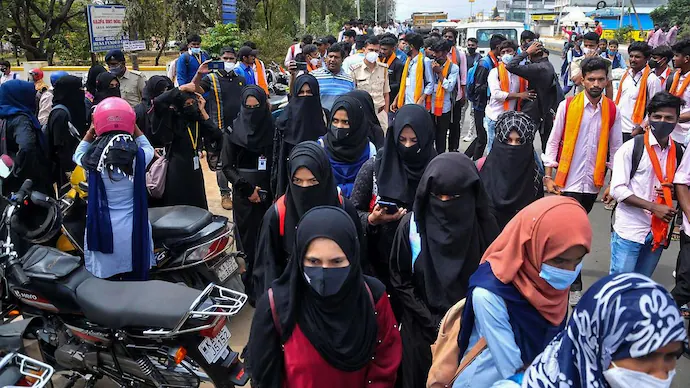
The issue quickly escalated into a nationwide political, legal and ideological confrontation. Protests spread across Karnataka, with groups of Muslim students demanding the right to wear hijab inside classrooms. In response, several Hindu students began wearing saffron scarves to colleges, arguing that if religious attire was allowed in educational institutions, Hindu symbols could not be selectively prohibited.
The visuals of hijab-clad students facing off against students wearing saffron shawls became symbolic of a larger conflict over secularism, constitutional rights and the role of religion in public institutions.
The Karnataka government subsequently issued an order reinforcing uniform rules in educational institutions and restricting clothing that could disturb equality, public order or discipline.
That government order was challenged before the Karnataka High Court, leading to one of the most closely watched constitutional cases in recent years.
Karnataka High Court upheld uniform rules
In March 2022, the Karnataka High Court upheld the government’s order and ruled that wearing the hijab was not an “Essential Religious Practice” under Islam.
The court held that prescribing school uniforms was a reasonable restriction and an important aspect of institutional discipline. It further ruled that educational institutions have the authority to maintain uniformity among students in order to preserve equality and order inside classrooms.
The High Court also rejected arguments that the ban violated Articles 19 and 25 of the Constitution dealing with freedom of expression and freedom of religion.
The judgment was welcomed by those who argued that classrooms should remain religion-neutral spaces where institutional identity takes precedence over visible religious assertion.
Many Hindu students and organisations questioned why hijabs should be treated differently if saffron scarves or other visible Hindu symbols were discouraged in classrooms under uniform policies.
“If hijab is permitted in the name of religious freedom, on what grounds can saffron scarves be opposed?” became one of the defining counter-questions raised during the protests.
Supreme Court split verdict left issue unresolved
The Karnataka High Court ruling was challenged before the Supreme Court, where a two-judge bench delivered a split verdict in October 2022.
One judge upheld the Karnataka government’s position, observing that the state was within its constitutional authority to enforce uniform rules in educational institutions.
The judge stated that uniforms promote equality and reduce visible markers of religious or social difference inside classrooms. Allowing religious attire in secular educational spaces, he observed, could create feelings of division and inequality among students.
He also held that adherence to a prescribed uniform constituted a reasonable restriction on individual expression and that students attending secular institutions cannot insist on wearing religious head coverings as a matter of absolute right.
However, the second judge took a different view and held that the ban disproportionately impacted Muslim girls and their education.
The judge described wearing the hijab as a matter of personal choice, dignity and privacy protected under Articles 19(1)(a) and 21 of the Constitution. He expressed concern that restrictions on hijab could discourage some girls from continuing education altogether.
Due to the split verdict, the matter remains legally unresolved and is expected to be referred to a larger bench of the Supreme Court for a final determination.
Previous court rulings on religious dress codes
Indian courts have dealt with similar issues in the past.
In 2015, the Kerala High Court directed the Central Board of Secondary Education (CBSE) to implement additional safeguards for students wearing religious attire during examinations while ensuring that discipline and examination integrity were not compromised.
In the 2016 Amna Bint Basheer case, the Kerala High Court recognised hijab as an essential religious practice but still permitted security checks and additional procedures during examinations.
In another case, Fathima Tasneem v State of Kerala (2018), the Kerala High Court ruled that the collective rights and institutional discipline of a school could take precedence over individual claims regarding dress practices.
These rulings highlighted the judiciary’s continuing effort to balance individual religious rights with institutional regulations and public order.
Why the issue remains politically sensitive
The hijab issue remains politically charged because it sits at the intersection of religion, women’s rights, constitutional freedoms and electoral politics.
For many Muslim organisations, the hijab represents religious identity and personal autonomy.
For many Hindu groups and supporters of uniform policies, the issue symbolises what they view as selective secularism and unequal treatment of religious expression in public institutions.
The saffron scarf protests that emerged during the controversy fundamentally altered the debate by introducing the question of reciprocity: if one visible religious identity is accommodated in classrooms, can another be restricted without appearing discriminatory?
That question continues to dominate public discourse as the legal battle remains unresolved before the Supreme Court.
The larger constitutional and cultural debate
The hijab controversy has evolved far beyond a dress-code dispute and emerged as a larger national debate over secularism, equal application of rules and the nature of public educational spaces in India.
Karnataka government’s latest move that educational institutions cannot maintain neutrality overt religious identities are increasingly asserted inside classrooms. They contend that schools and colleges are meant to function as common civic spaces where students participate primarily as learners under a uniform code rather than as representatives of competing religious identities.
Many supporters of the uniform policy maintain that India’s secular framework cannot operate selectively. They argue that if visible religious attire and symbols are permitted for one community, institutions would find it difficult to deny similar assertions from others, including saffron scarves, tilaks, rudraksha beads or other Hindu religious symbols.
This argument became particularly visible during the Karnataka protests when Hindu students wearing saffron scarves questioned what they described as a selective interpretation of secularism that appeared more willing to accommodate Islamic identity while discouraging visible Hindu assertion in the name of institutional neutrality.
Supporters of a strict uniform code further warn that relaxing such norms could gradually transform campuses into spaces of identity-based mobilisation, where religious assertion begins overshadowing academic and civic culture.
For many, the controversy is therefore not limited to the hijab alone, but centres on whether the state applies principles of secularism, equality and institutional discipline uniformly across all communities.