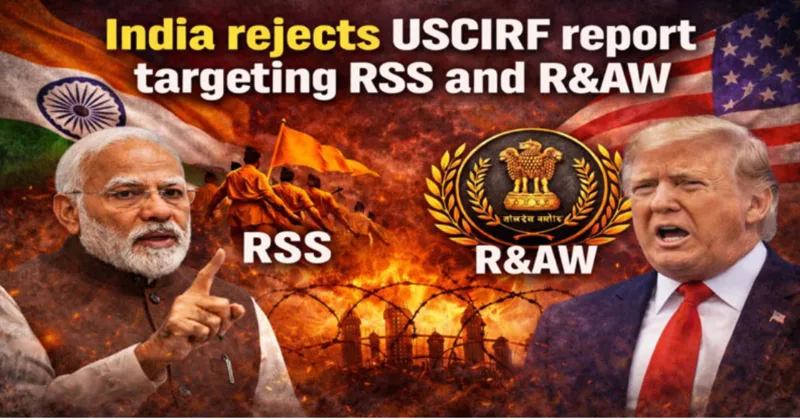
The annual report of the United States Commission on International Religious Freedom once again brought India into the centre of international discussions on religious freedom after recommending that the country be designated as a “Country of Particular Concern” (CPC) and proposing sanctions against the Rashtriya Swayamsevak Sangh (RSS) and the Research and Analysis Wing (R&AW). Responding to this, Ministry of External Affairs spokesperson Randhir Jaiswal called the report “biased and motivated,” saying it presents a selective and distorted picture of India. He added that such repeated claims only weaken the credibility of the commission. India also pushed back strongly by pointing out incidents within the US, especially attacks on Hindu temples and threats faced by the Indian community.
However, the significance of the debate surrounding the USCIRF report extends beyond disagreement over particular findings or recommendations. The larger issue concerns the framework through which India’s approach to religious freedom and pluralism is assessed. The purpose of this article, therefore, is not merely to revisit factual rebuttals that have already been widely discussed, but to examine the issue through India’s constitutional structure and enduring Indic principles. Both demonstrate that religious freedom, coexistence, and respect for diversity are not incidental features of the Indian system, but deeply embedded values reflected in its constitutional guarantees, democratic institutions, and broader social ethos.
India’s constitutional structure itself provides a compelling answer to many of the concerns raised in these reports. Articles 25 to 28 of the Constitution guarantee freedom of conscience and the right to freely profess, practice, and propagate religion. These protections are not symbolic declarations; they are fundamental rights safeguarded by an independent judiciary within a democratic system. More significantly, Articles 29 and 30 provide specific protections to minorities, including the right to conserve their culture, language, and script, and to establish and administer educational institutions. This dual structure—combining universal guarantees of religious freedom with specific protections for minorities—is relatively rare in comparative constitutional jurisprudence. It reflects not merely a formal commitment to equality, but a substantive recognition of diversity– ensuring that minority identities are not only protected but institutionally empowered.
This constitutional vision is reinforced by India’s democratic experience since independence. Despite extraordinary linguistic, cultural, and religious diversity, India has sustained a constitutional order where multiple faiths coexist within a single democratic framework. Electoral participation, judicial review, freedom of worship, minority educational rights, and vibrant public discourse collectively demonstrate the institutional depth of India’s pluralism. To equate such a constitutional democracy with regimes that systematically suppress religious freedom ignores both constitutional reality and historical experience.
It is precisely this disconnect that led many constitutional authorities and public figures in India to question the credibility and methodology of the USCIRF report. On March 21, a group of 275 former judges, diplomats, civil servants, and armed forces officers issued a detailed statement criticizing the report’s conclusions. The signatories questioned both the credibility of the commissioners of USCIRF, and the methodology used in the report. They argued that assessments of religious freedom must rely on long term demographic trends rather than selective or episodic narratives. Their observations are significant because they draw attention to demographic and institutional trends that are overlooked in the assessment. Census data indicates that the Muslim population in India has steadily increased from 9.8% in 1951 to 14.2% in 2011, while Christian and Sikh populations have remained stable at 2.6% and 1.7% respectively. Such trends are difficult to reconcile with allegations of systemic religious persecution. The signatories therefore, argued that the broader social and constitutional ecosystem in India does not support claims of institutionalized exclusion of minorities.
The group also strongly criticized recommendations seeking sanctions against Indian organizations and institutions, describing them as excessive and inadequately grounded in objective analysis. They acknowledged that organizations in a democracy remain open to criticism and scrutiny. However, they emphasized that criticism must rest upon verifiable evidence, contextual understanding, and consistent standards rather than selective interpretation.
Another concern relates to the selective nature religious freedom narratives. Incidents involving attacks on Hindu temples abroad, intimidation of members of the Indian diaspora, and the condition of Hindu minorities in neighbouring countries rarely receive sustained attention proportionate to their seriousness. In this light, the signatories highlighted that the Hindu population sharply declined from 20% to 22% in undivided Pakistan to around 1.5% to 2% in Pakistan and 7% to 8% in Bangladesh. Spokesperson Shri Randhir Jaiswal also said in response to the report that instead of persisting with selective criticism of India, USCIRF would do well to reflect on the disturbing incidents of vandalism and attacks on Hindu temples in the United States, selective targeting of India, and growing intolerance and intimidation of members of the Indian diaspora in the United States, which merit serious attention. This asymmetry shows that certain forms of religious vulnerability are highlighted extensively while others remain comparatively underexamined.
Moreover, the Indian understanding of pluralism cannot be explained only through constitutional provisions or demographic statistics. Beneath the constitutional framework lies a much older civilizational ethos that has historically shaped Bharat’s approach toward diversity and coexistence. The Indic worldview has traditionally regarded plurality not as a challenge to social order, but as a natural expression of it. This ethos is reflected in civilizational principles such as Vasudhaiva Kutumbakam—the world/earth is one family—and Sarve Bhavantu Sukhinah, Sarve Santu Niramayah—may all beings be happy and free from suffering. These are not merely philosophical ideals or ceremonial expressions. They embody a worldview that recognizes the dignity and well-being of all individuals, irrespective of their paths, traditions, or communities. India’s constitutional pluralism, therefore, is not detached from its civilizational heritage; rather, it represents its modern democratic articulation.
In this broader intellectual context, the work “Bharat ke Viruddh Pashchim ke Bauddhik Shadyantra” by Manoj Jwala becomes particularly relevant. the book examines how narratives concerning India are more often shaped through selective interpretative frameworks that insufficiently engage with Bharat’s constitutional structure, social realities, and its Dharmic traditions. In the context of recent report of USCIRF, the work becomes particularly relevant as it encourages a balanced and fair understanding of India’s pluralistic framework.
It is also important to remember that USCIRF is ultimately an advisory body whose recommendations are not binding on the United States government. Nevertheless, its reports influence international perceptions and policy discourse. This makes–intellectual fairness, methodological consistency, and contextual sensitivity–essential requirements for any credible assessment of a country as diverse and complex as India.
The discussion surrounding the USCIRF’s report, 2026 ultimately extends far beyond one annual assessment or one set of recommendations. At stake is the manner in which Bharat’s pluralistic framework, constitutional guarantees, and broader Indic ethos are understood in contemporary global discourse. By ignoring empirical evidence, disregarding constitutional safeguards, and advancing ideologically driven narratives, the recent report undermines not only its own credibility but also the broader cause of religious freedom it claims to champion. Any serious evaluation of religious freedom in Bharat must therefore move beyond selective narratives and engage honestly with both its constitutional safeguards and its deeper philosophical foundations. In reaffirming principles such as Vasudhaiva Kutumbakam and Sarve Bhavantu Sukhinah, Bharat does not merely respond to criticism; it offers a wider vision of pluralism rooted in dignity, coexistence, and Dharma.