For twelve consecutive years, a US advisory body has escalated its condemnation of democratic India while ignoring the selective foundations of its own case. It is time to ask who is really protecting religious freedom — and who is weaponising it.
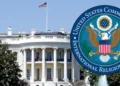
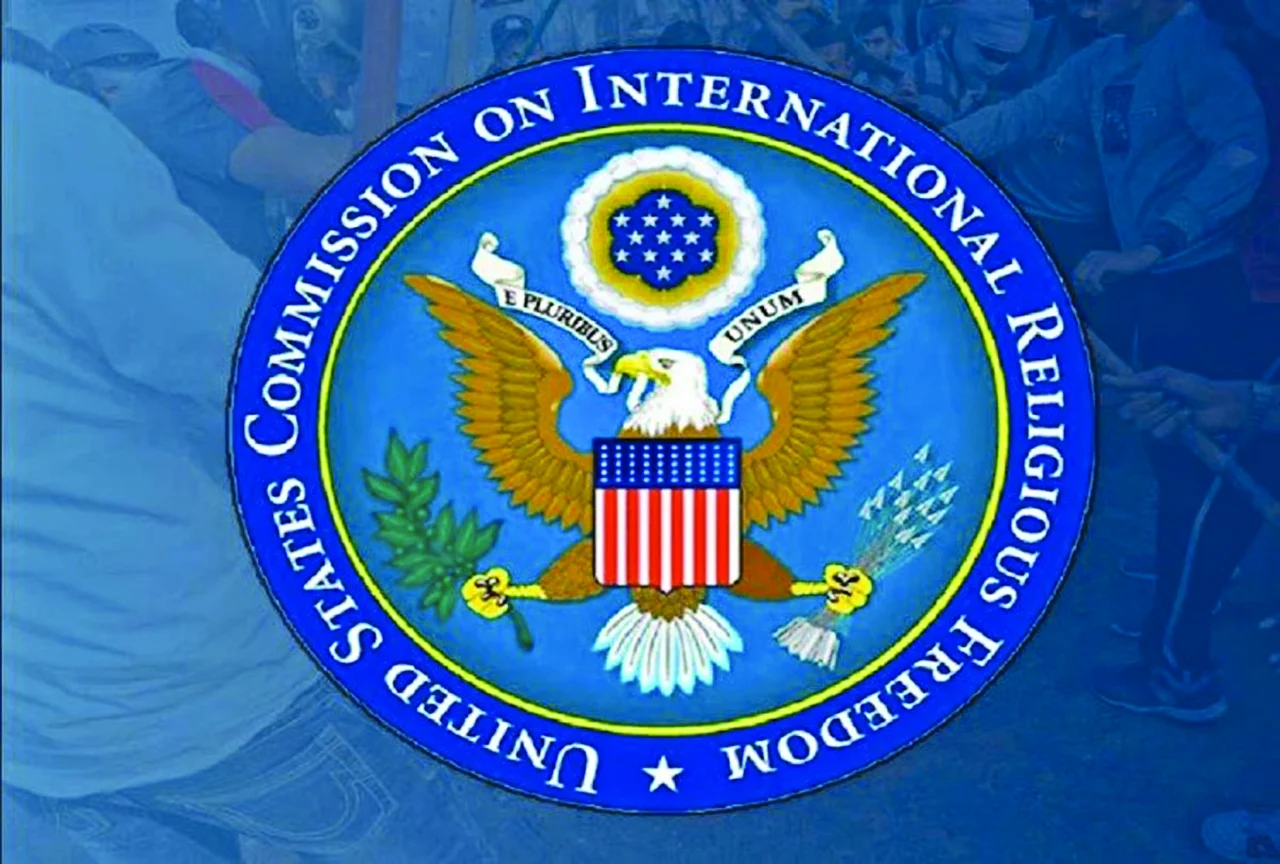
What begins as episodic reporting on communal incidents in early USCIRF reports transforms, by 2020, into a structural narrative where Hindutva is treated as the primary driver of religious freedom decline in India. Somewhere between an advisory recommendation and a sanctions demand, credibility gets lost. The United States Commission on International Religious Freedom (USCIRF) released its 2026 annual report in March, and for the seventh year in a row it called on the State Department to designate India as a “Country of Particular Concern” — placing the world’s largest democracy in the same tier of condemnation as North Korea, Eritrea, and China.
Targeted Sanctions
This year, it went further still: it recommended targeted sanctions, including asset freezes and travel bans, against the Rashtriya Swayamsevak Sangh and India’s foreign intelligence service, RAW. The justification rests on a framing of India so selective, so dependent on advocacy-driven sources, and so divorced from the actual condition of religious life in a country of 1.4 billion people, that it demands not merely a response but a reckoning.
Let us begin with what USCIRF is. It is not a court. It is not a treaty body. It is a bipartisan advisory commission created by the US Congress in 1998, staffed by political appointees, with no subpoena power, no in-country access to India, and no binding authority over anyone. Its recommendations are routinely noted and just as routinely set aside — including by the very State Department it advises. In every year since 2020, the department has declined to act on USCIRF’s India designation. That silence from the State Department is not a procedural footnote. It is a considered judgement by the arm of the US Government that actually conducts diplomacy, that the Commission’s findings do not reflect the balanced assessment required for the most serious designation in American foreign policy. When the body you advise keeps ignoring your advice, either you are ahead of your time — or you are wrong.
In less than a decade, a striking inversion has taken hold in the way USCIRF talks about India and its majority community. From the moment Narendra Modi and the Bharatiya Janata Party (BJP) emerge as the dominant force in New Delhi, the reports begin to tightly link “Hindu nationalism” with a “drastic turn downward” in religious freedom. On paper, the USCIRF is mandated to defend believers of all faiths everywhere. In practice, its India‑related work from 2014 onwards has evolved a more specific storyline: Hindus are cast primarily as authors of repression, not as rights‑bearing citizens inside a plural democracy.
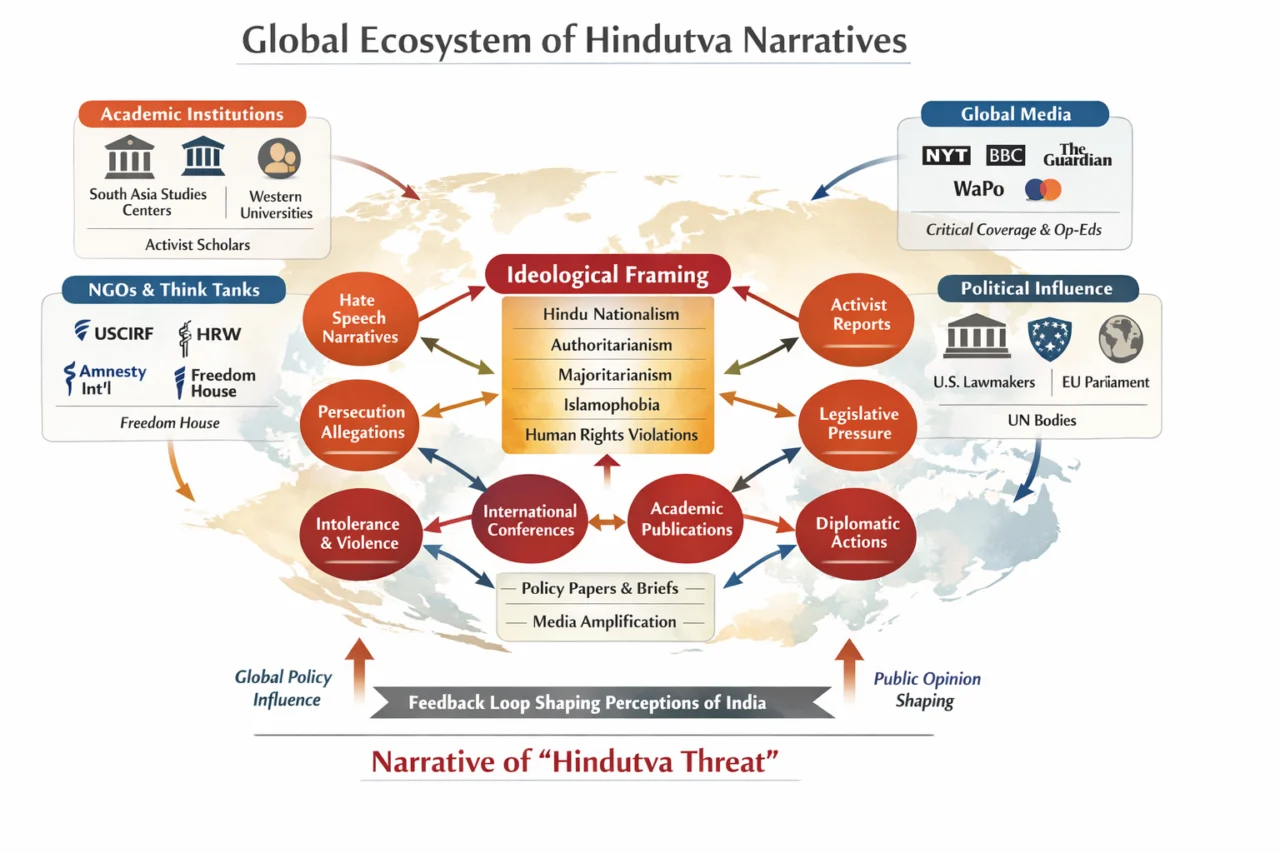
That storyline matters. USCIRF’s annual recommendations influence U.S. foreign‑policy debates, shape media frames, and bleed into academic and advocacy work. When it places India—an argumentative, federal democracy—alongside authoritarian regimes as a “Country of Particular Concern” (CPC), it is not just recording abuses. It is telling the world how to interpret the political agency of nearly a billion Hindus. And over twelve years of reports and special updates, that interpretation has hardened into a pattern of bias that deserves to be called out and corrected.
What Is USCIRF?
Let us begin with what USCIRF is. It is not a court. It is not a treaty body. It is a bipartisan advisory commission created by the US Congress in 1998, staffed by political appointees, with no subpoena power, no in-country access to India, and no binding authority over anyone. Its recommendations are routinely noted and just as routinely set aside — including by the very State Department it advises. In every year since 2020, the department has declined to act on USCIRF’s India designation. That silence from the State Department is not a procedural footnote. It is a considered judgement by the arm of the US Government that actually conducts diplomacy, that the commission’s findings do not reflect the balanced assessment required for the most serious designation in American foreign policy. When the body you advise keeps ignoring your advice, either you are ahead of your time — or you are wrong.
Bias in a human‑rights report does not typically announce itself as an outright falsehood. It shows up in what is selected and what is ignored, how cases are contextualised, and which assumptions are smuggled in as obvious. In USCIRF’s India work, at least four such patterns stand out.
Summary of Recurring Perceived Bias
Across the reports, USCIRF often moves from criticising specific laws, officials, or incidents to using broader language such as “Hindu nationalist policies,” “exclusionary extremist narratives,” or campaigns by RSS/VHP/Sangh Parivar, creating a frame in which Hindu-majority politics is treated as the main explanatory cause of India’s religious-freedom problems. The 2017 report explicitly names RSS, Sangh Parivar, and VHP as contributors to intimidation and violence, while the 2019 report again describes a campaign by those groups to alienate non-Hindus and lower-caste Hindus. By 2021–2025, the reports more directly tie the BJP-led Government and Modi-era politics to “Hindu nationalism” and even to an alleged push to establish India as an overtly Hindu state.
Because the reports often blur the line between Hinduism as a religion, Hindus as a people, Hindu organisations, and actions of a governing party or specific vigilante actors. This further gets connected to the organisations
A telling contrast emerges when one looks at how USCIRF describes Hindus where they are a vulnerable minority rather than the majority. Just one example, in Annual Report 2025, while referring to violence against Hindus, it says, “Hundreds of Hindus were reportedly killed in the violence following Prime Minister Hasina’s departure, though reporting suggests the killings were likely related to political affiliation rather than religion.” In other words, it brushes off its responsibility to review religious freedom and human rights of minorities when it comes to Hindus in the countries where they are minorities.
Scrutiny requires standards that are applied consistently, sources that are assessed for their own biases, and conclusions that are proportionate to the evidence. USCIRF has not met any of these tests in its India reporting. It has never conducted an in-country assessment. It has never sought formal response from the Government of India within its evidence-gathering process. Its commissioners include individuals with documented affiliations to advocacy networks hostile to the Indian government and hence. And it has escalated its recommendations each year regardless of actual conditions on the ground — which, by any independent measure, have not deteriorated to a degree commensurate with seven consecutive CPC recommendations. The following table provides Year-by-Year Analytical Breakdown of how RSS and Hindutva is referred to in the Annual Report since 2014.
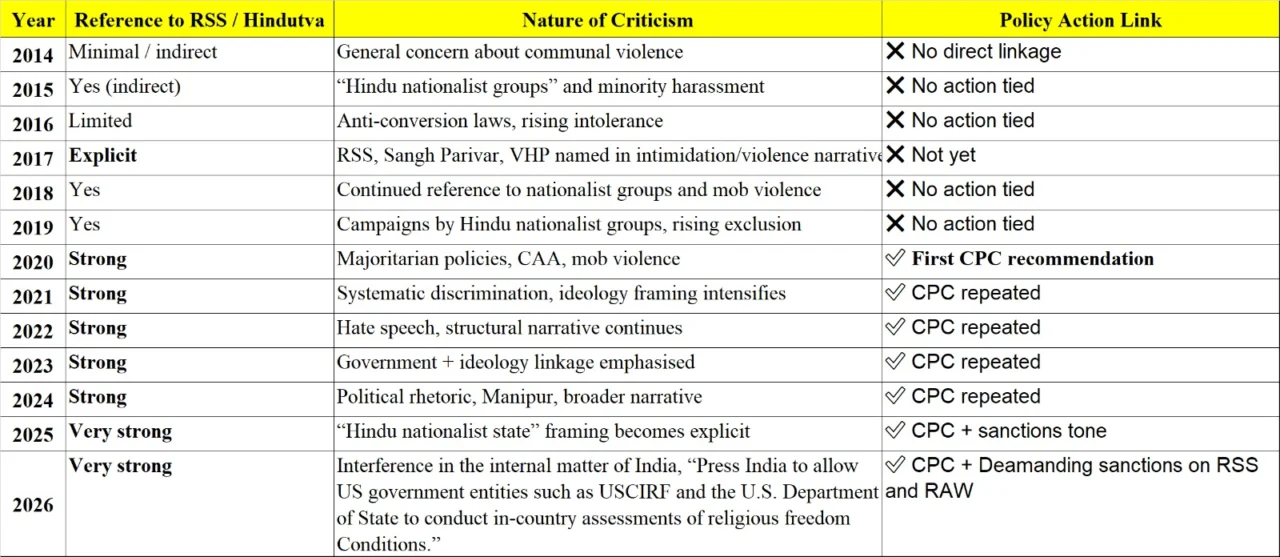
This clearly shows the Shift from “Groups” to “Ideology” to “State Structure” over the past 12 reports. What is further interesting to be noted, that the Annual Report 2026 mentions RSS (and for that matter RAW too) only once, that too, only to demand sanction on those entities. The report doesn’t discuss what are the reasons that the USCIRF board considered while demanding such action or at least to create a narrative against RSS. It is unfortunate that the politicians, intellectuals and media that are discussing this report didn’t question such hollow writing and politically motivated opinion making that systematically spreads further in institutions, media, and intelligentsia.
While the USCIRF supposedly applies a standardised statutory framework to evaluate religious freedom across all nations, several of its own Commissioners have explicitly dissented in the reports, arguing that the Commission’s evaluation of India exhibits a lack of proportionality and inappropriate categorisation when compared to other countries.
Sangh’s Role: Cementing Hindu Sikh Bond
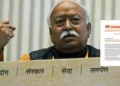
In reality, there are ample examples of minority communities in India that reflect a quiet contrary impression of RSS than what USCIRF is painting with their foreign ideological lenses. Maulana Arshad Madani (chief, Jamiat Ulema‑e‑Hind), in the context of his outreach and meeting with RSS chief Mohan Bhagwat, he said he liked Bhagwat’s statement that Hindus and Muslims in India share the same ancestry, and remarked that the RSS is “changing its old ideology and is now on the right track.” A Christian member profiled as “Isaac” describes being attracted by the RSS’s “commitment to national and social interest,” and says that in his experience the organisation is “more secular than those who claim to be secular,” also stressing that RSS workers respected his going to church and did not see his Christian faith as a problem. A Sikh advocate and former Left activist, GS Gill joined the RSS‑affiliated Bharatiya Mazdoor Sangh after hearing RSS ideologue Dattopant Thengadi, later becoming national president of Rashtriya Sikh Sangat. He credits the Sangh’s role in maintaining close Hindu‑Sikh relations after Operation Bluestar and has publicly associated himself with the RSS family of organisations.
It is worth noting that while the politically appointed body such as USCIRF kept itself busy in tarnishing image of India and Hindus, a well-respected research-based organisation, Pew Research not only found through their social-science research in 2021 that The vast majority of Indians (91 per cent) say they are very free to practice their religion. This sentiment is shared across groups: roughly nine-in-ten Buddhists (93 per cent), Hindus (91 per cent), Muslims (89 per cent), and Christians (89 per cent) say they feel very free to practice their faith.
Taken together, these factors suggest the need for a more balanced, evidence-based conversation—one that recognises both concerns and context, and that distinguishes between advocacy and analysis.