The United States frequently positions itself as a global defender of religious liberty. Through institutions such as the United States Commission on International Religious Freedom (USCIRF), Washington regularly scrutinises countries across the world, including India, over alleged violations of religious freedom and periodically recommends that India be designated a “Country of Particular Concern.” Yet within America itself, Christianity, the country’s historical civilisational backbone and majority faith, is undergoing one of the deepest institutional crises in its modern history.
The contradiction is becoming increasingly difficult to ignore. The President of the United States still takes the oath of office on the Bible. Churches remain deeply embedded in American political symbolism. White evangelical Christians continue to shape electoral outcomes. But beneath that public imagery, the country is experiencing an accelerating process of “unchurching,” collapsing seminary enrolment, clergy burnout, parish closures, declining public trust in pastors, and the fragmentation of organised religion into digital spirituality and decentralised belief systems. The crisis is no longer merely theological. It has become social, institutional, demographic and political. Nearly 29 per cent of Americans now identify as religiously unaffiliated, according to data from the Public Religion Research Institute. Among young adults aged 18 to 29, that number rises to 38 per cent. America is witnessing one of the fastest religious transformations in its history, and the consequences are extending far beyond church walls.
This transformation is unfolding despite the United States offering some of the strongest constitutional protections for religion in the world. Christianity faces no state restrictions in America. Churches enjoy legal protection, tax benefits, political access and cultural visibility. Yet the institutional structure of Christianity is weakening from within. The result is a paradox that the same country that often judges the religious climate of other nations is struggling to preserve the vitality of its own dominant faith tradition.
The collapse of the Pastor pipeline
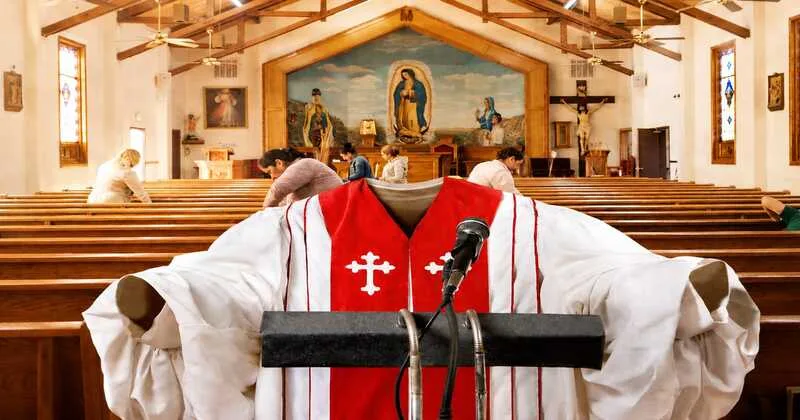
One of the clearest indicators of the crisis is the shrinking number of Americans willing to become pastors and priests. The role of clergy in the United States has become increasingly difficult, lower paid, politically polarised, socially distrusted and emotionally exhausting. Churches across denominations are now struggling to replace retiring clergy even as congregations continue shrinking.
Data from the Association of Theological Schools shows that enrolment in Master of Divinity programmes in the United States fell by 14 per cent between 2020 and 2024. The decline is particularly severe in historically influential communities. Black Protestant enrolment in ATS Master of Divinity and professional M.A. programmes declined by 31 per cent between 2000 and 2020.
The strain is visible across Catholic institutions as well. According to the Center for Applied Research in the Apostolate at Georgetown University, graduate-level Catholic seminary enrolment in the 2024–2025 academic year dropped 8 per cent, falling from 2,920 seminarians to 2,686 in a single year. College-level seminary enrolment also declined by 6 per cent, decreasing from 889 to 840 students. The longer historical trend is even more dramatic. In 1970–1971, the United States had 6,426 graduate-level seminarians. By 2024–2025, that number had fallen to 2,686. College seminarians declined from 7,917 in 1970–1971 to just 840 today. The collapse of high-school seminaries illustrates the institutional contraction even more starkly. America once had 122 Catholic high-school seminaries in 1967. Today, only three remain, a decline of roughly 97 per cent.
Church leadership shortages are now affecting everyday religious life across the country. The Hartford Institute for Religion Research found that more than four in ten clergy surveyed in 2023 had seriously considered leaving ministry since 2020. Pandemic-related stress accelerated an already existing crisis, while political polarisation further intensified pressure on pastors attempting to manage ideologically divided congregations. Research professor Eileen Campbell-Reed described the challenge of leading what she called “purple churches”, congregations divided between conservative and liberal political identities. Ministers increasingly face pressure not only as spiritual leaders but also as mediators in America’s culture wars.
The crisis is especially severe in rural America. Many rural churches already operate with shared pastors or part-time clergy, where one minister serves multiple congregations spread across large geographical areas. When those churches close, communities lose more than places of worship. They lose informal welfare systems that often provide food aid, disaster assistance, childcare support, elder care and community gathering spaces.
The decline is also hitting historically Black churches, institutions that have long functioned as centres of public health outreach, civil rights mobilisation and community service in underserved neighbourhoods.
Meanwhile, Catholic dioceses are increasingly shutting churches in poorer and minority communities. The Diocese of Oakland recently announced the closure of 13 churches because of financial difficulties and declining attendance. The diocese acknowledged it was facing an “all-time low” in priest availability across its 80 parishes.
The great unchurching of America
The pastoral crisis is part of a much larger transformation unfolding across American society, the rapid decline of organised Christianity itself. Around 57 per cent of Americans now seldom or never attend religious services, according to a recent survey by Gallup. In 2000, that figure stood at 40 per cent. The shift represents a massive generational and cultural departure from institutional religion.
An estimated 15,000 churches are expected to close across the United States this year alone, far exceeding the number of new churches opening. Many of these abandoned buildings once functioned as town halls, voting centres, Alcoholics Anonymous meeting locations and neighbourhood gathering spaces.
Church consultants and religious researchers note that even before the COVID-19 pandemic, American churches were losing approximately 15 per cent of their members annually. That translated into nearly 1.2 million departures from churches every year nationwide. Since the pandemic, the rate of disengagement appears to have accelerated further.
This decline is occurring across racial and denominational lines, though not uniformly. White evangelical Protestants remain one of the most politically organised religious blocs in the country. According to PRRI data, 85 per cent of white evangelical Protestants voted for Donald Trump in the 2024 election. Among white Catholics, 59 per cent supported Trump, while 57 per cent of white mainline or non-evangelical Protestants also backed him.
Church attendance continues to correlate strongly with conservative political identity among evangelicals and Catholics. Weekly-attending white evangelicals supported Trump at even higher levels than less frequent attendees. Yet the same political intensity may also be contributing to religious fatigue among younger Americans who increasingly view churches through partisan lenses.
The Democratic Party is simultaneously becoming more secular. PRRI data shows that Christians of colour constitute 35 per cent of Democrats, while religiously unaffiliated voters now make up 34 per cent of the party’s base. Political consultants increasingly acknowledge that America’s religious transformation is reshaping campaign strategies. Democratic strategist Sisto Abeyta noted that reaching religiously unaffiliated voters is more difficult and expensive than mobilising traditional church-based constituencies.
According to him, campaigns spend roughly $1.40 to engage one unaffiliated voter, compared with about $0.45 for a faith-based voter. The weakening of churches therefore has implications not only for religion but also for civic participation, political mobilisation and social cohesion.
Digital spirituality replaces institutional religion
As organised Christianity weakens, alternative forms of spirituality are rapidly filling the vacuum.
America’s emerging religious landscape is increasingly decentralised, digital and individualised. Younger generations are moving away from churches toward online spiritual ecosystems shaped by YouTube personalities, AI-driven religious tools, mystical content creators and folk belief systems. Platforms hosting “manifestation” spirituality, tarot content and personalised mysticism now attract massive online audiences. Videos featuring the late astronomer and agnostic thinker Carl Sagan and atheist biologist Richard Dawkins continue drawing millions of views attacking organised religion and traditional faith.
At the same time, unofficial folk saint movements such as devotion to Santa Muerte and Jesus Malverde have expanded significantly across the Americas outside formal church structures.
Artificial intelligence is also entering spiritual life. Religious chatbot applications are increasingly used for prayer guidance, confession-style conversations and scriptural advice. The app Bible Chat alone has reportedly crossed 30 million downloads.
This means the institutional Christianity is losing its monopoly over moral authority and spiritual identity.
The shift is also altering the social function of religion. Churches once acted as trusted local institutions that mediated community relationships, social services and civic participation. Digital spirituality, by contrast, is personalised, algorithm-driven and detached from geographic community life.
Even within Christianity, growth patterns are uneven. Assemblies of God reported increases in attendance and adherents, with attendance rising 6.2 per cent and overall adherents growing 2.5 per cent. Pentecostalism remains one of the few expanding sectors of American Christianity. Yet researchers caution that even these growing denominations face leadership shortages and uneven clergy supply.
Women are also entering ministry in record numbers. Campbell-Reed and Good Faith Media documented approximately 96,000 clergywomen in the United States, representing 23.7 per cent of all clergy, the highest level ever recorded. The change is historically significant given that women represented only 2.3 per cent of American clergy in 1960 and 20.7 per cent in 2016.
Meanwhile, the Catholic Church in America increasingly depends on foreign-born priests to sustain parish operations. CARA data indicates that 17 per cent of theologate students in 2024–2025 were foreign-born, with the largest groups coming from Vietnam, Mexico, Nigeria and Colombia. African priests have become increasingly visible in states such as Nebraska, New Mexico, Texas and Colorado, while Asian clergy presence has expanded in Massachusetts and California. The trend reflects a reversal in Christianity’s global demographic centre of gravity, with church growth increasingly concentrated in Africa and Asia rather than the West.
America’s religious authority faces a credibility test
The United States continues to exert enormous influence in global discussions on religious freedom, minority rights and democracy, often positioning itself as a moral evaluator of other societies. Yet the deepening collapse of Christianity within America raises uncomfortable questions about that authority. Churches in the United States enjoy constitutional protection, political influence, tax benefits and unmatched institutional freedom. Presidents invoke the Bible, religious advocacy groups shape elections and Christianity still occupies a visible place in public life. Despite all these protections, however, America is witnessing accelerating unchurching, shrinking seminaries, clergy burnout, collapsing parish networks and rising religious abandonment.
The crisis points to a much deeper transformation driven by secularisation, political polarisation, technological change, distrust of institutions, demographic shifts and changing spiritual habits. Claims of a large-scale religious revival among younger Americans remain weak, with researchers finding little evidence that isolated incidents or viral social media narratives are reversing the broader decline. The traditional religious map of America is steadily eroding and being replaced by a fragmented, digital and decentralised spiritual culture detached from organised institutions.
That contradiction now stands at the centre of America’s religious debate. If Christianity itself is increasingly becoming something many Americans no longer wish to embrace, questions naturally arise over why Washington continues exporting religious freedom narratives and faith-based activism abroad with such intensity. In many ways, the United States appears to be promoting to the world a religious product that its own society is rapidly abandoning.