
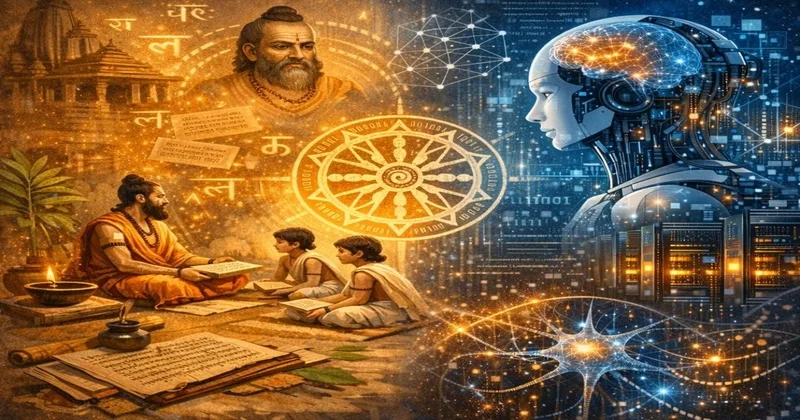
When people speak about India’s mathematical legacy, the discovery of zero often dominates the narrative. While that achievement alone reshaped global mathematics, it represents only a fraction of a much older and richer intellectual tradition. Nearly two thousand years before the emergence of modern computing, the Chandas Shastra, attributed to Pingala (circa 200 BCE), presented ideas that closely resemble the logical foundations of computer science. What appears to be a text on poetry, upon deeper examination, reveals an advanced system of structured thinking involving patterns, enumeration, and algorithmic processes.
"India didn’t just invent zero…
it built the LOGIC behind computing".
🧵#Thread A deep dive into Chandas Shastra.👇 pic.twitter.com/XnWczq5qo5— Sanatan Dharma (@_SanatanDharma) May 2, 2026
A Hidden Mathematical System
At its surface, Chandas Shastra is a treatise on Sanskrit prosody, analysing the structure and rhythm of poetic meters used in Vedic traditions. It classifies syllables into two types—Laghu (short) and Guru (long)—and studies how these combine to form metrical patterns. However, Pingala’s treatment of these syllables goes far beyond literary analysis. He transforms poetic rhythm into a systematic framework, where syllables are not merely aesthetic units but elements of a structured system. This abstraction is what allows the text to transcend poetry and enter the realm of mathematics and logic.
Binary Thinking Before Binary
Pingala’s classification of syllables into Laghu and Guru can be interpreted as a binary system, where two distinct states form the basis of all combinations. If one maps Laghu to 0 and Guru to 1, the resulting patterns align remarkably with binary representation. For a sequence of three syllables, Pingala’s framework generates combinations equivalent to 000, 001, 010, 011, 100, 101, 110, and 111. This is not merely a coincidence but reflects a structured approach to dual-state representation. Although Pingala did not describe electrical signals or digital circuits, the conceptual similarity to binary logic is striking, demonstrating an early form of thinking in terms of discrete states.
Prastara: Exhaustive Enumeration
One of the most significant contributions of Chandas Shastra is the concept of Prastāra, which refers to the systematic listing of all possible combinations of Laghu and Guru syllables for a given length. This process mirrors what modern computer science calls exhaustive enumeration, where every possible configuration of a system is generated. Pingala’s method ensures that no pattern is omitted, reflecting a deep understanding of completeness and systematic generation. Such thinking is central to algorithms, where defined rules are used to explore all possibilities within a given framework.
Nashtam: Recovering Lost Data
Pingala also introduces the concept of Nashtam, a method for reconstructing a missing or lost pattern within a sequence. This idea demonstrates an early awareness that information, once structured, can be retrieved or rebuilt through logical processes. In modern terms, this resembles techniques used in data recovery and reverse computation, where missing elements are deduced from known structures. The presence of such a concept in an ancient text highlights a sophisticated understanding of information integrity and reconstruction.
Uddishtam: Indexing and Addressing
Another remarkable idea in Pingala’s work is Uddishtam, which deals with identifying the position of a given pattern within the overall sequence. This reflects an early form of indexing, where elements are not only generated but also located systematically. In modern computing, indexing is fundamental to data structures, enabling efficient retrieval and organisation of information. Pingala’s approach shows that he was not merely interested in generating patterns but also in navigating and referencing them within a structured system.
Combinatorics Before Its Time
The text also explores the number of possible patterns that can be formed with a specific arrangement of Laghu and Guru syllables. This corresponds to the principles of combinations, a central concept in the field of Combinatorics. Pingala’s insights predate the formal development of combinatorics in Europe by many centuries, yet they demonstrate a clear understanding of how elements can be selected and arranged under defined constraints. This reinforces the idea that mathematical reasoning was deeply embedded in ancient Indian scholarship.
Samkhya: The Power of 2ⁿ
Pingala recognised that the total number of possible patterns for a sequence of syllables grows exponentially with its length. Specifically, for n syllables, the number of combinations is: 2n2^n2n. This principle is identical to the way modern computing systems calculate the number of possible states in binary systems. Each additional unit doubles the number of configurations, forming the basis of digital information storage and processing. Pingala’s articulation of this idea reveals a deep understanding of exponential growth in combinatorial systems.
Meru Prastara and Pascal’s Triangle
Later interpretations and commentaries on Pingala’s work introduce the concept of Meru Prastāra, a triangular arrangement of numbers that corresponds to what is now known as Pascal’s Triangle. This structure plays a crucial role in binomial expansions and probability theory. Its presence in the Indian mathematical tradition illustrates how complex numerical relationships were visualised and understood long before they were formally described in European mathematics.
Global Echoes of These Ideas
Centuries after Pingala, similar mathematical concepts began to appear in Europe through the works of scholars such as Gottfried Wilhelm Leibniz, who formalised binary arithmetic, and Blaise Pascal, who studied the triangular number arrangement that now bears his name. Leonardo Fibonacci contributed to number theory and sequences. These developments do not necessarily indicate direct borrowing, but they do highlight how mathematical ideas can emerge across different cultures and evolve over time, sometimes intersecting through knowledge exchange.
The foundations of modern computing rest on logic, pattern generation, and combinatorial reasoning. Pingala’s Chandas Shastra engages with all of these elements in a remarkably structured manner. The parallels between his concepts and modern computational principles suggest that the roots of algorithmic thinking extend far deeper into history than is often acknowledged. Rather than being an isolated development of the modern era, computing can be seen as the culmination of centuries of intellectual exploration across civilisations.
It is important to maintain clarity while interpreting these connections. Pingala did not invent computers, nor did he develop binary systems in the technological sense used today. However, he formulated methods of reasoning that align closely with the logical structures underlying computation. Recognising this distinction allows for a more accurate and meaningful appreciation of his contributions without overstating them.
The true significance of Chandas Shastra lies in its demonstration that abstract thinking about patterns, sequences, and logic existed long before the advent of machines. Computing, as it exists today, is the result of a long continuum of ideas, evolving through different cultures and periods. Pingala’s work represents one of the earliest known milestones in this journey, offering a glimpse into how deeply rooted the principles of computation truly are.