New Delhi: India and Vietnam agreed to substantially expand their bilateral engagement, setting a target of $25 billion in trade by 2030 and elevating their relationship to an “Enhanced Comprehensive Strategic Partnership” following talks between Prime Minister Narendra Modi and Vietnamese President To Lam at Hyderabad House.
The leaders held extensive discussions covering defence and security, trade and investment, maritime cooperation, renewable and atomic energy, science and technology, space collaboration, and people-to-people exchanges. Regional and global developments also figured prominently during the talks.
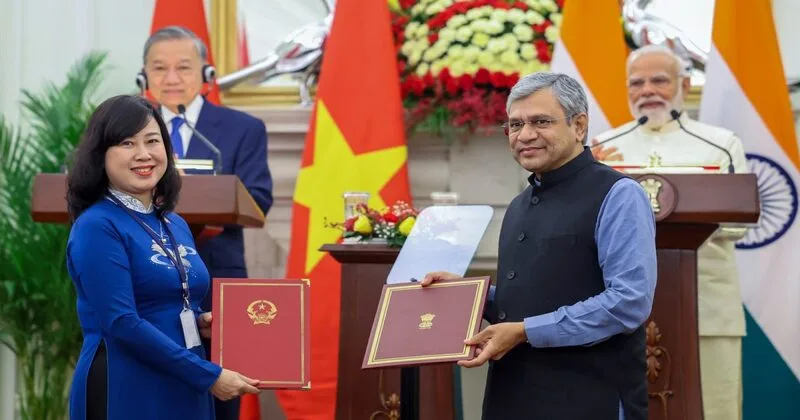
A key outcome of the visit was the signing of 13 Memoranda of Understanding (MoUs) across multiple sectors, signalling a deeper and broader strategic engagement between the two countries. Cooperation in critical minerals and advanced technologies was strengthened through an agreement between IREL (India) Limited and Vietnam’s Institute for Technology of Radioactive and Rare Elements on rare earth elements and emerging technologies. The two countries also signed a Cultural Exchange Programme for 2026–2030, extending long-standing cultural cooperation between India and Vietnam.
Agreements across finance, technology and healthcare
Financial cooperation received fresh momentum with the signing of an MoU between the Reserve Bank of India and the State Bank of Vietnam aimed at promoting collaboration in digital payments and financial innovation. In another major development in the fintech sector, NPCI International Payments Limited and Vietnam’s NAPAS agreed to work on cross-border QR code interoperability to make digital payments easier between the two countries.
In the healthcare sector, India’s Central Drugs Standard Control Organisation entered into an agreement with Vietnam’s Drug Administration to enhance regulatory cooperation relating to pharmaceuticals, medical devices, and associated fields.
The Prime Minister’s Office (PMO) said both countries also agreed to strengthen cooperation in digital technologies through a partnership between India’s Ministry of Electronics and Information Technology and Vietnam’s Ministry of Science and Technology. At the sub-national level, Brihanmumbai Municipal Corporation and Ho Chi Minh City signed a sister-city agreement aimed at sharing expertise in urban management and economic development. Academic and educational cooperation was expanded through agreements involving the Indian Council for Cultural Relations (ICCR), universities in Da Nang and Ho Chi Minh City, and Nalanda University, focusing on academic exchanges and capacity building.
Trade, Indo-Pacific cooperation and cultural preservation
Additional agreements included cooperation in public sector auditing, tourism promotion, and preservation of cultural heritage through the digitisation of Cham manuscripts. The Indira Gandhi National Centre for the Arts will collaborate in preserving and disseminating the manuscripts.
Alongside the MoUs, the two sides announced several new initiatives to deepen bilateral cooperation. Vietnam agreed to join the Indo-Pacific Oceans Initiative, while both countries decided to facilitate agricultural trade by enabling exports of Indian grapes to Vietnam and Vietnamese durians to India.
India also announced support for establishing a Site Interpretation Centre at the My Son Temple Complex, a UNESCO World Heritage Site in Vietnam.
According to the PMO, the outcomes of the visit are expected to strengthen economic cooperation, improve supply chain resilience, and further consolidate the strategic partnership between India and Vietnam. The agreements and initiatives are also expected to contribute to peace, stability, and cooperation in the Indo-Pacific region.
President To Lam is on a State Visit to India from May 7 to 10 at the invitation of Prime Minister Narendra Modi. The visit, which included delegation-level talks and the signing of multiple agreements in New Delhi, is being viewed as a significant step in further deepening the longstanding strategic partnership between India and Vietnam across economic, technological, cultural, and Indo-Pacific cooperation sectors.