
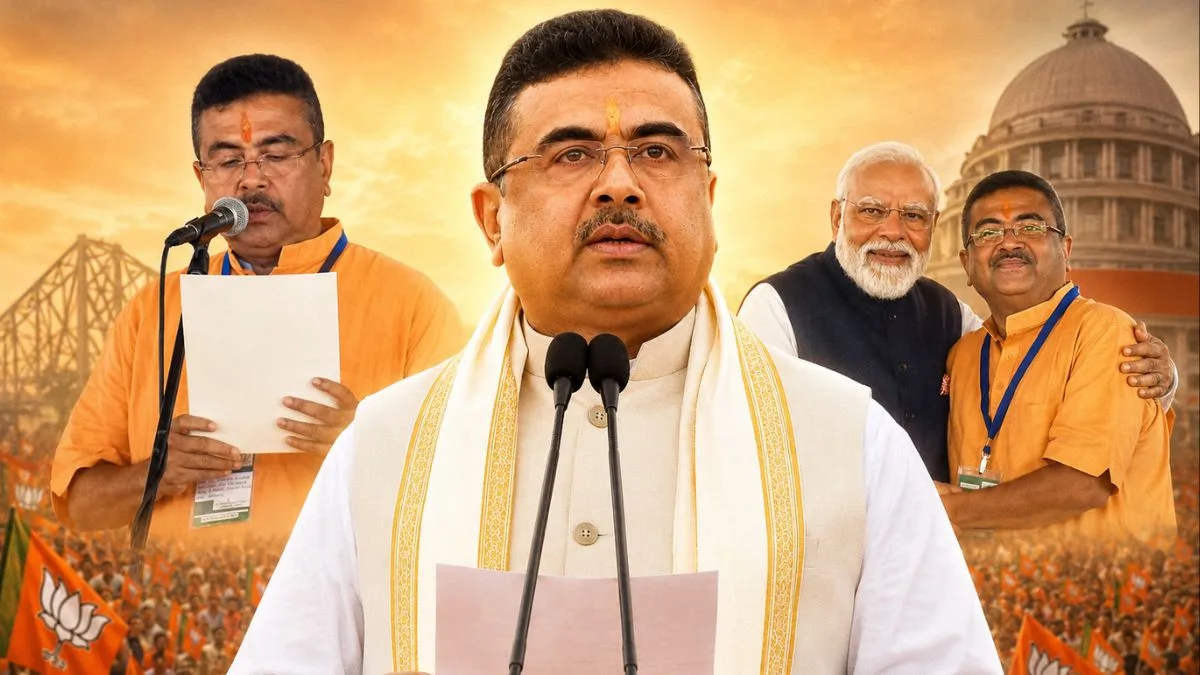
From the dusty lanes of Nandigram to the corridors of power in Kolkata — Suvendu Adhikari has emerged as Bengal’s most formidable political force. A leader who breathes grassroots politics, lives a strikingly simple life, and fights with raw aggression. BJP with Suvendhu dismantled the TMC’s dominance in key pockets and is now all set to script BJP’s golden chapter in West Bengal as its next Chief Minister.
There is a photograph from April 2022 that Suvendu Adhikari’s supporters keep sharing. It shows a Ram Navami procession in Howrah’s Shibpur area — participants in saffron, dhaks being carried — and then West Bengal Police wading in with lathis. People running, people bleeding, the celebration turned into chaos. Adhikari, then Leader of Opposition, posted the video the same night: “Ram Bhakts aren’t safe in WB.” It was not a political statement for him. It was personal.
That is the thread you have to pull to understand who Suvendu Adhikari is as a Hindu leader — not the speeches in air-conditioned auditoriums, but the years spent in the streets of Midnapore, Haldia, and Murshidabad, walking alongside devotees who felt invisible in their own state. When he took his oath as Chief Minister on May 9, 2026, many of those people were standing outside Raj Bhavan, and the ones who were crying weren’t crying for a political party. They were crying because something they had been told was impossible had just happened.
Adhikari grew in the soil of Kanthi, in a family that has been in public life for three generations and whose ancestors — Bipin Adhikari, Kenaram Adhikari — worked alongside Bengal’s freedom fighters, suffered British imprisonment, and had their home burned down twice. That family understands, in a way that is almost cellular, what it means to defend something you believe in against a power that doesn’t want you to.
Who is Suvendu Adhikari – New West Bengal CM
orn in 1970 in Karkuli, Purba Medinipur, Adhikari hails from the prominent Adhikari family of Kanthi, which has a storied legacy in India’s freedom struggle. His ancestors, Bipin Adhikari and Kenaram Adhikari, fought alongside Bengal’s freedom fighters, endured British imprisonment, and saw their family home burnt down twice during the independence movement. A postgraduate from Rabindra Bharati University, Adhikari embodies a rare combination of deep local roots, administrative experience, and uncompromising political will.
Suvendu Adhikari is widely regarded as one of West Bengal’s most battle-hardened grassroots politicians, with nearly three decades of relentless public service. Unmarried and completely dedicated to politics, he has spent over twenty years in elected office — serving as a two-time Lok Sabha MP, three-time MLA, and five years as Leader of Opposition in the West Bengal Assembly. He has also been a three-time councillor and Chairman of Contai Municipality.
As a senior minister, he handled critical portfolios like Transport and Irrigation, chaired the Hooghly River Bridge Commission. Playing a pivotal role in shaping Haldia’s industrial landscape. Deeply rooted in Bengal’s cooperative movement, he has led key institutions including agriculture and urban cooperative banks.
Suvendhu Adhikari’s Haldia and Tamluk March
When Adhikari led the Sanatani solidarity rallies through Haldia and Tamluk in March 2025, walking two kilometres through the industrial township alongside hundreds of BJP workers and ordinary families, it wasn’t a campaign stunt. He had been doing versions of this for years — showing up at Hindu Yatras in Digha, filing PILs in the Calcutta High Court after Ram Navami violence in 2023 demanding CBI and NIA probes, standing at temple gates in Asansol and Nandigram when idols were vandalized ahead of Ram Navami celebrations in 2026. The BJP’s Bengal victory didn’t come from Delhi. It came from that kind of sustained, ground-level presence.
“The previous government was a completely anti-Hindu government. But today, when all the Hindus in Bengal voted for the BJP, this temple has reopened.”
Asansol Durga Temple Opens Doors Again After BJP’s Bengal Victory
The numbers tell their own story. In 2011, BJP won six seats in the Bengal Assembly. By 2026, they won 206. That is not a swing — it is a transformation, and no single person did more groundwork for it than Adhikari. After he joined the BJP from TMC in December 2020, he brought with him not just defectors and party lists, but something harder to quantify: the trust of communities in South Bengal who had watched him for two decades, who knew he had chaired the Haldia Development Authority, run cooperative banks, built things, and actually showed up when something went wrong.
Within the BJP’s ideological framework, Adhikari represents a strand of Hindu leadership that is distinctly Bengali — rooted in Shakti worship, in the tradition of Durga Puja as civic identity, in the memory of partition and of communities pushed to the margins. He speaks of Sanatana Dharma not as an abstraction but as something that has a post office and a bus stand and a local police station that either protects it or doesn’t. His appeal to Hindu voters was never theoretical. It was look at what has happened here and now look at what we can change.
On the morning of the swearing-in, a Durga temple in Asansol that had remained shut for years — locked away by local tensions and administrative indifference under the previous government — reopened its doors. A BJP worker at the gate said what many were thinking: “We used to beg Delhi to notice this temple. Today it’s open.” It is a small thing, measured in stone and brass. But in Bengal, where faith and politics have always been the same conversation, it is the kind of thing that matters most.
After he joined the BJP from TMC in December 2020, he brought with him not just defectors and party lists, but something harder to quantify: the trust of communities in South Bengal who had watched him for two decades, who knew he had chaired the Haldia Development Authority, run cooperative banks, built things, and actually showed up when something went wrong.
Durga Puja, Partition Memory, and Politics
Within the BJP’s ideological framework, Adhikari represents a strand of Hindu leadership that is distinctly Bengali — rooted in Shakti worship, in the tradition of Durga Puja as civic identity, in the memory of partition and of communities pushed to the margins. He speaks of Sanatana Dharma not as an abstraction but as something that has a post office and a bus stand and a local police station that either protects it or doesn’t. His appeal to Hindu voters was never theoretical. It was: look at what has happened here and now look at what we can change.