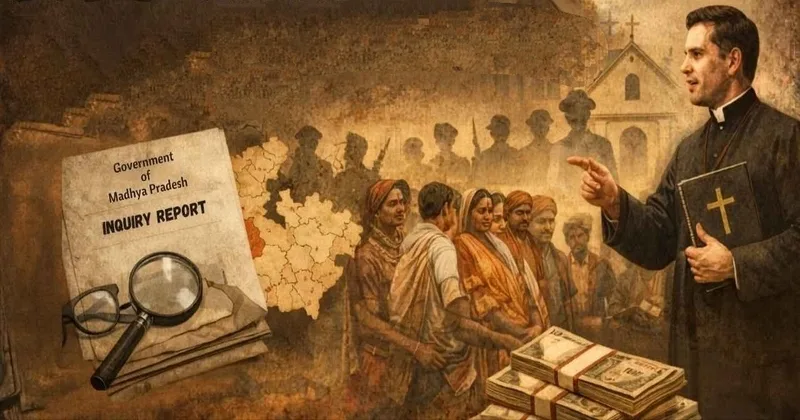
This committee was constituted by the Government of Madhya Pradesh after receiving repeated complaints from both Christians and non-Christians. It had been brought to the government’s attention that the conversion of illiterate vanvasi communities was allegedly taking place through coercion, fraud and inducements of financial gain. On the other hand, missionaries claimed they were being harassed by local officials and members of non-Christian communities.
The committee was tasked with conducting a thorough inquiry into the matter and submitting its recommendations. It was granted access to certain government records for its investigation. During its work, the committee visited 14 districts and 77 centres, and interacted with approximately 11,360 people. The objective of the exercise was to resolve doubts and disputes and to promote goodwill, harmony and peace among the communities.
The committee was fully aware that missionaries had contributed positively in fields such as education and medical relief. However, it also noted that there were widespread objections to the methods they employed, which were perceived as creating social tension and divisions within communities. Many people suspected that these activities were driven by ulterior political or non-religious motives.
It was observed that missionary work was largely concentrated in remote and inaccessible forest regions, where large-scale conversions were reported. Allegations were also made regarding the use of foreign funds in supporting these activities.
To examine the issue in detail, the committee prepared a comprehensive questionnaire. It functioned in a non-judicial capacity and had no authority to compel attendance, record statements under oath or enforce participation. Its approach remained neutral and objective, treating the issue as part of a broader historical and social context.
The response to the inquiry was substantial, with 55 Christian organisations and 330 non-Christian organisations submitting their views. However, the Catholic Church later withdrew its cooperation and approached the High Court, though its petition was ultimately dismissed.
The committee also identified several underlying causes of unrest. It noted that, prior to political integration, certain regions had experienced oppression and poor governance. After integration, there were high public expectations of rapid improvement and although conditions had stabilised, missionary activities were believed to have continued in a more discreet manner.
Based on reports received from the Madhya Pradesh government and other states, the committee observed that missionary activities were not always seen as healthy or acceptable. Even before independence, restrictions had been placed on their movement and after integration, there appeared to be concern about losing influence. It was also suggested that they were exploiting the sentiments of newly converted tribal populations.
Further, it was noted that missionaries opposed government initiatives to open schools in these regions under various development schemes. A Catholic priest had even given an undertaking that their activities would remain strictly religious and would not extend into political matters.
Missionary groups, on the other hand, viewed the establishment of schools as a form of religious propaganda aimed at reconverting people and preventing conversions. It was also alleged that such efforts were intended to exclude non-Christians (referred to in one letter as “pagans”) from educational institutions. This view was recorded in correspondence attributed to Father Vermiere.
The committee recorded that, according to certain reports, missionary activity was being carried out discreetly in the merged states as part of wider outreach efforts. It was also alleged that the regions targeted were dense forest areas rich in mineral resources and that there were attempts to keep vanvasi populations isolated from other communities while also limiting the influence of nationalist groups.
Some representations linked these developments to earlier political demands such as the idea of “Adiwasisthan”, which had been raised alongside other separatist proposals in 1938. In the post-independence period, there were also references to demands for a corridor connecting regions from East Bengal to Hyderabad. The emergence of a separate Jharkhand movement around 1948 was similarly noted, which sought to bring together tribal-dominated areas for a distinct administrative unit. It was argued in some accounts that such proposals would have increased missionary influence in these regions.
The report further mentioned that certain vanvasi regions, including areas like Surguja and Jashpur, were merged into Madhya Pradesh in 1948 despite such demands. It was also stated that missionaries continued to assert that local populations should have the freedom to choose their administrative affiliation, a position some critics interpreted as political mobilisation under the guise of democratic rights.
Instances from earlier years were also cited. In February 1941, restrictions were reportedly imposed to curb what authorities considered improper activities of some Catholic priests, and Rev. Tigga was fined for violating these regulations. Critics argued that such incidents indicated involvement in political matters beyond purely religious work.
Concerns were also raised by non-Christian groups regarding religious influence in educational institutions. While government schools were being introduced in vanvasi regions, missionaries were said to have objected, particularly where their own schools were already functioning. Although cooperation with government schemes was sometimes assured, allegations persisted of involvement in regional political movements, including Jharkhand-related activism.
Missionaries, in turn, raised complaints about the denial of scholarships and concessions to Christian students, but official inquiries reportedly did not substantiate these claims. It was also argued that the expansion of government welfare and education schemes in backward areas affected missionary activities.
There were allegations that selected tribal students were taken to missionary centres for vocational or higher education training, and that admissions were sometimes linked to prospects of conversion. Claims were also made regarding financial assistance or incentives associated with conversion, though such allegations were contested.
The report also referred to the involvement of organisations such as the Rashtriya Swayamsevak Sangh and Arya Samaj in opposing these activities. It noted instances of controversy, including complaints about provocative songs against the Hindu religion, which reportedly led to an apology from a missionary representative when brought to official attention.
Additional allegations included attempts to intimidate individuals opposing conversion efforts, though many such claims were either disputed or found unsubstantiated during inquiries. Similarly, serious accusations such as harassment of individuals were rejected after investigation, with the committee noting a lack of supporting evidence.
An incident involving a missionary accused in a rice smuggling case was also mentioned in the context of foodgrain restrictions at the time. The matter reportedly attracted international attention, with allegations of mistreatment of Christians being raised abroad, though officials maintained that illegal grain movement had occurred and appropriate legal action was taken.
While some organisations, including Christian bodies, supported claims of discrimination, the committee concluded that many of these allegations were not substantiated and appeared to be linked to efforts to counter scrutiny of missionary activities. It also observed local resentment in certain areas over perceived interference in social and cultural matters.
The report included statistical data indicating variations in conversion rates across tribal communities, particularly among the Uraon community. The figures cited were 4 in 1948, rising to 4,003 in 1952, then 877 in 1953, and 233 in 1954. It was noted that around 30 missions were active in Madhya Pradesh during this period, primarily focusing on Scheduled Tribes, Scheduled Castes, and other backward communities, though missionary organisations denied allegations of forced or inducement-based conversions.