Every year in India, as May 1 arrives, speeches, rallies, and ceremonial events marking ‘Labour Day’ become a common sight. Amidst government holidays, organisational activism and discussions regarding workers’ rights, a profound curiosity arises; is this date truly rooted in India’s own labour history, or is this tradition merely the result of external influence? This question becomes particularly pertinent given that many major nations across the globe have ceased observing this day as Labour Day, yet the tradition persists in Bharat.
Examining the historical context, one notes that ancient Greek and Roman civilizations held a tradition of celebrating the arrival of spring. These festivities observed in honor of Chloris, the Goddess of Flowers typically involved dance, revelry and social gatherings. With the expansion of the Roman Empire, this tradition spread to England and other parts of Europe. As time passed, however, these celebrations in many places began to spiral out of control, leading to their prohibition in Britain during the 17th century. In France, the day took on a religious character, coming to be celebrated in honor of the Virgin Mary. Thus, in its original form, May Day appears to have had no direct connection to the working class.
The True History Behind the Demand for an Eight-Hour Workday
During the Industrial Revolution, the plight of workers was extremely arduous. Working shifts ranging from twelve to sixteen hours were the norm. Against this backdrop, the demand for an eight-hour workday emerged. The prevailing popular belief is that this struggle originated in the city of Chicago, USA; however, historical facts suggest otherwise. In India, during the year 1862, approximately 1,200 laborers at the Howrah Railway Station staged a protest demanding an eight-hour workday. This event predates by several years, the American movement that is today widely regarded as the foundation of May Day. This clearly demonstrates that an awareness regarding workers’ rights had, in fact, developed within India well in advance.
Even in the United States, the demand for an eight-hour workday did not arise overnight. In 1866, the National Labor Union prominently put forward this demand during its first convention. Subsequently, several states adopted it, and in 1868, the U.S. Congress passed legislation establishing an eight-hour workday for the public sector. Understanding this historical context undermines the notion that the origins of May Day can be attributed to any single, decisive struggle.
The Events in Chicago and Their Impact
The events in Chicago are frequently cited in connection with May Day, though the reality is somewhat different. In May 1886, labor organisations called for a strike in which workers across the country participated. In its initial stages, this movement remained peaceful. However, events that unfolded on May 3rd and 4th altered the situation. Clashes outside the McCormick Factory resulted in the deaths of several workers. The following day, a sudden bomb explosion occurred during a rally at Haymarket Square, triggering a violent confrontation between the police and the crowd. This incident claimed numerous lives, and several labor leaders were handed down severe sentences.
Far from strengthening the labor movement, these events actually weakened it. The violence eroded public sympathy and provided the authorities with a pretext to take harsh punitive action. Viewed from this perspective, the incident did not prove to be a positive turning point for the cause of workers’ rights.
International Politics and the Evolving Nature of May Day
Towards the end of the nineteenth century, the influence of political ideologies began to grow within labor organizations on an international scale. At a conference held in Paris in 1889, May 1st was officially declared International Workers’ Day. From this point onward, the character of the day began to transform; alongside demands for workers’ rights, political ideologies began to be incorporated into the observance. Gradually, the day evolved into a vehicle for various slogans and objectives including class struggle, anti-imperialism, and other political goals.
Throughout the twentieth century, this day was utilized in many countries as a platform for ideological propaganda. In Russia, the date assumed particular significance during the revolutionary era. In subsequent years, amidst the shifting tides of global politics, the meaning and objectives of the day continued to evolve at times being presented as a symbol of resistance against Fascism and at other times being appropriated for various other political agendas. In this process, core labor issues gradually took a backseat.
Why Many Countries Changed Labor Day
Observing this trend in the United States, labor organizations there adopted a different approach. The first Monday of September was recognised as Labour Day. This decision was based on the premise that it is inappropriate to link the honoring of workers to any specific political ideology. Canada and other nations also adopted this same tradition. Thus, May Day gradually lost its former standing in many countries.
May Day in India and Our Own Tradition
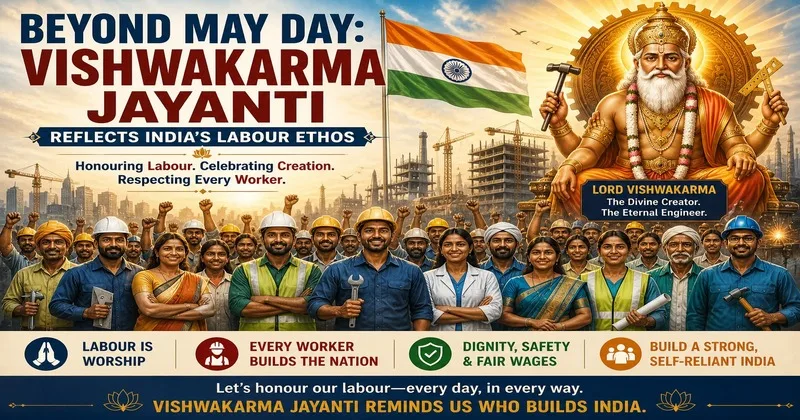
In this context, the Bharatiya Mazdoor Sangh- currently India’s largest trade union organization holds a distinct perspective. In the book “Bharatiya Mazdoor Sangh: A Brief Introduction”, author C.K. Saji Narayanan notes that the observance of May Day in India began during the third decade of the twentieth century. This trend was linked to the international influences prevalent at that time. Labor unions adopted the practice and gradually, this tradition spread across the country. Nevertheless, India’s own indigenous labor culture is far older and more deeply rooted than this. Here, labor is revered as an act of worship. Bhagwan Vishwakarma is regarded as the symbol of creation and labor. In many parts of the country, Vishwakarma Jayanti is celebrated as an occasion to honor workers. The roots of this tradition are evident everywhere from industrial cities to rural areas.
This fact suggests that the Indian concept of honoring labor is intrinsically linked to indigenous traditions. In this context, a pertinent question arises; is it truly necessary to designate a date originating from a foreign background as the sole National Labour Day? An examination of various historical facets reveals that the character of May 1st has evolved significantly over time. At various points, it has served as a spring festival, a symbol of the labor movement, and subsequently, a vehicle for political ideologies. Throughout this entire journey, there have been numerous junctures where the original objective became increasingly obscured.
Given this scenario, the need of the hour is to ensure that the honor accorded to workers is not confined to a single specific date. The value of labor must be recognized and appreciated in our daily lives. Reasonable working hours, safe workplaces, dignified wages and social security are critical issues that demand continuous attention. On the other hand, if India were to designate a specific day as its ‘Labor Day,’ that day would undoubtedly be “Vishwakarma Jayanti”; for on this day, everyone worships their deity of labour Bhagwan Vishwakarma. Consequently, for India, May 1st can never truly serve as its authentic Labor Day.