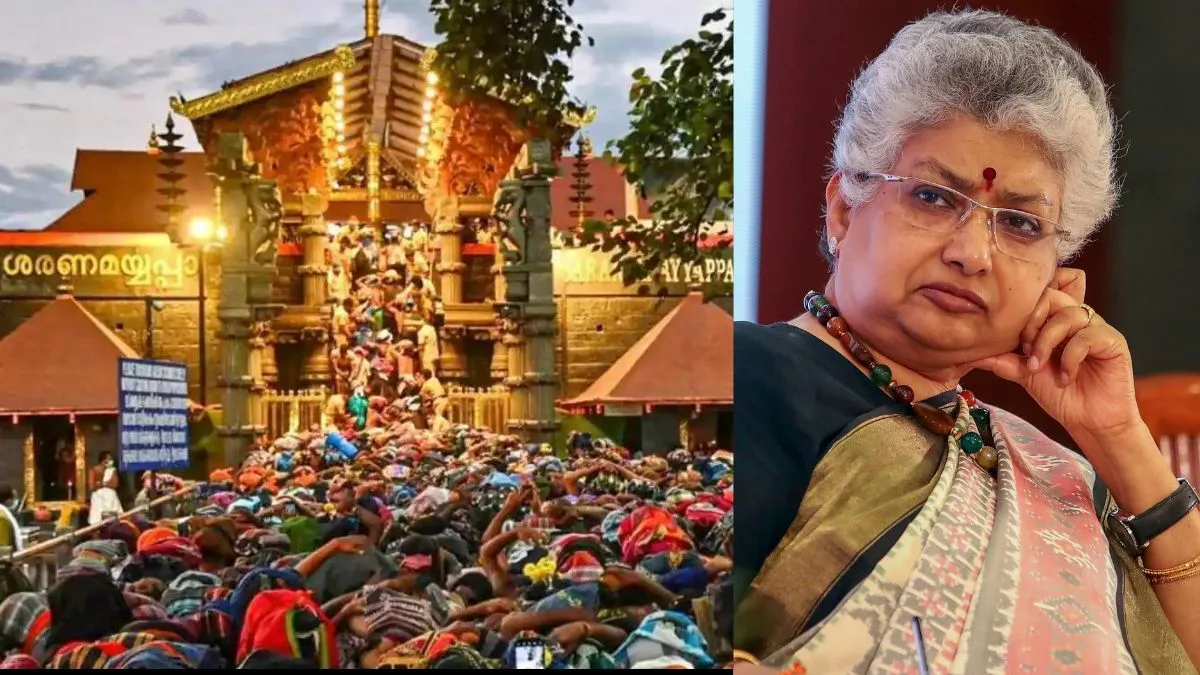
Sabarimala Women Entry SC Hearing: "We can't be a part of Annihilation of Religion"- Justice BV Nagarathna
June 23, 2026
  • Read Ecopy
  • Circulation
  • Advertise
  • Careers
  • About Us
  • Contact Us
Android AppiPhone AppArattai
Organiser
  • ‌
  • Bharat
    • Assam
    • Bihar
    • Chhattisgarh
    • Jharkhand
    • Maharashtra
    • View All States
  • World
    • Asia
    • Europe
    • North America
    • South America
    • Africa
    • Australia
  • Editorial
  • International
  • Opinion
  • RSS @ 100
  • More
    • Op Sindoor
    • Analysis
    • Sports
    • Defence
    • Politics
    • Business
    • Economy
    • Culture
    • Special Report
    • Sci & Tech
    • Entertainment
    • G20
    • Azadi Ka Amrit Mahotsav
    • Vocal4Local
    • Web Stories
    • Education
    • Employment
    • Books
    • Interviews
    • Travel
    • Law
    • Health
    • Obituary
  • Subscribe
    • Subscribe Print Edition
    • Subscribe Ecopy
    • Read Ecopy
  • ‌
  • Bharat
    • Assam
    • Bihar
    • Chhattisgarh
    • Jharkhand
    • Maharashtra
    • View All States
  • World
    • Asia
    • Europe
    • North America
    • South America
    • Africa
    • Australia
  • Editorial
  • International
  • Opinion
  • RSS @ 100
  • More
    • Op Sindoor
    • Analysis
    • Sports
    • Defence
    • Politics
    • Business
    • Economy
    • Culture
    • Special Report
    • Sci & Tech
    • Entertainment
    • G20
    • Azadi Ka Amrit Mahotsav
    • Vocal4Local
    • Web Stories
    • Education
    • Employment
    • Books
    • Interviews
    • Travel
    • Law
    • Health
    • Obituary
  • Subscribe
    • Subscribe Print Edition
    • Subscribe Ecopy
    • Read Ecopy
Organiser
  • Home
  • Bharat
  • World
  • Operation Sindoor
  • Editorial
  • Analysis
  • Opinion
  • Culture
  • Defence
  • International Edition
  • RSS @ 100
  • Magazine
  • Read Ecopy
Home Bharat

Sabarimala Women Entry SC Hearing: “We can’t be a part of Annihilation of Religion”- Justice BV Nagarathna

"Everytime the court intervenes, there has to be a limit because then the whole constitutional protection will look illusory," the Judge said

WEBDESKWEBDESK
Apr 30, 2026, 11:49 am IST
in Bharat, Law, Kerala
Follow on Google News
FacebookTwitterWhatsAppTelegramEmail

As the nation closely watches the Sabarimala Women Entry Case hearing, the Supreme Court of India orally observed that courts cannot dismantle religion in the name of reform, and that matters of belief and conscience are not amenable to judicial adjudication.

On the tenth day of proceedings, the nine-judge Bench raised a series of queries before Senior Advocate Indira Jaising, who appears for two women that entered the Sabarimala Temple following the 2018 ruling that lifted the prohibition on women aged 10 to 50.

Jaising contended that the individual right to religious freedom under Article 25(1) must take precedence over the collective rights of religious denominations under Article 26. She argued that courts cannot remain entirely hands-off in matters of faith, as the power of judicial review is integral to the constitutional framework. Emphasising the evolving nature of the Constitution, she said fundamental rights must be interpreted holistically rather than in isolation, adding that religious practices are dynamic and subject to reform over time.

It will be annihilation of religion, of which we don’t want to be a part: Justice Nagarathna

During the hearing, one of the questions that arose from the Bench was whether non-believers or casual visitors can challenge customary restrictions on entry to a religious temple.

Appearing for Kanaka Durga and Bindu Ammini, two women from Kerala who had faced backlash and threats after they entered the Sabarimala temple after the Court’s 2018 verdict, Indira Jaisingh said that “One needs to be a Hindu to claim such rights of entry.”

She added- “But I am also saying that it is not important whether I am a believer or not, but I must go with shraddha, with respect, to introspect.”

When Justice Amanullah asked whether such rights can be claimed even if it hurts the majority of believers, she said- “You tell me what legal injury I am causing to someone. If you show me the legal injury, I will not go. I am saying both of us are claiming a legal right.”

Justice Sundresh cautioned that accepting every individual claim based on differing and conflicting religious rights could open the door to serious consequences.

Justice Sundresh replied to Jaisingh – “If we agree with your contention, it is going to lead to dangerous consequences. I will tell you why. Suppose there is a common belief, followed by practice, professing and propagation. Each one (believer) goes and says, ‘I do not want this, I want it in a particular way.’ Another says, ‘I do not want this practice.’ Where is the end? If you really look at it, this kind of interpretation will be a disaster for the entire concept of religion itself. It will be militating against the right under Article 25(1).”

“It will be annihilation of religion, of which we don’t want to be a part,” added Justice Nagarathna.

She added that religious rights have to be given a broad meaning.

“We understand Article 25(2), which is the enabling power of the State (to make laws on religious matters on grounds of health, morality, public order). But otherwise, matters of religion are not a matter on which the Court or the legislature can pass a judgment upon. It cannot be the subject matter of debate because it is a matter of conscience. Having regard to the philosophy of that particular idol (Lord Ayyapa deity in Sabarimala), entry is banned for women between 10 and 50 years. It is part of religion.”

“First, they have to show there is such a rule. First, they have to show a theological text which says so,” Justice Jaising replied.

“It is a custom,” Justice Nagarathna observed.

Justice Nagarathna on Article 25(2)(b) 

Jaising contended that the individual right to religious freedom under Article 25(1) must take precedence over the collective rights of religious denominations under Article 26. She argued that courts cannot remain entirely hands-off in matters of faith, as the power of judicial review is integral to the constitutional framework. Emphasising the evolving nature of the Constitution, she said fundamental rights must be interpreted holistically rather than in isolation, adding that religious practices are dynamic and subject to reform over time.

Delineating the scope of the plea, she clarified that the claim under Article 25(1) is confined to the right of entry into the temple and does not extend to modifying religious rituals or ceremonies, which remain protected under Article 26.

According to Live Law, Justice B.V. Nagarathna questioned whether a devotee could approach a deity while accepting only select aspects of the belief system. He also raised concerns about challenging long-standing customs, noting that practices followed over centuries often crystallise into essential components of a tradition and cannot be disregarded abruptly after such a long passage of time.

Responding, Senior Advocate Indira Jaising asked what legal injury is caused by a woman entering the temple. She argued that if a woman chooses not to visit out of respect for the belief that the deity is a ‘Naishtika brahmachari’, that choice must be respected—but it cannot be mandated that no woman should be allowed entry.

She was appearing for Kanaka Durga and Bindu Ammini, two women from Kerala who had faced backlash and threats after they entered the Sabarimala temple after the Court’s 2018 verdict.

Topics: Supreme CourtSabarimala Women Entry CaseSupreme Court Justice BV Nagarathna
ShareTweetSendShareSend
✮ Subscribe Organiser YouTube Channel. ✮
✮ Join Organiser's WhatsApp channel for Nationalist views beyond the news. ✮
Previous News

Fact Check: “Viral fuel price hike order is fake,” says PIB

Next News

Keralam dumps, Bengal buries it: Exit polls signal complete collapse of the ‘Left’

Related News

Supreme Court of India

‘RTI activism has become business’: SC denies anticipatory bail, questions activist’s authority to monitor road project

The AMU Judgment: Why the Supreme Court must revisit Article 30

Tamil Nadu Assembly (File Photo)

Tamil Nadu speaker drops action against 21 rebel AIADMK MLAs after EPS withdrawal, targets 4 who joined TVK

Supreme Court remarks have revived the UAPA bail debate, with supporters citing national security concerns

UAPA Bail Debate: Striking a delicate balance between individual liberty and national security

Supreme Court invokes Article 142, issues strict timelines to curb delay in High Court judgments

Supreme Court invokes Article 142, orders strict timelines for High Court judgments to end delays in justice delivery

SIR and Article 324: Supreme Court strengthens the constitutional spine of Indian Democracy; Reaffirms ECI’s authority

Load More

Latest News

(Left) Fire at the coaching centre in Lucknow (Right) Members of ABVP extending all possible help

Lucknow Coaching Centre Fire tragedy is heartbreaking and deeply unfortunate: ABVP seeks action against culprits

Andhra Pradesh Minister and TDP National General Secretary Nara Lokesh

Nara Lokesh dismisses rumours of TDP sabotaging Modi government, reaffirms unconditional NDA support

With new military deployments, export opportunities and potential Russian production, BrahMos is entering a new era of strategic relevance

BrahMos enters high-volume production as military demand and global export orders surge

Dr Mahrang Baloch

Pakistan: Mahrang Baloch gets life sentence, Balochistan erupts in protest; BYC calls for shutdown

Prime Minister Narendra Modi

‘Maoism is breathing its last’: PM Modi highlights crackdown on red terror in last 12 years and growth in tribal areas

(Left) Dr Shyama Prasad Mookerjee (Right) West Bengal CM Suvendu Adhikari

Syama Prasad Mookerjee was instrumental in creation of West Bengal’: CM Suvendu Adhikari

Female recruitment in Jihadist networks emerges as major security concern

Khadija Terror Case: Female recruitment, online radicalisation in Jihadi networks poses major security concern

Outcry grows after Dalits in Theeyathur village carry deceased woman across paddy fields due to lack of burial access

Tamil Nadu: Dalits forced to carry deceased woman through paddy fields as Pudukkottai village lacks road access

ASI transfers Rakhigarhi skeletal remains to Anthropological Survey of India for detailed examination

Rakhigarhi’s ancient secrets to be unveiled as human skeletal remains reach AnSI for advanced scientific analysis

Dr Syama Prasad Mookerjee: A Life That Still Guides Bharat’s National Resolve

Load More
  • Privacy
  • Terms
  • Cookie Policy
  • Refund and Cancellation
  • Delivery and Shipping

© Bharat Prakashan (Delhi) Limited.
Tech-enabled by Ananthapuri Technologies

  • Home
  • Search Organiser
  • Bharat
    • Assam
    • Bihar
    • Chhattisgarh
    • Jharkhand
    • Maharashtra
    • View All States
  • World
    • Asia
    • Africa
    • North America
    • South America
    • Europe
    • Australia
  • Editorial
  • Operation Sindoor
  • Opinion
  • Analysis
  • Defence
  • Culture
  • Sports
  • Business
  • RSS @ 100
  • Entertainment
  • More ..
    • Sci & Tech
    • Vocal4Local
    • Special Report
    • Education
    • Employment
    • Books
    • Interviews
    • Travel
    • Health
    • Politics
    • Law
    • Economy
    • Obituary
  • Subscribe Magazine
  • Read Ecopy
  • Advertise
  • Circulation
  • Careers
  • About Us
  • Contact Us
  • Policies & Terms
    • Privacy Policy
    • Cookie Policy
    • Refund and Cancellation
    • Terms of Use

© Bharat Prakashan (Delhi) Limited.
Tech-enabled by Ananthapuri Technologies