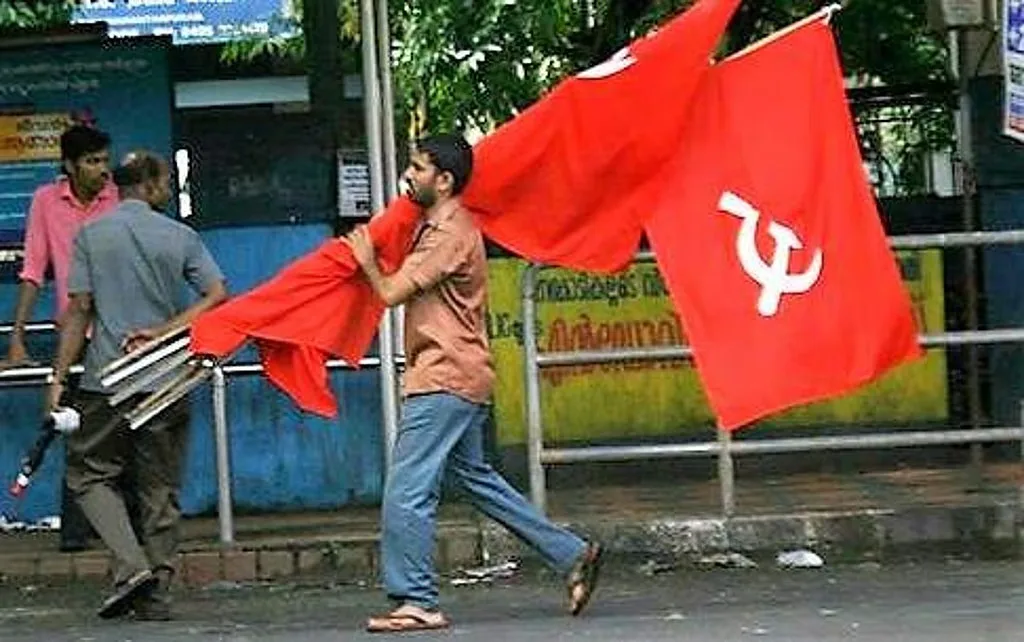
The 2026 Assembly exit polls do not merely indicate a routine electoral setback for the Left Front. They point towards a deep and possibly irreversible political decline. Once a dominant ideological and electoral force, the Left today appears to be losing both authority and relevance across its traditional strongholds, from Keralam to West Bengal.
The contrast between the two states reveals the full scale of the crisis. In Keralam, the Left is being pushed out of power after years of governance. In West Bengal, it is being pushed out of the political imagination itself. Together, these trends show not a temporary dip but a structural weakening of the Left’s base, narrative, and leadership.
Kerala: From continuity to clear rejection
In Kerala, the ruling Left Democratic Front led by Chief Minister Pinarayi Vijayan appears to be heading towards a decisive electoral defeat. After breaking a long-standing pattern by winning a second consecutive term in 2021, the Left now seems unable to retain power for a third term.
Exit poll projections across agencies consistently indicate a comeback for the Congress-led United Democratic Front. Estimates suggest the UDF could secure between 72 and 90 seats in the 140-member Assembly. The Left Democratic Front is projected to fall to a range of 49 to 62 seats. This sharp drop reflects a clear shift in voter mood.
Keralam has historically followed a pattern of alternating governments every five years. The current projections follow this pattern, which is reasserting itself, but with a sharper edge. The electorate is not just switching sides. It appears to be expressing dissatisfaction with the Left’s governance record.
Governance fatigue and erosion of trust
The decline of the Left in Keralam cannot be explained only through conventional anti-incumbency. There is a growing perception that the government has failed to deliver on key expectations. While Pinarayi Vijayan continues to retain some personal credibility, this has not translated into support for the administration as a whole.
Public dissatisfaction has increasingly been directed at ministers and departments seen as ineffective or disconnected. Administrative lapses, controversial statements, and a perceived lack of responsiveness have contributed to a gradual erosion of trust. Voters appear to be distinguishing between leadership image and governance outcomes, and the latter is being judged harshly.
The Left’s long-standing claim of stable and efficient governance is now being questioned. What was once presented as continuity is being viewed by sections of the electorate as stagnation.
Economic anxiety has emerged as a central factor in shaping voter behaviour. A significant section of Keralam’s middle class believes that the state has not been able to generate sufficient high-quality employment opportunities.
This has led to sustained outward migration, particularly among educated youth seeking better prospects abroad. The issue of brain drain has moved beyond economic analysis and entered the political discourse. Families are directly experiencing the consequences, with younger generations leaving and local opportunities remaining limited.
The perception that Keralam has not kept pace with infrastructure development and industrial expansion has further intensified dissatisfaction. For a government that emphasised welfare and social development, the inability to create a parallel growth narrative is proving politically costly.
Shifts in social coalitions
Another important dimension of the Left’s decline in Keralam is the gradual shift in its traditional support base. Communities that have historically aligned with the Left are showing signs of fragmentation.
There are indications that sections of voters are exploring alternatives, including the Bharatiya Janata Party. Even limited shifts in voting patterns can have a significant impact in closely contested constituencies.
In triangular contests, small changes in vote share often produce disproportionate electoral outcomes. The Left is finding itself vulnerable in precisely such scenarios, where its traditional dominance is no longer assured.
West Bengal: From dominance to near disappearance
If Keralam represents rejection, West Bengal represents collapse. The Left Front, which governed the state for 34 uninterrupted years, is now facing the possibility of near-total marginalisation.
Exit polls present a stark picture. Several projections suggest that the Left-Congress alliance may win zero or one seat. Even the most optimistic estimates place their tally in single digits, often grouping them under a broad “Others” category.
This dramatic fall marks a complete reversal of the Left’s historical position in the state. A political force that once defined governance, ideology, and organisational strength in Bengal now struggles to remain visible.
The primary reason for this collapse lies in the changing nature of political competition in West Bengal. The electoral contest has become sharply bipolar, dominated by the All India Trinamool Congress led by Mamata Banerjee and the Bharatiya Janata Party.
In such an environment, voters are making strategic choices rather than ideological ones. Those opposed to the BJP are consolidating behind the TMC, while those opposed to the TMC are rallying behind the BJP.
This leaves no meaningful electoral space for a third force. The Left is not just losing votes. It is being excluded from the core contest altogether.
Leadership crisis and outdated messaging
The Left’s organisational decline in Bengal is closely tied to its leadership vacuum. Unlike Mamata Banerjee or leaders such as Suvendu Adhikari, the Left has failed to project a credible and recognisable face capable of mobilising voters.
Its ideological messaging has also struggled to adapt. The traditional focus on class politics no longer resonates as strongly in a political climate shaped by identity, welfare delivery, and emotive narratives.
Key issues dominating the electoral discourse have sidelined the Left’s core arguments. As a result, its campaigns have struggled to gain traction among both urban and rural voters.
The alliance with the Indian National Congress has not provided the expected boost. Instead, it has exposed coordination challenges and strategic differences.
Reports indicate weak ground-level cooperation and mutual distrust between cadres. Rather than consolidating opposition space, the alliance has diluted the distinct identity of both parties.
This has further weakened the Left’s position in an already competitive and polarised environment.
Organisational strength under strain
The Left’s cadre-based structure remains one of the most disciplined in Indian politics. However, organisational strength alone is no longer sufficient to secure electoral success.
Modern elections are influenced by leadership visibility, narrative control, and voter perception. On these fronts, the Left appears to be lagging behind its competitors.
There is some speculation that a strong ground network may have created a last-minute push that exit polls have not captured. However, such possibilities are unlikely to significantly alter the broader trend of decline.
It is important to note that exit polls are not final results. They are based on sample data and may not fully capture complex political realities.
However, even with this limitation, the direction indicated by the projections is clear. The Left is losing ground where it governs and disappearing where it once dominated.
This suggests that the current situation is not merely cyclical. It reflects deeper structural challenges related to leadership, strategy, and voter connection.