Sabarimala Case: True women devotees aged 10-50 stay away
June 10, 2026
  • Read Ecopy
  • Circulation
  • Advertise
  • Careers
  • About Us
  • Contact Us
Android AppiPhone AppArattai
Organiser
  • ‌
  • Bharat
    • Assam
    • Bihar
    • Chhattisgarh
    • Jharkhand
    • Maharashtra
    • View All States
  • World
    • Asia
    • Europe
    • North America
    • South America
    • Africa
    • Australia
  • Editorial
  • International
  • Opinion
  • RSS @ 100
  • More
    • Op Sindoor
    • Analysis
    • Sports
    • Defence
    • Politics
    • Business
    • Economy
    • Culture
    • Special Report
    • Sci & Tech
    • Entertainment
    • G20
    • Azadi Ka Amrit Mahotsav
    • Vocal4Local
    • Web Stories
    • Education
    • Employment
    • Books
    • Interviews
    • Travel
    • Law
    • Health
    • Obituary
  • Subscribe
    • Subscribe Print Edition
    • Subscribe Ecopy
    • Read Ecopy
  • ‌
  • Bharat
    • Assam
    • Bihar
    • Chhattisgarh
    • Jharkhand
    • Maharashtra
    • View All States
  • World
    • Asia
    • Europe
    • North America
    • South America
    • Africa
    • Australia
  • Editorial
  • International
  • Opinion
  • RSS @ 100
  • More
    • Op Sindoor
    • Analysis
    • Sports
    • Defence
    • Politics
    • Business
    • Economy
    • Culture
    • Special Report
    • Sci & Tech
    • Entertainment
    • G20
    • Azadi Ka Amrit Mahotsav
    • Vocal4Local
    • Web Stories
    • Education
    • Employment
    • Books
    • Interviews
    • Travel
    • Law
    • Health
    • Obituary
  • Subscribe
    • Subscribe Print Edition
    • Subscribe Ecopy
    • Read Ecopy
Organiser
  • Home
  • Bharat
  • World
  • Operation Sindoor
  • Editorial
  • Analysis
  • Opinion
  • Culture
  • Defence
  • International Edition
  • RSS @ 100
  • Magazine
  • Read Ecopy
Home Bharat

Sabarimala Case: “True women devotees aged 10-50 stay away from shrine; after 50, they will go”: Justice BV Nagarathna

The Supreme Court of India on April 29 orally observed that women devotees of Bhagwan Ayyappa may choose to visit the Sabarimala Mandir after the age of 50, as it heard a key constitutional reference on religious freedom. The nine-judge Bench, led by CJI Surya Kant, underscored that it does not intend to play any role in the annihilation of religion while interpreting faith-based practices

Dr Vishnu AravindDr Vishnu Aravind
Apr 30, 2026, 07:00 am IST
in Bharat, Law, Culture, Kerala
Follow on Google News
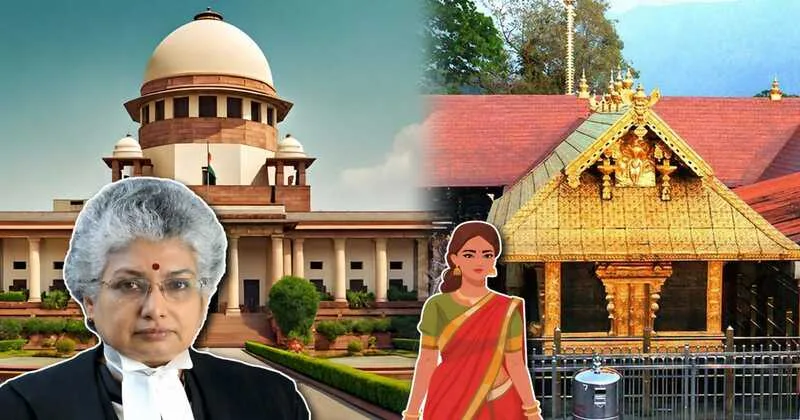
Sabarimala case Supreme Court examines religious customs as Justice Nagarathna points to practices followed by women devotees

Sabarimala case Supreme Court examines religious customs as Justice Nagarathna points to practices followed by women devotees

FacebookTwitterWhatsAppTelegramEmail

New Delhi: The Supreme Court of India on April 29 orally remarked that devout women followers of Bhagwan Ayyappa may choose to defer their visit to the Sabarimala shrine until after the age of 50 years in the case of Kantaru Rejeevaru v. Indian Young Lawyers Association. Justice BV Nagarathna, who is part of the Constitution Bench examining the issue, made the observation during the proceedings. “The true devotees who are women between 10-50 years, they also observe this restraint and stay away (from Sabarimala Mandir). After 50 years, they will go,” Justice Nagarathna said. The matter is being heard by a nine-judge Bench headed by Chief Justice of India Surya Kant, alongside Justices MM Sundresh, Ahsanuddin Amanullah, Aravind Kumar, Augustine George Masih, Prasanna B Varale, R Mahadevan and Joymalya Bagchi.

The Bench also emphasised that while interpreting constitutional protections relating to religious freedom, the Court does not wish to contribute to the erosion or destruction of any religion.
Background of the Sabarimala dispute

The present proceedings arise from a reference linked to the Supreme Court’s landmark 2018 judgment that permitted women of all age groups to enter the Sabarimala Mandir in Keralam. That verdict had struck down a long-standing custom that barred women of menstruating age from accessing the hill shrine dedicated to Bhagwan Ayyappa.

Read More: Aadhaar goes digital-first on Google wallet: Faster verification, less data sharing feature takes centre stage

Subsequently, in November 2019, the Supreme Court delivered its decision on review petitions challenging the 2018 ruling. However, instead of conclusively deciding the issue, the Court framed seven broad constitutional questions relating to the scope of religious freedom and referred them to a larger Bench. These questions, now under consideration by the nine-judge Bench, are expected to have implications beyond the Sabarimala dispute. The outcome could influence similar cases involving faith-based practices and customary restrictions across different religious communities in India.

Courtroom exchanges on faith and custom

During the hearing, Justice Nagarathna pointed out that certain restrictions on Mandir entry are not unique to the Sabarimala context. She observed that similar limitations exist for individuals who have experienced births or deaths in their families, which are traditionally regarded as periods of ritual impurity.

Senior advocate Indira Jaising responded by stating that such practices are typically voluntary and observed by believers out of personal conviction rather than being enforced externally.
Justice Nagarathna then drew a parallel, noting that many women devotees of Bhagwan Ayyappa themselves refrain from visiting the Mandir during the 10–50 age bracket, adhering to the belief system associated with the deity.

“Yes, there are many women in Keralam who say ‘why should I go between the age of 10 and 50 years? I will wait.’ But there are also women who say, ‘why should I not go between the age of 10 and 50 years? You have to deal with them as well. They are not committing a crime by saying they want to go,’ Jaising replied.

Justice Nagarathna further remarked, “Question is whether they are understanding the philosophy of that God or not.” In response, Jaising highlighted her familiarity with traditional practices, stating that such customs have historically governed social conduct, particularly regarding notions of ritual purity.

“Yes, we are aware of it. I have read it in the Shastras. It operates in my personal house. I was not allowed to touch my mother during these periods. As you know, they are not even allowed to go to the funeral pyre. But question is, is it right or wrong? That custom is now gone through actual practice. In my family, every single daughter of the family attended the funeral of our father. No one stopped us, no tantri stopped us, no organisation stopped us. It took place in the Arya Samaj premises. We went, no priest said ‘why are you here?’ We carried out parents on our shoulders,” Jaising said.

She argued that exclusionary practices affecting women are often rooted in the perception that they may defile sacred spaces. “Don’t perceive it in that form,” replied Justice Nagarathna.

“I have taken it (this position) from the Shastras,” said Jaising. The hearings remain ongoing, with the Court expected to address foundational constitutional questions that balance religious tradition with individual rights.


Topics: Supreme CourtBhagwan AyyappaSabrimala Case
ShareTweetSendShareSend
✮ Subscribe Organiser YouTube Channel. ✮
✮ Join Organiser's WhatsApp channel for Nationalist views beyond the news. ✮
Previous News

Popular Exit Polls 2026 predicts: Bengal & TN on edge, BJP set to retain Assam, NDA Puducherry & UDF surges in Kerala

Next News

Bengal Exit Polls 2026: Mamata Banerjee reign set to end? Tight contest between TMC and BJP, pollsters give edge to BJP

Related News

Supreme Court remarks have revived the UAPA bail debate, with supporters citing national security concerns

UAPA Bail Debate: Striking a delicate balance between individual liberty and national security

Supreme Court invokes Article 142, issues strict timelines to curb delay in High Court judgments

Supreme Court invokes Article 142, orders strict timelines for High Court judgments to end delays in justice delivery

SIR and Article 324: Supreme Court strengthens the constitutional spine of Indian Democracy; Reaffirms ECI’s authority

Andhra Pradesh cancels Pastor Anand’s SC certificate following Apex Court’s verdict on SC/ST Act on Christian converts

Supreme Court - DMK leader MK Stalin

Tamil Nadu: After reserving judgment, SC Bench recuses from delivering verdict in Stalin’s 2011 Kolathur election case

Akhil Bharatiya Adhivakta Parishad explores India’s early constitutional battles over free speech and judicial review

The First Amendment at 75: Revisiting Organiser’s historic free speech battle against the Nehru government

Load More

Latest News

Assam: Auto driver Monowar Hussain arrested for molesting, attempting to rape tribal woman passenger in Guwahati

The world recognises unprecedented growth in digital infrastructure during the 12 years of Modi's government

12 Years of Modi Government: How India built one of the world’s largest digital public infrastructure ecosystems

The image of alleged "Kolkotta Bayee" Jewel King living at Pathanamthitta

Keralam: WhatsApp status reveals illegal Bangladeshi who lived in Pathanamthitta for five years as ‘Kolkotta Bayee’

Following TMC’s defeat in 2026 West Bengal Assembly election, speculation grew that its MPs were moving towards the NDA under BJP pressure

Why TMC MPs are looking towards the NDA: Examining the electoral arithmetic behind the political shift

Father dies on the day of daughter's Nikah over dispute over Mehar amount in Uttarakhand

Uttarakhand: Bride’s father dies of heart attack amid pressure and dispute over mehar amount in nikah

India has been transformed by major advances in digital governance, financial inclusion, and global influence under Modi govt

India After 12 Years of Modi: A record, revolution and remaining challenges

Will CM Joseph Vijay preserve Tamil Nadu’s priceless temple heritage as artefacts decay in Egmore museum

Book Review | Zubeen Garg: 'The Voice That Bridged Worlds' by Prosenjit Nath

Book Review | Zubeen Garg: ‘The Voice That Bridged Worlds’ by Prosenjit Nath

A representative image generated using AI

“I am Christian, I don’t want any bhagwan”: Nurse booked for placing murtis of Hindu gods on footwear stand in Palghar

Uttar Pradesh CM Yogi Adityanath

Project GANGA: Yogi Adityanath’s ambitious plan to transform rural Uttar Pradesh into network of smart digital villages

Load More
  • Privacy
  • Terms
  • Cookie Policy
  • Refund and Cancellation
  • Delivery and Shipping

© Bharat Prakashan (Delhi) Limited.
Tech-enabled by Ananthapuri Technologies

  • Home
  • Search Organiser
  • Bharat
    • Assam
    • Bihar
    • Chhattisgarh
    • Jharkhand
    • Maharashtra
    • View All States
  • World
    • Asia
    • Africa
    • North America
    • South America
    • Europe
    • Australia
  • Editorial
  • Operation Sindoor
  • Opinion
  • Analysis
  • Defence
  • Culture
  • Sports
  • Business
  • RSS @ 100
  • Entertainment
  • More ..
    • Sci & Tech
    • Vocal4Local
    • Special Report
    • Education
    • Employment
    • Books
    • Interviews
    • Travel
    • Health
    • Politics
    • Law
    • Economy
    • Obituary
  • Subscribe Magazine
  • Read Ecopy
  • Advertise
  • Circulation
  • Careers
  • About Us
  • Contact Us
  • Policies & Terms
    • Privacy Policy
    • Cookie Policy
    • Refund and Cancellation
    • Terms of Use

© Bharat Prakashan (Delhi) Limited.
Tech-enabled by Ananthapuri Technologies