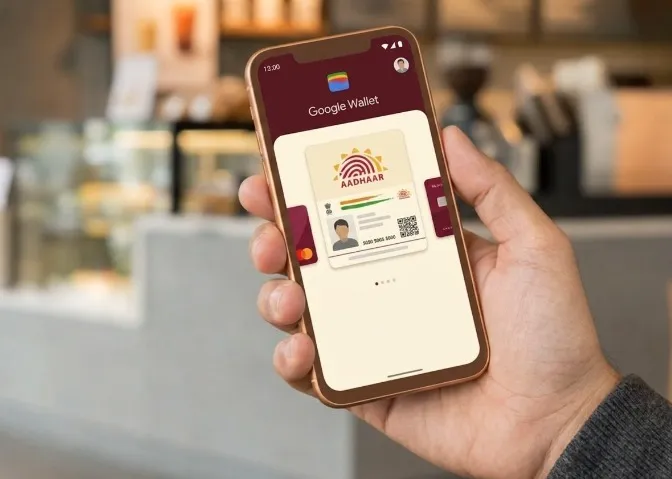
Towards simplifying digital identity verification, Google has rolled out support for Aadhaar-based credentials in Google Wallet for users in India. The move, developed in partnership with the Unique Identification Authority of India, allows users to securely store and present their Aadhaar details digitally, eliminating the need to carry physical cards or repeatedly log into verification portals.
The rollout introduces Aadhaar as a Verifiable Credential within Google Wallet, placing it alongside commonly used digital items such as boarding passes, tickets, and payment cards. The feature is aimed at making everyday identity verification faster, more secure, and less intrusive.
The introduction of Aadhaar in Google Wallet shows a broader shift towards digital-first identity systems in India. With Aadhaar already serving as the country’s most widely used identification framework, integrating it into a widely used platform like Google Wallet is expected to significantly enhance user convenience.
Unlike traditional methods that require physical documents or OTP-based logins, the new system allows users to verify their identity directly from their smartphone. This is particularly useful in real-world scenarios such as entering residential complexes, verifying age at cinemas, or completing online documentation.
Importantly, Google has clarified that this is not a full “linking” of Aadhaar with a Google account, unlike Aadhaar-PAN or Aadhaar-bank account integrations. Instead, the credential is stored securely on the user’s device, ensuring greater control and privacy.
What is selective disclosure?
One of the key highlights of this feature is its privacy-centric design. The Aadhaar credentials stored in Google Wallet are encrypted and remain on the user’s device rather than being uploaded to cloud servers or linked directly to their Google account.
A standout feature is “selective disclosure,” which allows users to share only the specific information required for verification. For instance, if a service provider needs to confirm a user’s age, only the age-related data is shared—without revealing the full Aadhaar number or other personal details.
This approach addresses long-standing concerns around data privacy and over-sharing of sensitive personal information. By limiting the scope of data disclosure, the system aims to strike a balance between convenience and security.
Speaking on the development, Alan Stapelberg, Group Product Manager at Google Wallet, said, “Building on our UIDAI partnership, consumers in India can now save their Aadhaar Verifiable Credentials directly in Google Wallet on the device. This new capability creates a secure, digital-first ID and makes it easier to verify identity for everyday conveniences.”
Where can aadhaar via google wallet be used?
In its initial phase, the feature is being rolled out with select partners across different sectors. These include:
1. PVR INOX for movie ticket verification
2. BharatMatrimony for identity checks
3. Atlys for international documentation
Google has also announced that more partners will soon join the ecosystem. Services such as MyGate and Snabbit are expected to integrate Aadhaar-based verification via Google Wallet in the near future, extending its use to residential security and local service providers.
This phased rollout indicates that Aadhaar verification through digital wallets could soon become a standard feature across multiple sectors.
How to add aadhaar to google wallet
To use this feature, users need:
1. An Android smartphone running version 9 or above
2. A secure screen lock enabled on the device
3. The official Aadhaar mobile application installed
The process to add Aadhaar is straightforward:
Users can either initiate the process through the Aadhaar app by selecting the “Add to Wallet” option or start from Google Wallet and follow the prompts to complete verification via the Aadhaar app.
In some cases, users may see a “Reviewing your request” message. This indicates that the system is cross-verifying the details, after which a notification will confirm successful addition.
Once added, the Aadhaar credential can be used both in-person, via NFC or QR code and online, wherever supported.
How the technology works
The Aadhaar integration is built on the concept of Verifiable Credentials, an emerging global standard for secure digital identity. This system allows institutions to verify identity without needing to access or store the entire dataset.
UIDAI introduced this offline verification protocol recently, enabling users to share digitally signed identity data without exposing sensitive details. Google’s implementation leverages this framework, ensuring compliance with both Indian regulatory standards and global digital identity norms.
Notably, similar functionality is already available through the official Aadhaar app. However, integrating it into Google Wallet provides users with a single, unified platform for storing and managing multiple digital credentials.
Convenience vs concerns
While the feature has been widely welcomed for its convenience, it also raises questions around digital dependence and security. Reports note that while on-device encryption reduces risks, users must ensure their devices are secure to prevent unauthorised access.
At the same time, the emphasis on selective disclosure is being seen as a progressive step in addressing privacy concerns associated with Aadhaar usage over the years.
Google, for its part, has highlighted that the system is designed to minimise data exposure and give users greater control over what they share.
Alongside the India rollout, Google is also expanding its digital identity features globally. The company has introduced a passport-based ID pass feature in countries such as Singapore, Taiwan, and Brazil, signalling a broader push towards digital identity ecosystems worldwide.
This positions India as a key market in Google’s digital identity strategy, given Aadhaar’s scale and widespread adoption.
As more service providers integrate Aadhaar verification through Google Wallet, the feature is expected to become increasingly common in daily life from apartment entries to online registrations.
However, its long-term success will depend on user trust, regulatory oversight, and the ability to maintain robust security standards.
For now, the move marks a significant step in India’s digital journey bringing identity verification closer to a frictionless, privacy-first experience.