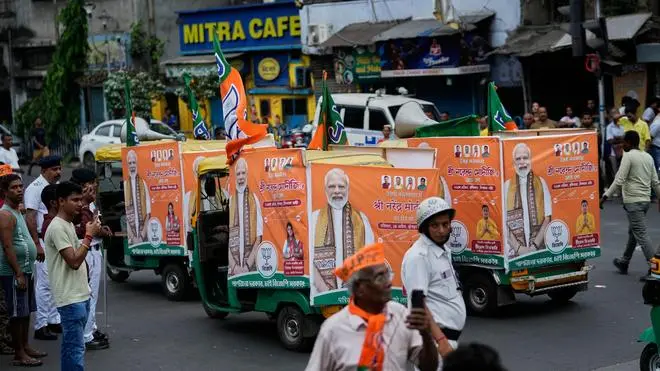
With polling concluded across West Bengal, the focus has now shifted to exit poll projections that attempt to capture voter sentiment after an intense and high-voltage campaign. The central question dominating political discourse is whether Chief Minister Mamata Banerjee can secure a fourth consecutive term or whether the Bharatiya Janata Party has managed to convert its years of organisational expansion into a decisive electoral breakthrough against the ruling All India Trinamool Congress.
A majority of exit poll agencies indicate that the BJP has gained significant ground across regions and may be in a position to challenge the TMC more strongly than in previous elections. Several projections even place the BJP above the majority mark of 148 seats in the 294-member assembly, suggesting the possibility of a major political shift in the state. However, this narrative is not uniform across all surveys, with a few agencies continuing to project a strong comeback for the TMC or an extremely tight contest that could go either way.
According to a consolidated poll of polls, which aggregates multiple exit poll findings, the BJP appears to have a marginal edge, with seat projections ranging between 137 and 157 seats. The TMC is projected to secure between 131 and 151 seats, placing both parties in a closely contested range. Smaller parties, including the Congress and Left, are expected to remain largely on the margins, with only a handful of seats. This narrow gap highlights the fragile nature of the projected lead and suggests that even minor shifts in vote share could significantly alter the final results.
A closer look at individual agency projections reveals both convergence and divergence. Agencies such as Chanakya Strategies, Matrize, Poll Diary, JVC and PMARQ consistently place the BJP in a strong position. Matrize, for instance, projects the BJP to win between 146 and 161 seats, comfortably above the majority threshold, while placing the TMC between 125 and 140 seats. Chanakya Strategies estimates a similar outcome, projecting 150 to 160 seats for the BJP and 130 to 140 for the TMC. Poll Diary offers a wider range, projecting 141 to 171 seats for the BJP and 99 to 127 seats for the TMC, indicating both the BJP’s potential dominance and the volatility of the contest.
At the same time, a set of outlier projections presents a contrasting picture. Peoples Pulse forecasts a strong victory for the TMC, estimating 177 to 187 seats for the ruling party and 95 to 110 seats for the BJP. Janmat Polls goes even further, projecting 195 to 205 seats for the TMC and only 80 to 90 seats for the BJP. These starkly different estimates underline the complexity of voter behaviour in West Bengal and the difficulty of accurately capturing electoral trends in a politically dynamic state.
Phase wise data further adds nuance to the projections. According to the VoteVibe survey conducted for CNN News18, the BJP appears to have a structural advantage in the first phase of polling, with projections of 88 to 98 seats compared to 51 to 61 seats for the TMC. The Congress is expected to remain limited to a marginal presence with 2 to 4 seats. Analysts attribute this advantage to the BJP’s ability to consolidate support across multiple social groups, including Scheduled Castes, Scheduled Tribes, Other Backward Classes and upper caste voters. However, certain regions such as Malda continue to show strong support for the TMC, indicating that the contest is far from uniform across the state.
One of the most striking features of the 2026 elections has been the exceptionally high voter turnout. Participation levels have reached nearly 90 percent across phases, with several districts reporting even higher figures. Purba Bardhaman recorded turnout exceeding 92 percent, while Hooghly, Nadia, Howrah and both North and South 24 Parganas reported turnout close to or above 89 percent. Such high levels of participation are often interpreted as a sign of strong voter engagement and can sometimes indicate a desire for change, although the exact electoral impact remains uncertain until counting day.
The political contest in West Bengal has largely evolved into a direct face-off between Mamata Banerjee’s TMC and a resurgent BJP seeking its first full term in the state. Key political figures, including Leader of Opposition Suvendu Adhikari and TMC leader Abhishek Banerjee, have played crucial roles in shaping the campaign narrative. Issues such as governance, identity politics, welfare delivery and allegations of political violence have all featured prominently in the electoral discourse.
The wide variation in exit poll predictions can be explained by several factors, including the state’s complex social composition, regional diversity, and the presence of silent voters who may not fully disclose their preferences during surveys. Additionally, India’s first past the post electoral system amplifies small differences in vote share into large variations in seat counts, making accurate projections particularly challenging in tightly contested elections.
It is also important to recognise that exit polls, while useful as indicators, are not definitive predictors of electoral outcomes. Historical trends in Indian elections have shown that actual results can diverge significantly from exit poll estimates due to last mile voting behaviour and counting dynamics.
As the state awaits the official results, the 2026 West Bengal Assembly elections stand at a critical juncture. The outcome will determine whether the TMC retains its hold on power for a fourth consecutive term or whether the BJP succeeds in scripting a historic political shift. Counting day is expected to provide clarity on what is shaping up to be one of the most closely watched electoral battles in the country.