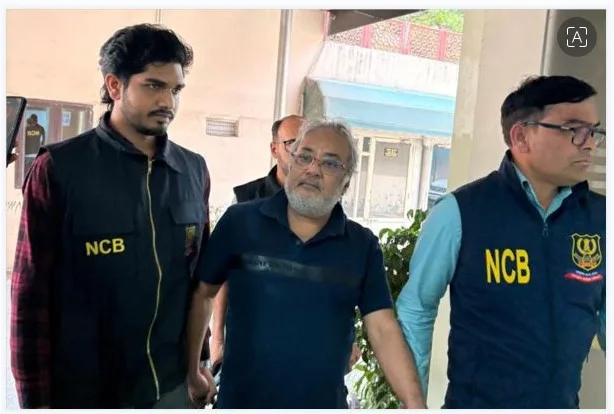
In what is being described as a significant breakthrough in India’s long battle against organised crime and terror networks, Salim Dola, a close aide of fugitive underworld don Dawood Ibrahim, has been deported from Istanbul and taken into custody by Indian agencies.
Dola is not just another operative in the vast D-Company network. Investigators say he functioned as a key logistical and financial node within the syndicate, making his capture far more consequential than a routine arrest. His deportation, facilitated through coordinated diplomatic and intelligence efforts, is expected to provide deep insights into the current structure and functioning of D-Company, which has long operated across continents.
After being flown to New Delhi under the supervision of the National Investigation Agency, Dola was taken to a secure location for questioning. Officials have termed the operation a “big win,” underlining the strategic importance of bringing him back to India alive and in custody.
Who is Salim Dola and why he matters
Salim Dola rose through the ranks of the D-Company syndicate during the 1990s, a period when the network was expanding aggressively across South Asia and the Middle East. Over the years, he has been named in multiple cases, including extortion, narcotics trafficking and terror financing.
Significantly, he is also linked to the conspiracy behind the 1993 Mumbai blasts, one of the deadliest terror attacks in India’s history. Investigators believe that Dola played a supporting role in facilitating logistics and safe passage for operatives involved in the attack.
Unlike foot soldiers or contract shooters, Dola operated in the shadows, handling sensitive responsibilities such as fake passport arrangements, money transfers and coordination between different arms of the syndicate. “Dola is not just a shooter or extortionist. He handled logistics, fake passports and money movement for Dawood’s core group. He knows the current structure,” a senior official said.
This insider knowledge is precisely what makes him invaluable to investigators now.
The Istanbul Operation: How he was tracked down
Dola had been living under an alias in Istanbul’s Beylikduzu district, evading Indian agencies for years. His arrest earlier this month by Turkish authorities came after an Interpol Red Corner Notice was issued at India’s request.
Sources indicate that his capture was the result of sustained intelligence sharing between Indian agencies and their Turkish counterparts. Real-time inputs suggested that Dola had turned Istanbul into a transit hub for illegal financial operations, including hawala transfers and gold smuggling linked to D-Company.
Turkey’s strategic location, bridging Europe and Asia, made it an ideal base for such activities. Officials believe Dola exploited the country’s connectivity and diaspora networks to maintain and expand D-Company’s operations after increased scrutiny in traditional hubs like Dubai.
Following his detention, diplomatic clearances were secured swiftly, enabling his deportation to India. He landed in New Delhi on April 17 and was immediately taken into custody.
Inside the D-Company: What agencies want to know
Dola’s interrogation is now being handled by a multi-agency team comprising officials from the National Investigation Agency, Intelligence Bureau, Research and Analysis Wing and Mumbai Police.
The focus of questioning is wide-ranging and deeply strategic.
One of the primary objectives is to map the current hierarchy of D-Company. With growing speculation around Dawood Ibrahim’s declining health, agencies are keen to understand who is now calling the shots and managing day-to-day operations.
Investigators are also probing Dola’s alleged links with terror outfits such as Lashkar-e-Taiba, especially in the context of recent hawala transactions tied to terror cases, including the Pahalgam attack.
Another key area of investigation is the network of safe houses and fake passport operations spread across Turkey, the UAE and Southeast Asia. These networks are believed to facilitate the movement of operatives and funds, making them critical to dismantling the syndicate’s infrastructure.
“He is cooperating selectively,” an officer involved in the probe quoted in media, said. “But we have digital and financial trails to corroborate. His phone and laptop seized in Istanbul are already being analysed.”
Hawala, Gold and Drugs: The Financial Backbone
Dola’s role in managing hawala operations is of particular interest. According to investigators, he was instrumental in routing funds from Dubai to Mumbai via Karachi and Istanbul—a complex web designed to evade detection.
In addition to hawala, he is suspected of coordinating gold smuggling networks and facilitating the movement of synthetic drugs from Pakistan into India through maritime routes.
These activities form the financial backbone of D-Company, enabling it to sustain operations, fund terror activities and maintain influence across regions. By targeting key operatives like Dola, agencies aim to disrupt these financial pipelines.
One of the most significant revelations emerging from Dola’s arrest is the shifting geography of organised crime networks.
With increased pressure on D-Company operations in the UAE, Istanbul has reportedly emerged as a new operational base. Its strategic location, ease of travel and relatively flexible residency norms have made it attractive for syndicate members.
Officials say Dola’s presence in Turkey was not incidental but part of a larger strategy to reposition the network’s global operations. His arrest, therefore, is not just about one individual but about understanding and countering this shift.
A Larger crackdown in motion
Dola’s deportation is part of a broader push by Indian agencies to dismantle D-Company’s global footprint. In recent years, there has been increased coordination with international partners to track down and extradite key operatives.
This includes the 2024 extradition of another Dawood aide from Malaysia, signalling a sustained effort to choke the network from multiple fronts.
Officials believe that sustained pressure, combined with intelligence-led operations, is gradually weakening the syndicate’s global reach.
The capture of Salim Dola comes at a time when India is intensifying its focus on dismantling terror-financing networks and organised crime syndicates with cross-border linkages.
His interrogation could provide actionable intelligence on a range of issues, from funding channels and recruitment patterns to operational strategies and international linkages.
More importantly, it offers a rare opportunity to gain insight into the inner workings of D-Company, an organisation that has long operated with impunity across borders.
For Indian agencies, this is not just a tactical success but a strategic opening, one that could potentially reshape the fight against organised crime and terror networks in the region.
As the investigation unfolds, all eyes will be on what Dola reveals and how that information is used to strike at the heart of one of the most enduring criminal networks in the world.