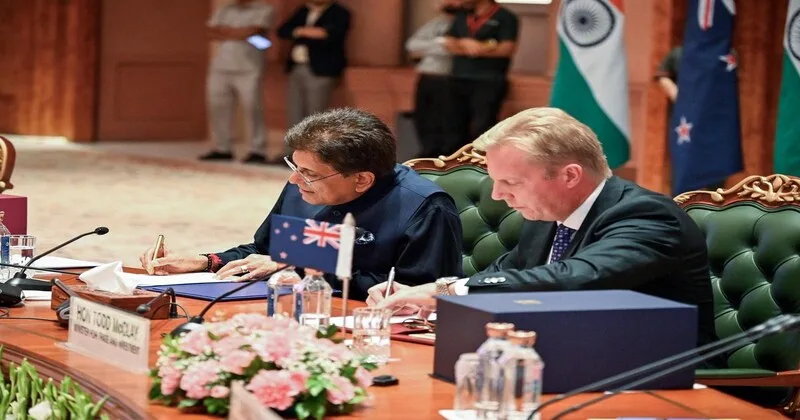
India and New Zealand signed a historic Free Trade Agreement (FTA) on Monday, April 27, marking a major step in bilateral economic engagement between the two nations. The agreement was finalised after negotiating teams from New Delhi and Wellington concluded discussions in December 2025, completing the process in a notably short span. The FTA spans 20 chapters and includes provisions on trade in goods, trade remedies, dispute settlement, and legal frameworks, among other areas, making it one of the most comprehensive trade pacts signed by India in recent years.
India, New Zealand ink historic deal
Following the signing of the agreement, Union Minister of Commerce and Industry Piyush Goyal emphasised the speed and significance of the negotiations, noting that the deal was concluded in just nine months. He said that this pace reflects the “depth of trust and shared ambition between our nations,” underlining the growing alignment between India and New Zealand in trade and strategic cooperation. Goyal further described the agreement as a defining milestone in India’s engagement with the developed world, adding that it advances the vision of a “Viksit Bharat 2047.” He also highlighted that this is the seventh major trade agreement he has signed in nearly four years, indicating a sustained push by India to expand its global trade footprint.
Today marks a landmark moment in the India-New Zealand partnership!
I am delighted that the India-New Zealand FTA signed today will add unprecedented momentum to our developmental partnership. It reflects the deep trust, shared values and ambition that bind our two nations.… https://t.co/WBHn4gb1yB
— Narendra Modi (@narendramodi) April 27, 2026
Prime Minister Narendra Modi also welcomed the development, stating that the agreement will generate wide-ranging benefits across sectors. He underscored that Indian farmers, youth, women, MSMEs, artisans, startups, students, and innovators stand to gain significantly from the new framework. According to Modi, the FTA will open new avenues for economic growth, create opportunities across industries, and deepen bilateral synergy between the two countries.
On the other side, New Zealand Prime Minister Christopher Luxon described the agreement as a gateway to a “dynamic” new market. He noted that the FTA would help diversify New Zealand’s export destinations and support the country’s long-term objective of doubling the value of its exports over the next decade. Luxon also stressed that the agreement would enable New Zealand exporters to compete on a more level playing field in India, particularly against countries that already enjoy preferential market access.
Scope and structure of the agreement
The India–New Zealand FTA is notable for both its breadth and depth, covering 20 chapters that address multiple dimensions of trade and economic cooperation. These include not only trade in goods but also regulatory frameworks, dispute resolution mechanisms, and legal provisions designed to facilitate smoother commercial engagement. The agreement reflects a modern trade architecture that balances market access with institutional safeguards, ensuring predictability and transparency in bilateral trade relations. A central feature of the agreement is the elimination of tariffs on a wide range of goods, alongside commitments to open markets in a calibrated manner. New Zealand has agreed to eliminate duties on 100 per cent of its tariff lines for Indian exports upon the agreement’s entry into force. This commitment covers all 8,284 tariff lines, significantly enhancing market access for Indian products across sectors such as textiles, apparel, leather, pharmaceuticals, machinery, and auto components. At the same time, India has opened 70.03 per cent of its tariff lines to New Zealand, covering 95 per cent of its current imports from the Oceanic nation. This balanced approach reflects India’s strategy of liberalising trade while safeguarding sensitive sectors, ensuring that domestic industries are not adversely affected by sudden exposure to global competition.
Trade benefits and sectoral impact
The FTA is expected to generate substantial economic gains for both countries by enhancing trade flows and investment opportunities. One of the most significant commitments under the agreement is New Zealand’s pledge to invest $20 billion in India over the next 15 years. This investment is expected to support infrastructure development, industrial growth, and technological collaboration, thereby strengthening the overall economic partnership.
Indian exports are likely to benefit considerably from the removal of tariffs, particularly in labour-intensive sectors such as textiles, plastics, leather goods, and engineering products. These sectors, which employ large numbers of workers, stand to gain from improved access to a developed market like New Zealand, thereby boosting employment and income generation in India.
The agreement also introduces mobility provisions that facilitate temporary employment opportunities for Indian professionals in New Zealand. Under the FTA, at least 5,000 visas will be issued annually under the “Temporary Employment Entry Visa” category, allowing skilled Indian professionals to work in sectors such as information technology, healthcare, engineering, and education for a period of up to three years. This provision is expected to strengthen people-to-people ties while addressing skill shortages in New Zealand’s economy.
In addition, the agreement provides for gradual tariff reductions on specific products such as wine and spirits. Indian wine and spirits will gain duty-free access to New Zealand, while New Zealand wines will enter the Indian market at concessional duties that will be reduced progressively over a period of 10 years. This phased approach ensures a smooth transition for domestic industries while encouraging bilateral trade in high-value products.
New Zealand is also expected to benefit from increased exports of wool, wine, wood, coal, and fruits such as avocados and blueberries. These products, which are integral to New Zealand’s export profile, will gain improved access to the Indian market, thereby diversifying the country’s trade portfolio.
Agriculture, industry and expert views
Beyond trade in goods, the FTA includes provisions for cooperation in agriculture, reflecting the complementary strengths of the two economies. The agreement outlines plans to support Indian farmers in cultivating crops such as kiwis and apples, as well as enhancing honey production. These initiatives are expected to promote knowledge exchange, improve agricultural productivity, and create new income opportunities for farmers.
Industry experts have also highlighted the transformative potential of the agreement. Agneshwar Sen, Trade Policy Leader at EY India, noted that New Zealand’s commitment to eliminate duties on all tariff lines effectively removes an average applied tariff of 2.2 per cent on Indian goods. He stated that this would enable Indian exports in sectors such as textiles, apparel, leather, pharmaceuticals, machinery, and auto components to enter the New Zealand market duty-free, significantly improving their competitiveness. Sen further emphasised that the agreement opens new mobility pathways for Indian professionals, particularly in IT, healthcare, engineering, and education.
Vikram Gandotra, President of the Indian Electrical and Electronics Manufacturers’ Association (IEEMA), described the FTA as a strategic entry point for Indian manufacturers into a high-value developed market. He pointed out that New Zealand already imports over $25 million worth of critical electrical equipment from India, including transformers and cables. According to Gandotra, the immediate elimination of duties on select items, combined with a long-term tariff reduction roadmap, provides Indian manufacturers with a decisive competitive advantage while strengthening India’s position in Indo-Pacific supply chains.
Nirmal K Minda, President of the Associated Chambers of Commerce and Industry of India (ASSOCHAM), characterised the agreement as a milestone in India’s liberalised trade regime. He noted that the provision of 100 per cent duty-free market access for Indian exports, coupled with the proposed $20 billion investment commitment from New Zealand, will significantly enhance bilateral trade and investment flows. According to Minda, the agreement sets the stage for a more robust and mutually beneficial economic partnership between the two nations.